
Technical Analysis with Python for Stock Market Predictions
Learn Python-based technical analysis for stock market predictions, covering data retrieval, chart patterns, moving averages, and advanced visualization techniques using data science libraries.

Python for Data Science - Mastering NumPy, Pandas, and Plotly
Comprehensive tutorial on using NumPy, Pandas, and Plotly for data science in Python. Covers core concepts and practical applications with hands-on examples and free resources.

Best Stocks to Buy Now - Python for Finance - Part 6
Learn to automate stock market predictions using Python, focusing on regression analysis to identify high-momentum stocks and forecast potential returns across the entire market.

Stock Market Prediction Using Regression Analysis - Python for Finance
Learn stock market prediction using Python, covering regression analysis, forecasting, and ARIMA models to guide investment decisions based on past performance.
Linear Regressions with StatsModels - Data Science Tutorial
Learn to create linear regressions using StatsModels, exploring datasets and examples with NumPy, Pandas, Matplotlib, and Seaborn. Analyze professor ratings and tipping strategies through practical applications.
Stabilizing the Unstable Output of Persistent Homology Computations
Explore stabilizing techniques for persistent homology computations, focusing on generating cycles and their applications in topological data analysis.
Visualizing Climate Data
Create a climate spiral visualization using p5.js to illustrate temperature changes over time. Learn data handling, polar coordinates, and animation techniques to effectively represent climate data.

David Uminsky - LatMath 2022 - IPAM's Latinx in the Mathematical Sciences Conference
Explore mathematical applications in data science, including topological analysis and Fourier transforms, with insights on research initiatives and educational approaches.
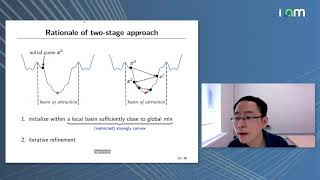
The Effectiveness of Nonconvex Tensor Completion - Fast Convergence and Uncertainty Quantification
Explores nonconvex optimization for tensor completion, proposing a two-stage algorithm with guaranteed success, linear convergence, and statistical accuracy. Discusses distribution characterization and confidence interval construction.
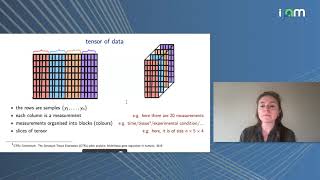
Principal Components along Quiver Representations
Explore principal components in quiver representations, a generalization of multi-indexed data tensors, and their applications in optimization and data analysis.
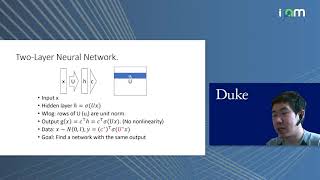
Beyond Lazy Training for Over-parameterized Tensor Decomposition
Explore tensor decomposition in over-parameterized settings, analyzing gradient descent variants and their performance beyond lazy training regimes for improved optimization in neural networks.
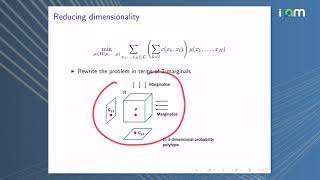
Strictly-Correlated Electron Functional and Multimarginal Optimal Transport
Explore convex optimization methods for multi-marginal transport problems in density functional theory, including relaxation techniques and rounding schemes for energy bounds.
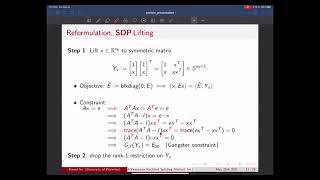
A Peaceman-Rachford Splitting Method for the Protein Side-Chain Positioning Problem
Explore protein side-chain positioning through doubly nonnegative relaxation and Peaceman-Rachford splitting method, with insights on facial reduction and numerical experiments for optimal solutions.
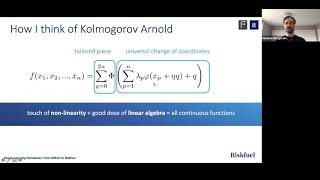
Deeply Learning Derivatives - From Hilbert to Riskfuel
Explore advanced derivatives pricing using deep learning, from Hilbert's 13th problem to modern neural networks for valuing high-dimensional contingent claims in quantitative finance.
Simulated Greeks for American Options
Explore simulated Greeks for American options, covering hedging strategies, state variables, and regression techniques. Compare with European options for comprehensive understanding.
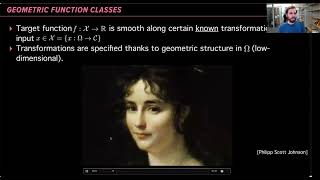
On the Role of Data Structure in High-Dimensional Learning
Explores high-dimensional learning challenges, focusing on geometric function classes, optimization aspects, and computational hardness. Discusses algorithmic approaches and implications for deep learning.
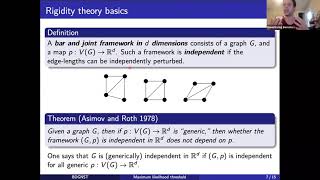
Rigidity Theory for Gaussian Graphical Models - The Maximum Likelihood Threshold of a Graph
Explore rigidity theory's application to Gaussian graphical models, focusing on maximum likelihood thresholds and their implications for data analysis in genomics and other fields.
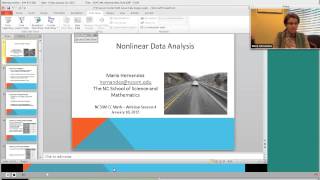
Nonlinear Data Analysis for Teachers - Professional Development
Explore nonlinear data analysis techniques for real-world applications, including residual assessment, inverse function linearization, and implementation of CCSS Mathematical Practices with web resources.

Mathematical and Computational Challenges in Quantum Computing - IPAM UCLA
Explore mathematical and computational challenges in quantum computing through workshops and collaborations, focusing on empowering mathematics to impact quantum information science and vice versa.
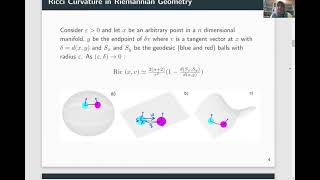
How Optimal Transport Can Help Us to Determine Curvature of Complex Networks
Explore Ollivier Ricci curvature in complex networks, its applications in network analysis, and implementation in chemical reaction networks using optimal transport theory.
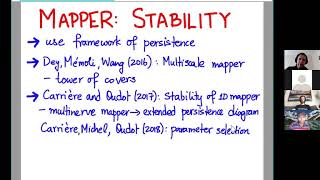
Bala Krishnamoorthy - Steinhaus Filtration and Stable Paths in the Mapper
Explore Steinhaus filtration and stable paths in Mapper, a topological data analysis tool. Learn applications in recommendation systems and explainable machine learning for data-driven insights.