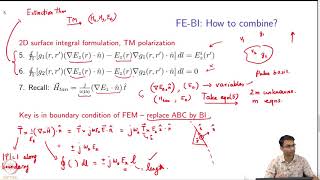
Applications of Computational Electromagnetics: Finite Element-Boundary Integral - Part 2
Explore advanced finite element-boundary integral techniques in computational electromagnetics, focusing on practical applications and problem-solving strategies.
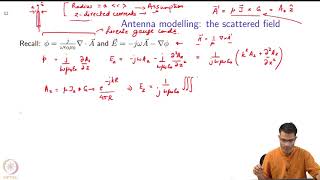
Applications of Computational Electromagnetics: Antennas - Pocklington's Integral Equation - Part 1
Explore Pocklington's Integral Equation for antenna analysis in computational electromagnetics. Learn key concepts and applications in this introductory segment.
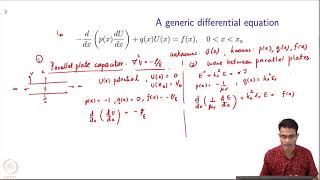
1D Finite Element Method: Weak Form of 1D-FEM - Part 1
Explore the weak form of 1D Finite Element Method in this concise tutorial, focusing on fundamental concepts and practical applications in numerical analysis.

Introduction to the Finite Element Method: 2D Basis Functions
Explore 2D basis functions in finite element method. Learn key concepts and applications for advanced numerical analysis and engineering problem-solving.
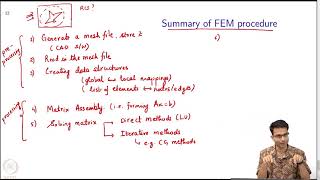
2D Finite Element Method - Summary of FEM Procedure
Explore the 2D Finite Element Method procedure, covering key steps and applications in engineering analysis. Gain insights into this powerful numerical technique for solving complex problems.
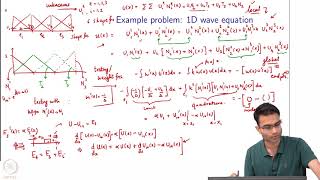
1D Finite Element Method: Matrix Assembly for 1D Wave Equation
Explore matrix assembly techniques for the 1D Finite Element Method applied to the 1D Wave Equation, enhancing understanding of numerical solutions in computational physics.
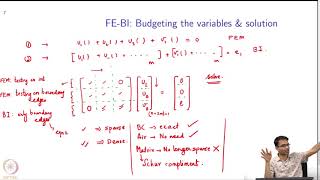
Applications of Computational Electromagnetics: Finite Element-Boundary Integral - Part 3
Explore advanced finite element-boundary integral techniques in computational electromagnetics, focusing on practical applications and problem-solving strategies.
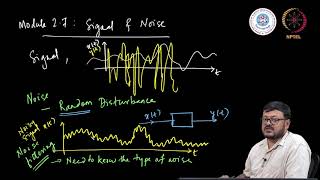
Signal and Noise - Lecture 14
Explore signal and noise concepts in this concise lecture, enhancing your understanding of fundamental principles in signal processing.
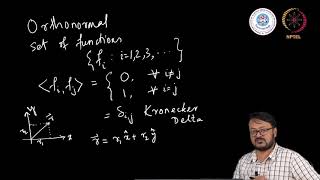
Orthogonality of Signals - Lecture 10
Explore orthogonality of signals, a fundamental concept in signal processing and communication systems. Gain insights into its applications and importance.
Signals in the Physical World - Lecture 15
Explore signals in the physical world, examining their characteristics, types, and applications in various scientific and engineering domains.

Why is Reciprocity Useful in Practice? - Lecture 1.6
Explore the practical applications and benefits of reciprocity in electrical engineering, enhancing understanding of circuit analysis and design.
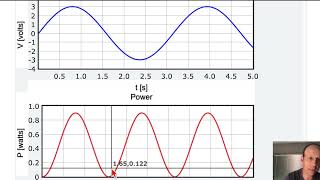
Why Does the RMS Voltage Have a Square Root of 2?
Explore the concept of RMS voltage, its relationship to the square root of 2, and the average of sin^2 using Python code examples.
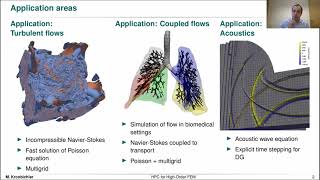
High-Performance Implementations for High-Order Finite-Element Discretizations of PDEs
Explore matrix-free finite-element algorithms for solving PDEs, focusing on high-performance implementations and recent developments in performance engineering for complex geometries.
Geometric Constructions for Sparse Integer Signal Recovery
Explore geometric constructions for sparse integer signal recovery, focusing on matrix design for robust vector reconstruction in compressed sensing applications.
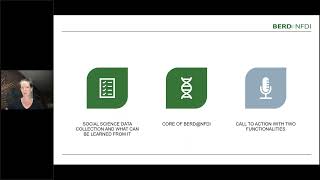
Unlocking Unstructured Data - Opportunities and Challenges in Social Sciences
Explore how BERD@NFDI program addresses challenges in accessing unstructured data for social sciences, driving innovation at the intersection of AI and social research.

On the Fourier Weight of F2 Polynomials
Explore Fourier weight of F2 polynomials, focusing on level k and degree d relationships. Gain insights into pseudorandom generators and recent mathematical proofs.
Network Models for Game Theory and Economics - 2004
Explore graph-theoretic models for game theory and economics, covering Nash equilibria, social networks, and connections to probabilistic modeling and inference.
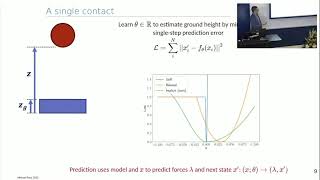
Do We Really Need All That Data? Learning and Control for Contact-rich Manipulation
Explore data efficiency in robotic manipulation, focusing on contact-driven aspects and implicit learning techniques for improved adaptability and real-time multi-contact MPC deployment.
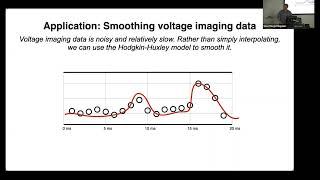
Nuts and Bolts of Modern State Space Models - Part I
Explore state space models for analyzing sequential data, covering foundations, algorithms, and applications using the dynamax library. Learn to uncover latent states in high-dimensional measurements.
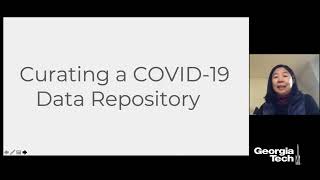
Curating a COVID-19 Data Repository and Forecasting County-Level Death Counts in the United States
Explore COVID-19 data curation and forecasting techniques for county-level death counts in the US, including ensemble methods and prediction intervals for informed decision-making.
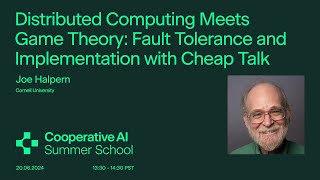
Distributed Computing Meets Game Theory
Explore the intersection of distributed computing and game theory, examining their synergies and applications in multi-agent systems and decision-making processes.