A Family of Crouzeix-Raviart Non-Conforming Finite Elements in Two- and Three Spatial Dimensions
Explore non-conforming finite elements in 2D and 3D, focusing on Crouzeix-Raviart type. Learn about optimal a priori estimates, jump conditions, and explicit representations of local basis functions.
Convergence Theory of Adaptive Finite Element Methods
Explore the convergence theory of adaptive finite element methods for elliptic PDEs, including approximation classes and optimal convergence rates.
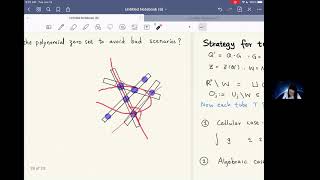
The Restriction Problem and the Polynomial Method - Lecture 2
Explore Stein's restriction conjecture, Kakeya conjecture, and polynomial method in harmonic analysis. Understand wave packet decomposition and intersection of tubes in Fourier analysis.
On Spectra of Quasiperiodic Matrices
Explore the mathematical intricacies of quasiperiodic matrices and their spectral properties in this advanced lecture by Igor Krasovsky from Imperial College London.
Simultaneous Control of Ensembles of Dynamical Systems
Control strategies for managing multiple dynamic systems simultaneously, focusing on mathematical approaches and applications in various fields.
Introduction to Geometric Control Theory - Lecture 4
Explore geometric control theory's advanced concepts, focusing on mathematical foundations and practical applications in dynamic systems and optimization.
Introduction to Geometric Control Theory - Lecture 3
Explore advanced concepts in geometric control theory, focusing on mathematical principles and applications in dynamic systems and optimization.
Introduction to Geometric Control Theory - Part II
Explore advanced concepts in geometric control theory, focusing on mathematical principles and applications in dynamic systems and optimization.
Introduction to Geometric Control Theory - Lecture 1
Explore geometric control theory fundamentals with expert Andrei Agrachev, covering key concepts and applications in this comprehensive lecture from ICTP Mathematics.
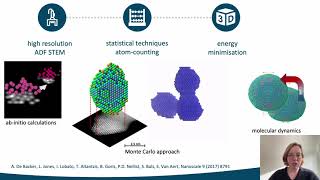
3D Atomic Resolution Through Dose-Efficient Fusion of Image & Analytical Technique
Explore 3D atomic structure analysis of nanomaterials using advanced quantitative TEM techniques, including parameter estimation, deep learning, and fusion of ADF STEM with EDX for heterogeneous materials.
Computational Methods for Mean-Field Games
Explore computational methods for mean-field game systems, including finite-difference, convex optimization, Lagrangian, and machine-learning techniques for solving high-dimensional Hamilton-Jacobi PDEs.
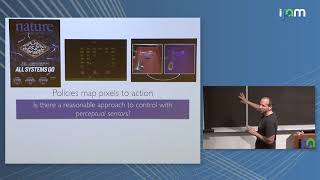
Trying to Make Sense of Control from Pixels
Explores challenges in merging machine learning with control systems, focusing on autonomous vehicles using vision. Discusses uncertainty quantification, robust controller design, and performance guarantees.
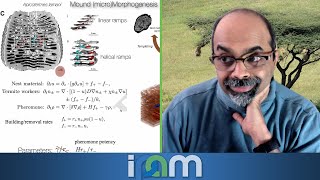
Physical Intelligence in Insect and Robot Societies - IPAM at UCLA
Exploring collective problem-solving in insect societies and robotic systems, linking physics and behavior across scales to understand embodied physical intelligence in nature and technology.

What the Numbers Say - How Can We Get to a Safer Summer?
Experts discuss COVID-19 modelling, public health measures, and strategies for controlling the pandemic in Ontario, offering insights on how to achieve a safer summer through data-driven approaches.
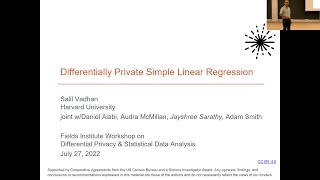
Differentially Private Simple Linear Regression
Explore advanced techniques for protecting data privacy in statistical analysis, focusing on simple linear regression methods and their applications.
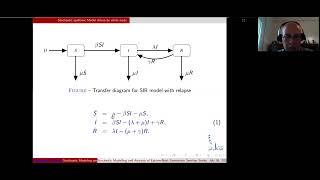
Stochastic Modeling and Analysis for Epidemic Models With Loss of Immunity
Explore stochastic modeling techniques for epidemic analysis, focusing on scenarios involving loss of immunity. Gain insights into advanced mathematical approaches for disease spread prediction.
Tame Control Theory - Lecture 5
Explore advanced concepts in tame control theory, focusing on phenomena over real fields. Delve into graduate-level mathematical analysis and applications.
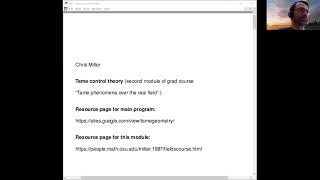
Tame Phenomena Over the Real Field - Graduate Course Lecture 1
Explore fundamental concepts of tame control theory, focusing on real field applications and advanced mathematical principles in this graduate-level lecture.
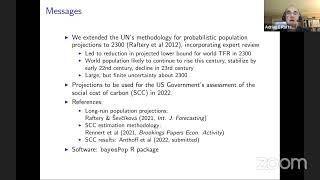
Keyfitz Lecture - Adrian E. Raftery - Very Long-Term Probabilistic Population Projections
Explore probabilistic methods for long-term population projections, examining statistical techniques and demographic trends to forecast global population changes over extended time horizons.
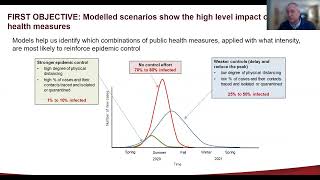
Predicting What Comes Next: Modelling the COVID-19 Epidemic
Explore mathematical modeling techniques for predicting COVID-19 epidemic trends and future scenarios, with insights from public health experts.
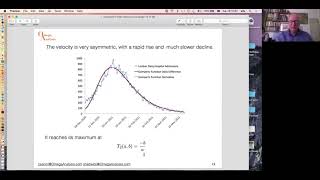
Predicting the Course of Covid-19
Explore mathematical models for predicting COVID-19 trends, analyzing data patterns, and discussing implications for public health strategies and decision-making.