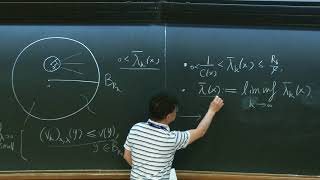
Second Order Conformally Invariant Elliptic Equations - Lecture 4
Explore advanced mathematical concepts in conformally invariant elliptic equations, focusing on second-order systems and their applications in geometry, physics, and probability theory.

Logarithmic Transformations and Vector Bundles on Elliptic Surfaces via O-Minimal Geometry II
Explore logarithmic transformations and vector bundles on elliptic surfaces through o-minimal geometry, examining their impact and applications in various mathematical fields.

Logarithmic Transformations and Vector Bundles on Elliptic Surfaces via O-Minimal Geometry I
Explore logarithmic transformations and vector bundles on elliptic surfaces through o-minimal geometry, examining their impact and applications in various mathematical fields.
Generalized Complex Branes, Doubling, and Shifted Symplectic Geometry, Part I
Explore symplectic approaches to generalized complex geometry, focusing on brane construction and implications for Kaehler geometry. Delve into shifted symplectic geometry and homotopy complex structures.
Generalized Complex Branes, Doubling, and Shifted Symplectic Geometry, Pt II
Explore symplectic approaches to generalized complex geometry, focusing on brane construction and implications for generalized Kaehler geometry. Delve into shifted symplectic geometry and homotopy complex structures.
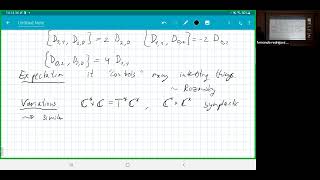
P=W via H_2
Exploration of Lie algebra H_2 and its action on cohomology of moduli spaces, connecting natural filtrations and tautological operations to unify mathematical concepts.
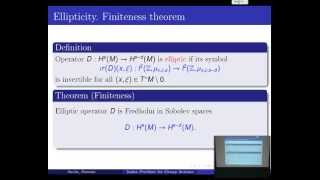
Index Problem for Elliptic Operators Associated With Group Actions and NCG
Explore noncommutative geometry methods for solving index problems in elliptic operators associated with group actions, including pseudodifferential uniformization and applications to mathematical physics.
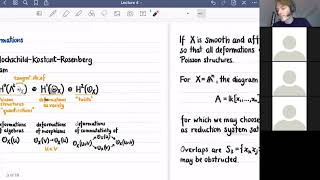
Deformations of Path Algebras of Quivers With Relations
Explore deformation theory of path algebras using reduction systems. Learn about L-infinity algebras, formal deformations, and Poisson structure quantization. Accessible to non-experts with examples.
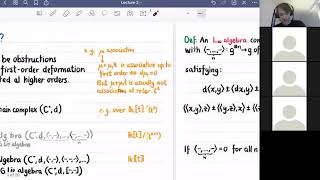
Deformations of Path Algebras of Quivers with Relations
Explore deformation theory of path algebras using reduction systems. Learn to describe all deformations by systematically modifying relations, with applications in representation theory and algebraic geometry.
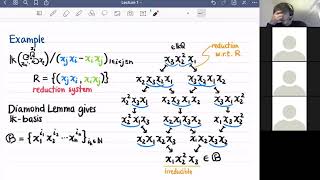
Deformations of Path Algebras of Quivers With Relations - Lecture I
Explore path algebras of quivers with relations in representation theory and algebraic geometry. Learn about deformation theory using reduction systems to systematically deform relations.
Ph. Korablev - Skein-Invariants of 3-Manifolds
Explore skein-invariants of 3-manifolds in this advanced topology lecture, delving into complex mathematical concepts and their applications in quantum topology.
HOMFLY Polynomials for Virtual Knots
Explore HOMFLY polynomials for virtual knots, delving into advanced concepts in quantum topology and knot theory.
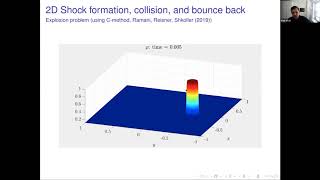
Shock Formation and Vorticity Creation for Compressible Euler
Exploration of shock formation and vorticity creation in compressible Euler equations, featuring constructive proofs, self-similar variables, and analysis of singularities in multiple dimensions.
Introduction to Theory and Numerics of Partial Differential Equations - Lecture 5
Explore numerical methods for solving partial differential equations, focusing on techniques essential for gravitational wave astronomy and computational relativity.

Introduction to Theory and Numerics of Partial Differential Equations - Lecture 2
Explore numerical methods for solving partial differential equations, focusing on techniques essential for gravitational wave astronomy and computational relativity.
Introduction to Theory and Numerics of Partial Differential Equations - Lecture 3
Explore numerical methods for solving partial differential equations, focusing on techniques essential for gravitational wave astronomy and computational relativity.
Introduction to Theory and Numerics of Partial Differential Equations - Lecture 1
Explore fundamental concepts and numerical techniques for solving partial differential equations, essential for modeling complex physical phenomena in gravitational-wave astronomy and astrophysics.
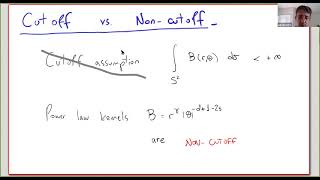
Gaussian Lower Bounds for the Boltzmann Equation Without Cut-off - SIAM PDE Seminar
Explore Gaussian lower bounds for the Boltzmann equation, examining particle density evolution in gases and conditional estimates for solving global well-posedness challenges in fluid dynamics.
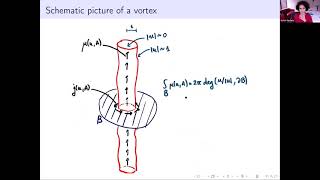
Ginzburg-Landau Model in Superconductivity - Old and New Results
Explore Ginzburg-Landau model of superconductivity, analyzing vortex patterns in 2D and 3D, energy minimizers, and vortex dynamics with expert Sylvia Serfaty from NYU's Courant Institute.
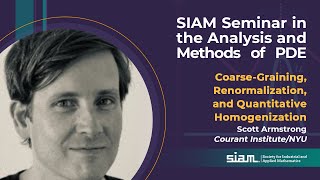
Coarse-graining, Renormalization, and Quantitative Homogenization in PDE Analysis
Explore quantitative homogenization in elliptic and parabolic equations, focusing on coarse-graining and renormalization techniques. Discuss applications to degenerate equations and mathematical physics models.

Directed Mean Curvature Flow in Noisy Environment
Explore directed mean curvature flow in noisy environments and its connection to the KPZ equation through advanced mathematical analysis and stochastic PDEs.