Universality of Dynamic Processes Using Drinfel'd Twisters
Explore universality in dynamic processes using Drinfel'd twisters, examining long-time asymptotics and Tracy-Widom fluctuations through quantum group duality and asymptotic analysis.
Elliptic Orthogonal Polynomials and Their Integrability
Explore elliptic orthogonal polynomials and their integrability through Riemann-Hilbert analysis, examining discrete and continuous integrable systems and connections to the sixth Painlevé equation.
Critical Phenomena Through the Lens of the Ising Model
Explore critical phenomena in the Ising model, from its origins in ferromagnetism to recent breakthroughs in three and four dimensions using probabilistic interpretations and percolation models.
Six-Vertex Model in the Rare Corners Regime
Explore limit shapes in six-vertex models, focusing on low-density corner scenarios. Discover new features, hyperbolic PDEs, density discontinuities, and connections to random permutations.
Iterated Integrals of Modular Forms in String Theory
Explore iterated integrals of modular forms in string theory, their connection to scattering amplitudes, and the concept of multiple modular values in physics.
Frozen Boundaries and Their Fluctuations in the Square-Ice Model
Explore the emptiness formation probability in the six-vertex model, focusing on frozen boundaries and fluctuations in square-ice. Discover insights into arctic curves and the GUE Tracy-Widom distribution.
On the Higher-Rank Dimer Model
Richard Kenyon explores the higher-rank dimer model, discussing GL(n) local systems, Kasteleyn operators, and n-multiwebs. He presents scaling limit results for SL(3) and their conformal invariance in this advanced mathematics talk.
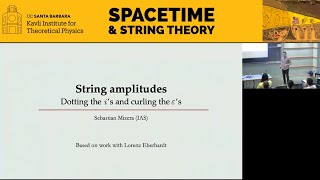
String Amplitudes - Dotting the I's and Curling the Epsilons
Explore advanced string theory concepts with Sebastian Mizera's talk on string amplitudes, focusing on precise mathematical techniques and their implications for understanding spacetime and quantum information.
Branching Laws for Symplectic Groups by Dibyendu Biswas
Explore branching laws for symplectic groups, delving into representation theory and its applications in algebraic and combinatorial methods.
Construction of Interpolation Symmetric Functions from q-Hahn Integrable Models
Explore q-Hahn integrable models and their connection to quantum loop sl2 algebra, leading to a new family of symmetric functions generalizing Macdonald functions with unique properties.
Inhomogeneous Multispecies t-PushTASEP and Macdonald Polynomials
Explore connections between inhomogeneous multispecies t-PushTASEP's stationary distribution and Macdonald polynomials at q=1 in this advanced mathematics lecture by Harvard's Lauren Williams.
The Inhomogeneous Multispecies PushTASEP
Explore multispecies PushTASEP variants, stationary distributions, and symmetry properties. Discover explicit formulas for correlations using Schur functions in this advanced mathematical presentation.
Compact Formula for Symmetric Macdonald Polynomials via ASEP and TAZRP
Explore connections between particle models and Macdonald polynomials, unveiling a new compact tableau formula with applications in probability and integrable systems.

The Squish Map and the SL_2 Double-Dimer Model
Explore measure-preserving maps between dimer models on hexagon lattices, connecting single and double-dimer models for insights into partition functions and plane partition enumeration.
From Twistors to Gravitational Scattering - Part 1
Explore linear gravity and nonlinear self-dual sector in 4D using twistor space, complex analysis, and holomorphic discs for space-time reconstruction.
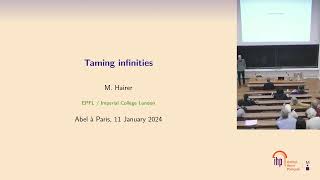
Taming Infinities: Renormalisation Techniques in Physics and Mathematics
Explorez les techniques de renormalisation pour maîtriser les infinis en physique et mathématiques, avec des applications récentes en théorie des probabilités.

Transition from Fractional Diffusion to Normal Diffusion in Kinetic Models
Explore the transition between fractional and normal diffusion in kinetic models, examining mathematical principles and applications in complex systems.
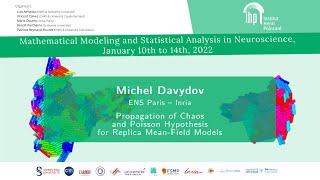
Propagation of Chaos and Poisson Hypothesis for Replica Mean-Field Models
Explore propagation of chaos and Poisson hypothesis in replica mean-field models, delving into advanced statistical physics concepts.
Mathematical Physics of Weakly Interacting Bosons
Explore mathematical physics of weakly interacting bosons with Jan Solovej, covering key concepts and recent developments in this advanced field.
Some Open Mathematical Problems Concerning Charged Quantum Particles
Explore open mathematical challenges related to charged quantum particles, delving into complex theoretical concepts and unsolved problems in quantum physics.
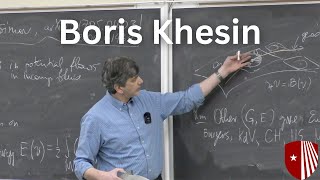
Vortex Sheets and Groupoids in Ideal Hydrodynamics
Explore Arnold's group-theoretic approach to ideal hydrodynamics and its applications to vortex sheets, fluids with moving boundaries, and multiphase fluids using Lie groupoid symmetries.