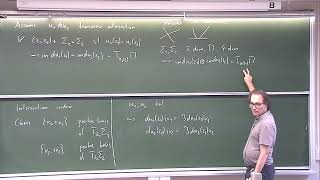
The Restricted Three-Body Problem and Holomorphic Curves - Lecture 3
Delve into advanced celestial mechanics, exploring holomorphic curves and their role in solving the restricted three-body problem through Birkhoff's conjecture and periodic orbits.
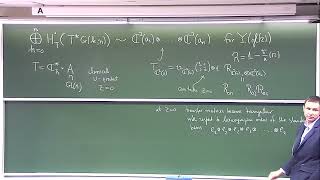
Curve Counting, Geometric Representation Theory, and Quantum Integrable Systems - Lecture 5
Delve into advanced mathematical concepts exploring curve counting, geometric representation theory, and quantum integrable systems with Professor Andrei Okounkov's expert analysis and insights.
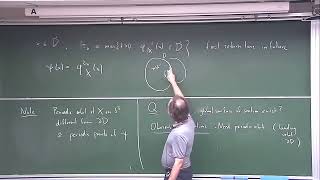
The Restricted Three-Body Problem and Holomorphic Curves - Lecture 1
Explore the dynamics of the restricted three-body problem and its relationship to holomorphic curves, focusing on Birkhoff's conjecture and the mathematical analysis of celestial mechanics.
Quantum Phase Transitions: Transverse Field Ising Model and Path Integrals - Lectures 11-12
Delve into quantum phase transitions through detailed analysis of the Transverse Field Ising Model and explore path integral applications in understanding quantum phenomena and phase transitions.
Probing Sign Structure Using Measurement-Induced Entanglement - Timothy Hsieh
Exploring measurement-induced entanglement to probe sign structure in quantum systems, with applications to hybrid circuits, spin systems, and critical models. Novel insights into quantum information and condensed matter physics.
The Power of Random Quantum Circuits - Bill Fefferman
Explores the computational power of random quantum circuits, discussing classical intractability, simulation algorithms, and the quantum supremacy conjecture. Examines average-case hardness and noise effects in quantum systems.
The Relevance of Being Irrelevant - Stefano Negro
Explore the concept of irrelevance in integrable models across mathematical physics, condensed-matter physics, and string theory. Gain insights into recent advances and their implications for various fields.
Tilting the Cusp Anomalous Dimension in Planar N=4 SYM - Lance Dixon
Explore cutting-edge research on planar N=4 SYM scattering, focusing on the cusp anomalous dimension and its connections to integrable models in theoretical physics.
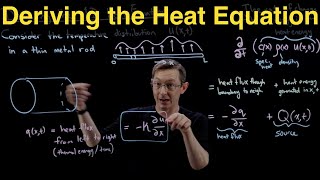
Deriving the Heat Equation - A Parabolic Partial Differential Equation for Heat Energy Conservation
Comprehensive derivation of the heat equation, exploring its mathematical foundations and physical principles in thermal energy conservation and transfer.
Noether's Amazing Theorem - Symmetry and Conservation
Explore Emmy Noether's groundbreaking theorem linking symmetry and conservation in physics, explained by Brian Greene through accessible mathematics and engaging storytelling.
Critical Phenomena Through the Lens of the Ising Model by Hugo Duminil-Copin
Explore critical phenomena in the Ising model, a powerful tool for understanding cooperative phenomena in statistical physics, with insights on recent progress in three and four dimensions.
Superdiffusion, Subdiffusion, Integrability - Sarang Gopalakrishnan
Explores non-equilibrium many-body physics, focusing on superdiffusion, subdiffusion, and integrability in quantum systems. Discusses the XXZ spin chain and integrability-breaking, providing insights into transport phenomena and diffusion.
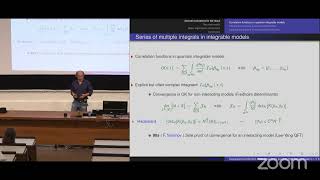
Convergence of the Two-Point Form Factor Series in the 1+1 Dimensional Sinh-Gordon Model
Explores convergence of form factor series in 1+1D Sinh-Gordon model, developing techniques to prove convergence and estimate large-n behavior of n-fold integrals, advancing mathematical foundations of integrable quantum field theories.

Algebraic-Geometrical Methods in the Theory of Integrable Systems
Explore algebraic-geometrical methods in integrable systems theory with renowned mathematician Igor Krichever, delving into advanced mathematical concepts and their applications.
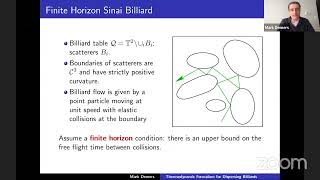
Thermodynamic Formalism for Dispersing Billiards
Explores mathematical billiards in statistical mechanics, focusing on dispersing billiards. Discusses equilibrium states, geometric potentials, and spectral analysis, with insights into SRB measures and maximal entropy.
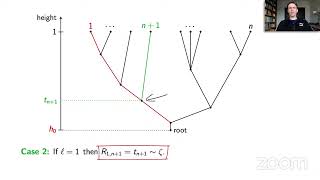
Ultrametricity in Spin Glass Models
Explore ultrametricity in spin glass models with Dmitry Panchenko, delving into mathematical concepts and their applications in statistical physics and complex systems.
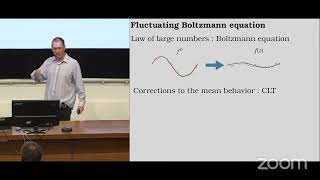
Convergence of a Dilute Gas to the Fluctuating Boltzmann Equation
Explore the convergence of a dilute gas to the fluctuating Boltzmann equation, examining empirical measure fluctuations and their convergence to a Gaussian process for short and long time periods.
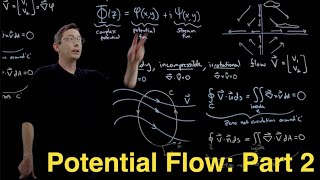
Potential Flow Part 2 - Details and Examples
Explore advanced potential flow concepts, solving Laplace's equation for idealized fluid flows. Learn contour integrals, analyze examples, and understand how PDE solutions establish vector fields.

Gauss's Divergence Theorem
Explore Gauss's Divergence Theorem, a fundamental tool in mathematical physics for deriving conservation laws and translating them into partial differential equations.
Integrability in Planar AdS/CFT - Yangian Symmetry and Applications - Lecture 1
Explore Yangian symmetry in AdS/CFT correspondence, focusing on N=4 supersymmetric Yang-Mills theory and its applications to scattering amplitudes, correlation functions, and Wilson loops.
Turbulence - Arrow of Time and Equilibrium-Nonequilibrium Behaviour
Explore turbulence, time's arrow, and equilibrium-nonequilibrium behavior. Delve into fundamental physics concepts, Kolmogorov's theory, energy transfer, and connections to kinetic theory and cosmology.