
Real Numbers as Cauchy Sequences - Limitations and Challenges - Math Foundations 114
Explores logical weaknesses in using Cauchy sequences to define real numbers, challenging traditional approaches and highlighting ambiguities in fundamental mathematical concepts.
Dedekind Cuts and Computational Difficulties with Real Numbers - Famous Math Problems 19
Explores the challenges and misconceptions surrounding 'real numbers', examining various approaches like infinite decimals, Dedekind cuts, and Cauchy sequences, while emphasizing the importance of concrete computations in mathematics.
Are All True Mathematical Statements Provable? - Famous Math Problems
Explores the philosophical question of mathematical truth and provability, challenging conventional views with explicit examples of likely true but unprovable mathematical statements.
Infinite Sequences - Understanding Finite and Ongoing Sequences in Mathematics - Math Foundations 99
Explore the concept of infinite sequences, focusing on natural numbers, primes, and Catalan numbers. Examine the distinctions between finite and ongoing sequences, and delve into various definitions and formulas.
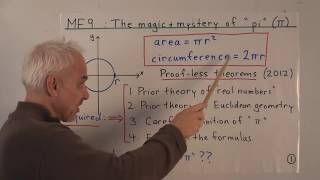
The Magic and Mystery of Pi - Real Numbers and Limits
Explore the history, formulas, and philosophical implications of pi, from ancient calculations to modern computations, challenging traditional views on its nature and role in mathematics.
Logical Challenges in Abstract Algebra - Math Foundations 214
Explores logical difficulties in abstract algebra, focusing on defining groups and the impact of different definitions on group theory development. Emphasizes critical thinking in mathematical foundations.
A New Trichotomy for Integer Arithmetic - Math Foundations 206
Novel approach to integer arithmetic using marks, anti-marks, and nothing. Explores symmetry between natural and negative numbers, foundational arithmetic of integers, and the role of multisets in organizing mathematical objects.
The Successor-Limit Hierarchy and Ordinals - Part 2
Explores the connection between the successor-limit hierarchy and ordinal numbers in set theory, critiquing modern mathematical foundations and suggesting potential reinterpretations of ordinal theory.
Logical Difficulties with Cyclotomic Fields - Famous Math Problems 20
Explores logical issues in cyclotomic fields, focusing on the challenges of embedding roots of unity into complex numbers and the limitations of purely algebraic approaches.
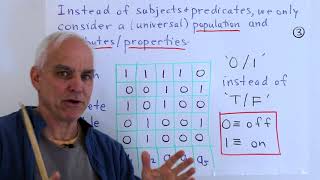
The Algebra of Boole and Boolean Algebra - Key Differences - Part 1
Introduction to the Algebra of Boole, focusing on the bifield of two elements and n-tuples. Explores its role in circuit analysis and contrasts it with Boolean algebra, highlighting implications for 20th-century mathematics.
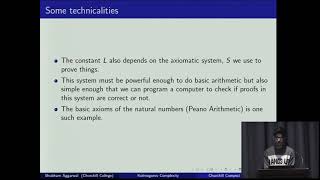
Kolmogorov Complexity and Gödel's Incompleteness Theorems
Explore Kolmogorov complexity, randomness, and compressibility in data, and discover their surprising connections to Gödel's incompleteness theorems in mathematical logic.
Beautiful Formalizations and Proofs in Mechanized Mathematics
Explore the aesthetics of mathematical formalization, examining how beauty in mathematics adapts to mechanization and automation, with illustrative examples of elegant definitions and proofs.
Towards a Formalized Proof of Carleson's Theorem
Explores formalizing Carleson's theorem on Fourier series convergence, discussing its significance, challenges, and recent generalizations in metric spaces using the Lean theorem prover.
Calculating Ordinal Invariants - Can You Do Better Than a Human?
Explore ordinal invariants calculation techniques, comparing human and computational approaches in this advanced mathematics lecture by Mirna Džamonja.
Dialectica Categories for All
Explore dialectica categories and their applications in logic, mathematics, and computer science with expert Valeria de Paiva in this insightful talk.
Capturing Mathematical Equality - Constructivism and Canonical Isomorphisms
Explore the impact of rejecting constructivism in mathematics, examining the confusion between theorems and definitions and the overuse of "canonical isomorphism" in number theory.
An Alternative Approach to Formal Mathematics - Prioritizing Communication over Certification
Exploring a communication-oriented approach to formal mathematics, emphasizing accessibility and practicality for a wider range of practitioners without sacrificing rigor.
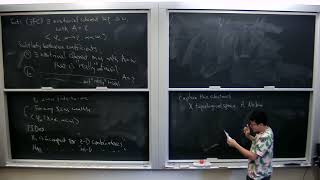
Compactness and Incompactness in Higher Dimensional Combinatorics - Part 1
Explore higher dimensional combinatorics, focusing on compactness and incompactness concepts in set theory, with insights from Jing Zhang of the University of Toronto.

Teaching Mathematics to Computers - Modern Approaches and Challenges
Explore the potential of computers in theorem-proving and advanced mathematics, from basic logic to modern research, and their future role in mathematical discovery.
Universes in Set and Type Theory
Explore universes in set and type theory, examining their foundations, structures, and applications in mathematical logic and computer science.
Constructive Mathematics - How to Not Believe in the Law of Excluded Middle
Explore constructive mathematics and challenge traditional logic with Andrej Bauer's thought-provoking examination of the Law of Excluded Middle in mathematical reasoning.