
Methods for Differential Equations Physics Students Need to Know
Explore five powerful methods for solving differential equations in physics: ansatz, energy conservation, series expansion, Laplace transform, and Hamiltonian flow, with practical applications to harmonic oscillators.
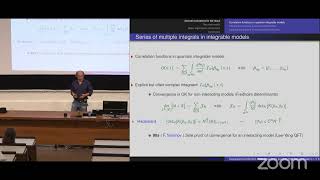
Convergence of the Two-Point Form Factor Series in the 1+1 Dimensional Sinh-Gordon Model
Explores convergence of form factor series in 1+1D Sinh-Gordon model, developing techniques to prove convergence and estimate large-n behavior of n-fold integrals, advancing mathematical foundations of integrable quantum field theories.
Vorticity Measures and Vanishing Viscosity
Explore vorticity measures and vanishing viscosity in fluid dynamics, focusing on 2D Navier-Stokes equations and their relation to Euler equations in bounded domains.
Unbiasing Procedures for Scale-Invariant Multi-Reference Alignment - IPAM at UCLA
Explore unbiasing techniques for scale-invariant multi-reference alignment in signal processing, focusing on applications in cryo-electron microscopy and distribution learning from biased, sparse batches.
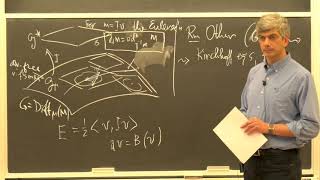
Hamiltonian Geometry and Dynamics Behind Compressible Fluids
Explore Hamiltonian geometry and dynamics in relation to compressible fluids, delving into mathematical concepts and physical applications in fluid mechanics.
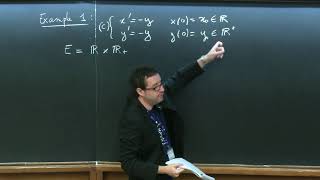
Collisions in Plasmas: The Landau Equation - I
Explore the Landau equation's role in modeling plasma collisions, delving into its mathematical foundations and applications in physics and probability theory.
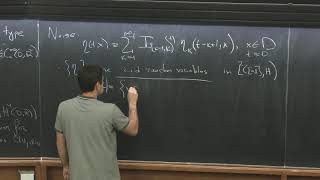
Ergodicity for the Randomly Forced Navier-Stokes System
Explore ergodicity in randomly forced Navier-Stokes systems for 2D unbounded domains. Gain insights from expert Vahagn Nersesyan on mixing and control in fluid dynamics.
Black Hole Stability - Global and Microlocal Analysis Aspects
Explore global and microlocal analysis aspects of black hole stability with Stanford's Andras Vasy, delving into advanced mathematical concepts in geometry and gravity.
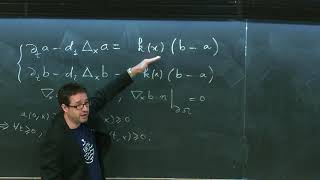
Collisions in Plasmas: The Landau Equation - II
Explore advanced concepts of plasma collisions and the Landau equation, delving into mathematical models for complex physical phenomena.
Mean Field Limit by Gamma Convergence
Explores mean-field limit for λ-convex potentials using variational methods, focusing on gradient flows and Γ-convergence in interacting particle systems.
On the Muskat Problem with Different Mobilities and the Vortex Sheet Problem with Non-Fixed Sign
Explores recent findings on unstable Muskat problem in porous media and vortex sheet problem in Euler equations, discussing h-principle, convex integration, and globally dissipative weak solutions.
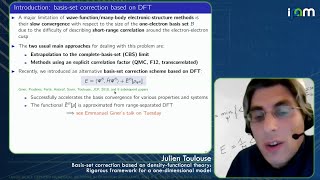
Basis-Set Correction Based on Density-Functional Theory - IPAM at UCLA
Rigorous framework for basis-set correction in quantum mechanics using density-functional theory, explored through a one-dimensional model with delta-potential interactions for systematic analysis.
E. Fominykh - Special Spines with Three 2-Components
Explore special spines with three 2-components in topology, focusing on their unique properties and applications in quantum theory and geometric structures.
Spectral Gap Estimates for the Random Field Ising Model - Lecture
Spectral gap estimates for random field Ising model: convergence rates, Glauber dynamics, Griffiths phase. Combines stochastic localization and percolation-theoretic coarse-graining techniques.
Understanding Climate Dynamics Through Linear Response Theory
Explore climate dynamics using Linear Response Theory. Learn how this mathematical framework helps predict and analyze complex climate system behaviors, offering insights into future climate scenarios.
Reynolds Decomposing Heat Waves - Geophysical Fluid Dynamics
Explore Reynolds decomposition for analyzing heat waves, focusing on atmospheric dynamics and energy transfers across scales. Gain insights into geophysical fluid dynamics and climate modeling techniques.
Taming Infinities: Renormalisation Techniques in Physics and Mathematics
Explorez les techniques de renormalisation pour maîtriser les infinis en physique et mathématiques, avec des applications récentes en théorie des probabilités.
Voigt Boussinesq Equations - Global Regularity and Fluid Dynamics
Explore Voigt Boussinesq equations, their relation to fluid mechanics, and global regularity results for critical cases. Gain insights into incompressible fluid equations and their approximations.
Instability and Non-uniqueness for the Euler and Navier-Stokes Equations
Explore recent advances in non-unique solutions for incompressible Navier-Stokes and Euler equations, including groundbreaking work on forced Navier-Stokes equations' non-uniqueness.
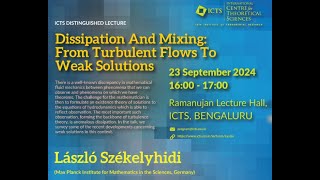
Dissipation and Mixing: From Turbulent Flows to Weak Solutions - Lecture 1
Explore dissipation and mixing in turbulent flows, focusing on weak solutions in hydrodynamics. Gain insights into anomalous dissipation and recent developments in mathematical fluid mechanics.
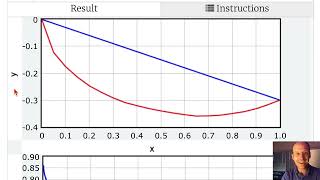
Solving the Brachistochrone Problem with Random Numbers
Discover the fastest path for a frictionless bead using random numbers to solve the Brachistochrone problem in physics.