Introduction to Random Walks on Groups - Lecture 7
Explore random walks on groups, a fundamental concept in probability theory and group theory, with applications in various mathematical fields and real-world scenarios.
Introduction to Random Walks on Groups - Lecture 6
Explore random walks on groups, a fundamental concept in probability theory and group theory, with applications in various mathematical fields and real-world scenarios.
Introduction to Random Walks on Groups - Lecture 21
Explore the fascinating world of random walks on groups, delving into mathematical concepts and applications with expert guidance from Giulio Tiozzo of the University of Toronto.
Introduction to Random Walks on Groups - Lecture 2
Explore random walks on groups, a fundamental concept in probability theory and group theory, with insights into their applications and properties.
Introduction to Random Walks on Groups - Lecture 20
Explore the mathematical concept of random walks on groups, delving into their properties, applications, and theoretical foundations in this comprehensive lecture by Giulio Tiozzo.
Cutoff for Biased Transpositions in Card Shuffling
Explore card shuffling algorithms and mixing times with biased transpositions, extending Diaconis and Shahshahani's work on random transpositions in deck shuffling.
Spectrum of Random-to-Random Shuffling in the Hecke Algebra
Explore the elegant eigenvalue formulas of random-to-random shuffling and its generalization to the Hecke algebra, with insights into Markov chains and algebraic combinatorics.
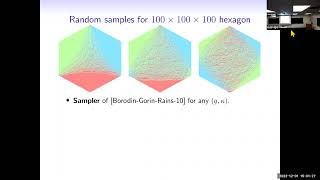
Lozenge Tilings via the Dynamic Loop Equation
Explore discrete Markov chains with particle interactions, focusing on lozenge tilings and their asymptotic behavior using holomorphic observables.
Singularity of Stationary Measures in Markov Chains
Explore stationary measures of compound Markov chains, focusing on examples using boundary processes of random walks on the modular group PSL(2,Z) and related classical constructions.
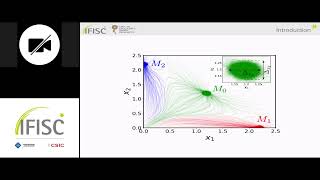
Generation of Stochastic Trajectories - Applications to Complex Systems
Explore stochastic trajectory generation and its applications in complex systems, focusing on interdisciplinary physics concepts and advanced modeling techniques.
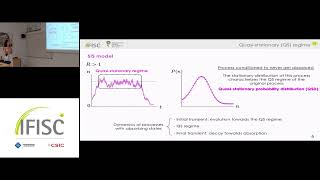
Numerical Methods for Quasi-Stationary Distributions
Explore numerical techniques for calculating quasi-stationary distributions in complex systems, enhancing understanding of long-term behavior in stochastic processes.

Expanders in Higher Dimensions: From Local to Global Properties and Applications
Explore high-dimensional expanders, their local-to-global properties, and applications in coding theory, networking, and computational complexity.
An Introduction to Intertwining via Strong Stationary Duality - Developments and Open Problems
Explores advanced applications of dual chains in random walks, focusing on less symmetric scenarios and statistical applications, with examples from hyperplane arrangements and non-uniform duals.
Applications of Duality - Lecture 3
Explore applications of dual processes in Markov chains, including strong stationary times, eigenvalue interpretation, and solutions to the Peres conjecture for Birth and Death chains.
Duality and Intertwining in Markov Chains - Lecture 2
Explore advanced Markov chain analysis through embedded processes, intertwining relations, and various dualities. Gain insights into stationarity and extensions to set and measure-valued duals.
An Introduction to Intertwining via Strong Stationary Duality - First Examples and Basic Setup
Explore Markov chains, mixing times, and card shuffling techniques. Learn about strong stationary times and their properties in this advanced probability theory lecture.
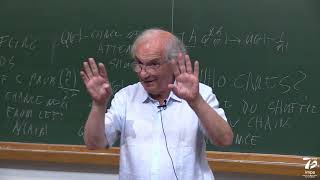
Shuffling Cards and Random Matrix Theory
Explore card shuffling and random matrix theory with Stanford's Persi Diaconis in this IMPA 70th anniversary conference talk on mathematical applications in everyday phenomena.
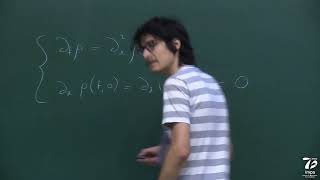
Mixing Time and Cutoff for One Dimensional Systems
Explore mixing time and cutoff for one-dimensional systems in this advanced mathematics lecture by Hubert Lacoin at IMPA's 70th anniversary conference.
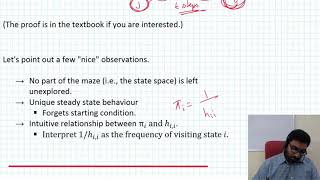
Stationary Distribution of a Markov Chain
Explore the concept of stationary distribution in Markov chains, understanding its properties and applications in probability theory and stochastic processes.
Time Sampled M/M/1 Queue and Burke's Theorem - Lecture 66
Explore Burke's Theorem and M/M/1 Queue concepts, including reversibility and time sampling, to enhance understanding of queueing theory.
The Birth-Death Continuous Time Markov Chains - Lecture 74
Explore continuous time birth-death Markov chains, analyzing expected waiting times and queue lengths in various queueing systems.