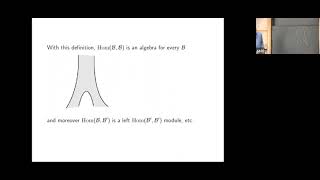
Gauge Theory and the Analytic Approach to Geometric Langlands - Edward Witten
Explore gauge theory's role in geometric Langlands correspondence, comparing categorical and analytic approaches through quantum states, operators, and gauge theory interpretations.
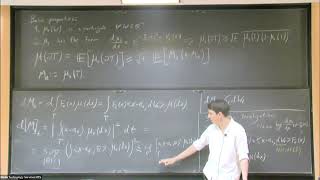
On Chen’s Recent Breakthrough on the Kannan-Lovasz-Simonovits Conjecture and Bourgain's Slicing Problem - Part III
Explore Chen's breakthrough on the KLS conjecture and Bourgain's slicing problem, covering key mathematical concepts, historical context, and implications for discrete mathematics and computer science.
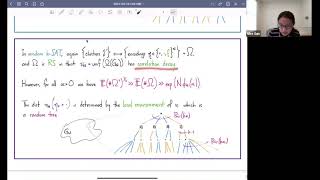
On the Ising Perceptron Model - Nike Sun
Explore the Ising perceptron model's statistical physics, replica symmetry, and cavity methods. Delve into calculations, rare events, and conditional moment methods in this advanced mathematical lecture.
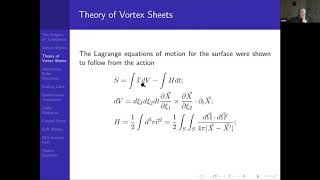
Turbulence as Gibbs Statistics of Vortex Sheets - Alexander Migdal
Explore vortex sheet dynamics, anomalous Euler equations, and Gibbs statistics in turbulence. Gain insights into scaling laws, spontaneous turbulence, and the ground state of turbulent systems.
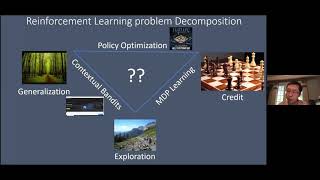
Latent State Recovery in Reinforcement Learning - John Langford
Explore latent state recovery in reinforcement learning, covering core problems, alternative approaches, and state abstraction. Gain insights from John Langford's expertise in theoretical machine learning.
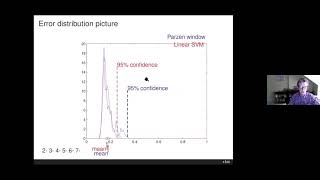
Statistical Learning Theory for Modern Machine Learning - John Shawe-Taylor
Explore statistical learning theory's role in modern machine learning, covering PAC-Bayes framework, risk measures, and deep network training experiments with John Shawe-Taylor.
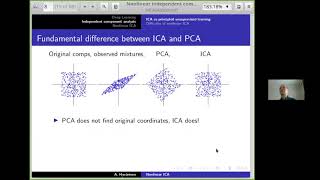
Nonlinear Independent Component Analysis - Aapo Hyvärinen
Explore nonlinear independent component analysis, its applications in AI and unsupervised learning, and recent advancements in deep latent variable models with Aapo Hyvärinen.
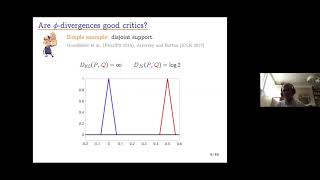
On the Critic Function of Implicit Generative Models - Arthur Gretton
Explore implicit generative models' critic function, divergence measures, and energy-based models with Arthur Gretton. Gain insights into topological properties, neural net divergences, and multimodality in machine learning.
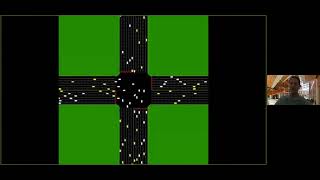
Efficient Robot Skill Learning via Grounded Simulation Learning, Imitation Learning - Peter Stone
Explore efficient robot skill learning through grounded simulation, imitation learning, and off-policy reinforcement learning. Discover innovative approaches for transferring skills from simulation to real-world robots.

Priors for Semantic Variables - Yoshua Bengio
Explore semantic variables, learning theory, and cognitive processes with Yoshua Bengio. Delve into attention mechanisms, causality, and modular recurrent networks for advanced machine learning insights.
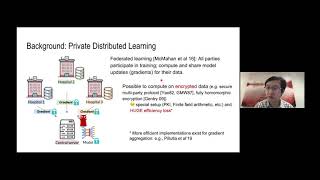
Instance-Hiding Schemes for Private Distributed Learning
Explore private distributed learning techniques, including instance-hiding schemes, cryptographic methods, and data augmentation, with insights on privacy laws and practical applications.

The Challenges of Model-Based Reinforcement Learning and How to Overcome Them - Csaba Szepesvári
Explore challenges in model-based reinforcement learning, including modeling errors and efficient planning, and discover strategies to overcome them in complex environments.
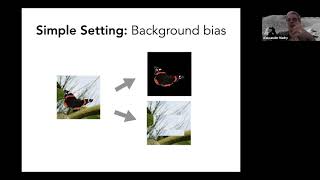
What Do Our Models Learn? - Aleksander Mądry
Exploring machine learning model behavior, biases in datasets, and challenges in dataset creation and replication for more robust and reliable AI systems.
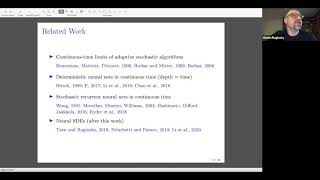
Neural SDEs - Deep Generative Models in the Diffusion Limit - Maxim Raginsky
Explore deep generative models through stochastic control, diffusion limits, and neural nets. Learn about efficient sampling, expressiveness quantification, and unbiased simulation techniques.
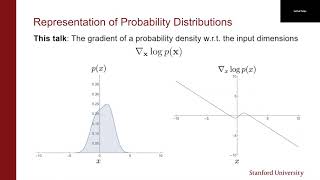
Generative Modeling by Estimating Gradients of the Data Distribution - Stefano Ermon
Explore generative modeling through gradient estimation of data distributions, covering deep energy-based models, score matching, and innovative sampling techniques for improved AI generation.
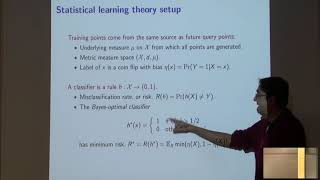
Convergence of Nearest Neighbor Classification - Sanjoy Dasgupta
Explore nearest neighbor classification's convergence, consistency, and accuracy rates in various spaces, with insights on smoothness conditions and adaptive classifiers.
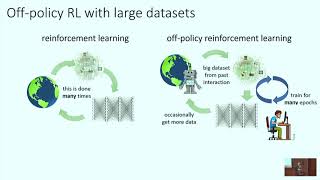
Deep Reinforcement Learning in the Real World - Sergey Levine
Explore deep reinforcement learning applications in real-world scenarios, focusing on off-policy methods, model-free and model-based approaches, and their practical implementations in robotics and manipulation tasks.
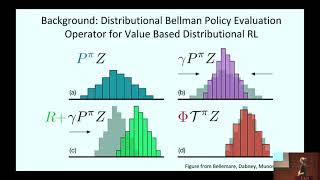
Towards Structural Risk Minimization for RL - Emma Brunskill
Explore structural risk minimization in reinforcement learning, focusing on efficient learning of risk-sensitive policies using conditional value at risk and optimistic exploration techniques.
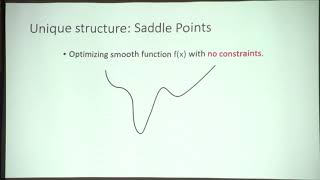
Optimization Landscape and Two-Layer Neural Networks - Rong Ge
Explore optimization landscapes and two-layer neural networks, focusing on non-convexity, saddle points, and symmetric distributions in theoretical machine learning.
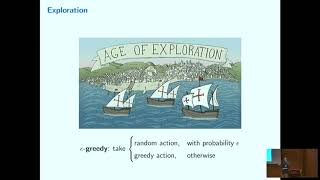
Provably Efficient Reinforcement Learning with Linear Function Approximation - Chi Jin
Explore efficient reinforcement learning with linear function approximation, covering key concepts like sample efficiency, value-based algorithms, and exploration in multi-armed bandits and linear MDPs.
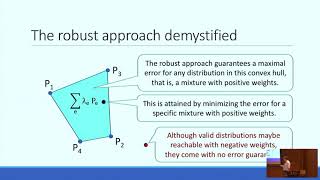
Learning Representations Using Causal Invariance - Leon Bottou
Explore causal invariance in machine learning representations, focusing on stable properties, extrapolation, and robust supervised learning techniques for improved model performance and generalization.