
Rapture of the Deep: Highs and Lows of Sparsity in Neural Networks
Explore sparsity in neural networks, its role in interpretability, and innovative optimization techniques beyond gradient descent for learning fast transforms.

Learning with Missing Values: Theoretical Insights and Application to Health Databases
Explore theoretical insights and practical applications of learning with missing values in health databases, focusing on regression, classification, and neural network solutions.

Weak Signals: Machine Learning Meets Extreme Value Theory
Explore machine learning's intersection with extreme value theory, focusing on angular measure recovery and its applications in classification and anomaly detection.

Contextual Stochastic Bandits with Budget Constraints and Fairness Application
Explore contextual stochastic bandits, budget constraints, and fairness applications in machine learning. Learn strategies for balancing exploration and exploitation in reward maximization.

Synthetic Data - Friend or Foe in the Age of Scaling?
Explore synthetic data's impact on AI scaling laws, model performance, and potential degeneration. Analyze theoretical frameworks and experimental findings for future AI development challenges.
Five Key Insights in Quantum Machine Learning - and What is Still Missing
Explore five crucial insights in quantum machine learning and identify gaps in current research with expert Maria Schuld.
FastIce.jl: A Massively Parallel Ice Flow Model Running on GPUs
Explore FastIce.jl, a Julia-based ice flow model for GPUs. Learn about its modular architecture, performance on supercomputers, and applications in efficient large-scale ice sheet modeling.

Pinecone Vector Database - Build Knowledgeable AI
Discover vector databases' advantages, explore Pinecone's innovative features, and watch a live demo on getting started with its powerful search capabilities.
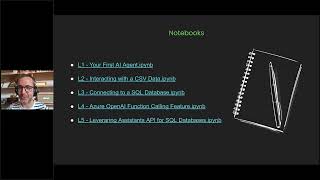
Advanced RAG Scenarios: Building Your Own Database Agents - Developing AI Agents for Natural Language Database Interaction
Develop AI agents for natural language database interactions, enabling efficient data querying and analysis without advanced SQL knowledge.
Non-commutative Optimal Transport - Spring 2025
Explore non-commutative optimal transport's applications in AI, quantum physics, and electronic structure theory. Delve into evolution equations, Wasserstein distances, and computational algorithms for density operators.
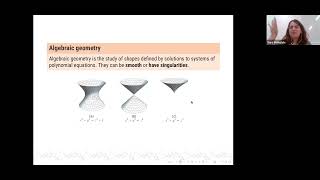
Machine Learning Detects Terminal Singularities in Q-Fano Varieties
Explore machine learning applications in algebraic geometry, focusing on Q-Fano varieties and terminal singularities detection. Gain insights into new combinatorial criteria and high-dimensional Q-Fano landscapes.
Functional and Structural Connectome of Reinforcement Learning
Explore functional and structural connectomes of reinforcement learning, focusing on neural substrates, computational models, and applications in depression research.
The Promise and Challenge of Harnessing Collateral Information from Medical Images Using AI
Explore AI's potential in extracting collateral information from medical images, discussing promises and challenges in this field.
Mapping Brain Dynamics and Trajectories with Geometric and Topological Machine Learning
Explore geometric and topological machine learning techniques for mapping brain dynamics and trajectories, enhancing understanding of neural processes.

Validation of AI Techniques in MRI for Clinical Studies
Explore AI validation techniques for MRI in clinical studies, focusing on enhancing accuracy and reliability in medical imaging analysis.
Beyond Truth and Falsehood - Logic as a Calculus of Events in AI
Explore logic's evolving role in AI, from truth calculus to event calculus, enabling advancements in probabilistic reasoning, machine learning, and explainable AI systems.
Quantum Error Correction of Bosonic Qudits Beyond Break-even
Explore quantum error correction for qudits, focusing on experimental demonstrations of error-corrected logical qutrits and ququarts using the GKP bosonic code in circuit QED architecture.
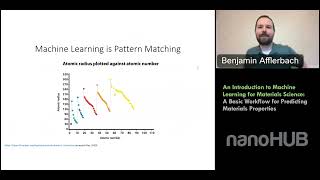
Introduction to a Basic Machine Learning Workflow for Predicting Materials Properties
Learn a basic machine learning workflow for predicting material properties, covering data cleaning, feature engineering, model training, and optimization using decision trees to forecast material bandgaps from compositions.
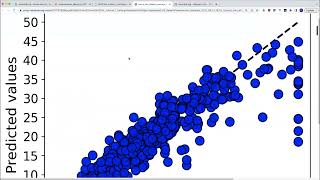
The Materials Simulation Toolkit for Machine Learning (MAST-ML): Automating Development and Evaluation of Machine Learning Models for Materials Property Prediction
Automate machine learning model development for materials property prediction using MAST-ML. Learn data import, feature engineering, model evaluation, and uncertainty quantification through hands-on activities.
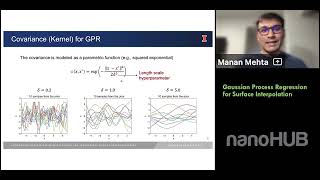
Gaussian Process Regression for Surface Interpolation
Explore Gaussian Process Regression for surface interpolation in manufacturing. Learn fundamentals, applications, and the innovative filtered kriging technique for improved performance in nanomanufacturing contexts.
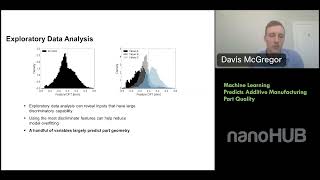
Machine Learning for Predicting Additive Manufacturing Part Quality - Tutorial on Support Vector Regression
Learn to predict additive manufacturing part quality using support vector regression. Explore data analysis, hyperparameter tuning, and cross-validation techniques for machine learning in 3D printing applications.