
PINNs for Inverse Problems in Scientific Computing
Explore Physics-Informed Neural Networks (PINNs) and their application in solving inverse problems in scientific computing and engineering.

Connecting Modeling, Simulations, and Machine Learning with Experiments for Soft Materials Design - Structure-Property Relationships
Explore molecular modeling, simulations, and machine learning for soft materials design. Connect computational methods with experiments to uncover structure-property relationships in polymers and colloids.
Machine Learning: A Route to High Accuracy Simulation of Complex Reacting Systems
Explore machine learning for high-accuracy simulation of complex reacting systems, focusing on chemistry-driven evolution and multiscale challenges in computational modeling.

Learning How to Build Molecules That Fold Like Proteins
Explore protein-like molecule folding with Prof. Michael Shirts, uncovering insights into building and understanding complex molecular structures.

Multi-fidelity Bayesian Optimization of Nanoporous Materials for Xe/Kr Separations
Explore multi-fidelity Bayesian optimization for nanoporous materials in Xe/Kr separations with Prof. Cory Simon's virtual seminar.

Acceleration and Analysis of Molecular Dynamics Simulation Using Machine Learning
Explore machine learning techniques to enhance molecular dynamics simulations, focusing on acceleration and analysis methods for improved efficiency and insights.
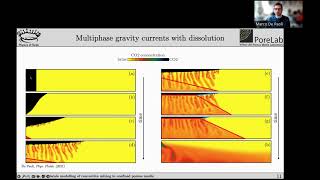
Multiscale Modelling of Convective Mixing in Confined Porous Media
Explore multiscale modelling of convective mixing in porous media, covering pore-scale and large-scale effects, simulations, experiments, and physical models for geophysical subsurface flows.
Continuous Upscaling in Multiscale Modeling
Explore continuous upscaling methods for multi-scale modeling. Learn about gradual smoothing transformations, upscaling rules for various physical quantities, and applications to steady-state diffusion problems.
AI in DevSecOps: From Science Fiction to Reality
Explore AI's impact on cybersecurity: from hacker tools to protective measures. Learn how to integrate AI-based tools in cloud and on-premises environments for enhanced DevSecOps practices.

AI Safety, Security, and Play - Episode 137
Explore AI safety and security with David Haber, covering prompt injections, data poisoning, LLM vulnerabilities, and approaches to handling sensitive data in AI models.
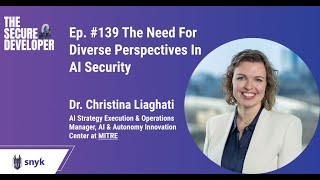
The Need for Diverse Perspectives in AI Security - Episode 139
Explore diverse perspectives in AI security, early measures, and risk evaluations. Learn collaboration strategies and resources for addressing AI-related risks.

OWASP Top 10 for Machine Learning Security - A Comprehensive Walkthrough
Explore OWASP's top 10 ML security vulnerabilities, gain insights into real-world examples, and learn actionable strategies for securing machine learning models and systems.
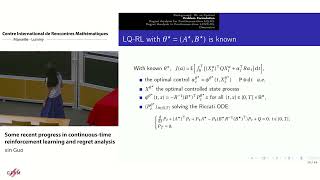
Recent Progress in Continuous-Time Reinforcement Learning and Regret Analysis
Explore recent advancements in continuous-time reinforcement learning and regret analysis, focusing on mathematical applications in economics and finance.
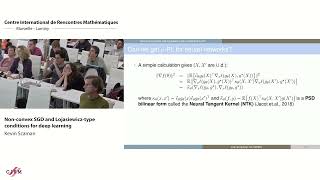
Non-convex SGD and Lojasiewicz-type Conditions for Deep Learning
Explore non-convex SGD and Lojasiewicz-type conditions for deep learning in this mathematical conference talk by Kevin Scaman at CIRM.
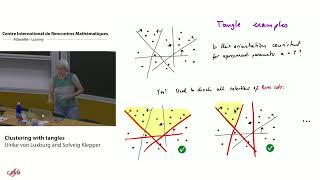
Clustering with Tangles - Machine Learning and Signal Processing on Graphs
Explore clustering with tangles, covering partitions, agreement parameters, cost functions, and applications in machine learning and signal processing on graphs.
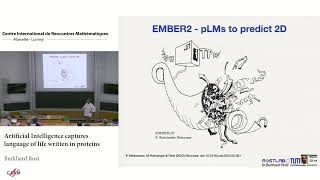
Artificial Intelligence Captures Language of Life Written in Proteins
Explore AI's role in decoding protein language, unveiling insights into life's fundamental processes and potential applications in genomics and biology.
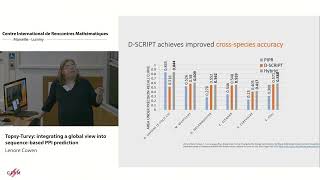
Topsy-Turvy: Integrating a Global View into Sequence-Based PPI Prediction
Explore innovative approaches to protein-protein interaction prediction by integrating global perspectives with sequence-based methods.
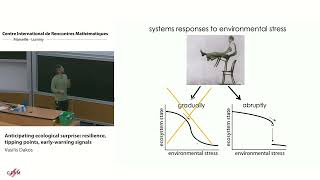
Anticipating Ecological Surprise: Resilience, Tipping Points, and Early-Warning Signals
Explore ecological surprises, resilience, tipping points, and early-warning signals in complex systems. Gain insights into anticipating and understanding sudden environmental changes.
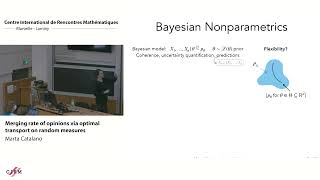
Merging Rate of Opinions via Optimal Transport on Random Measures
Explore optimal transport on random measures to analyze opinion merging rates, focusing on Bayesian statistics applications in mathematical research.
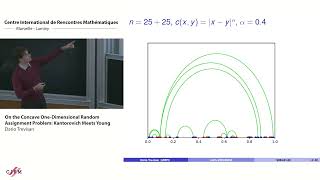
On the Concave One-Dimensional Random Assignment Problem: Kantorovich Meets Young
Explore the concave one-dimensional random assignment problem, bridging Kantorovich and Young's theories in this mathematical conference talk by Dario Trevisan.
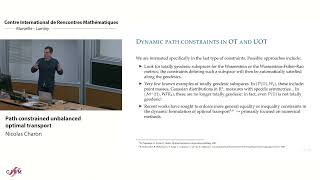
Path Constrained Unbalanced Optimal Transport
Explore path constrained unbalanced optimal transport with Nicolas Charon, delving into geometric statistics and shape analysis applications.