Inside TensorFlow- Building ML Infra
Explore research and engineering challenges in building machine learning infrastructure, focusing on TensorFlow runtime and optimization techniques for ML programs.
Inside TensorFlow - Quantization Aware Training
Learn quantization aware training in TensorFlow, covering fundamentals, APIs, and implementation. Optimize ML models with hands-on guidance from a Software Engineer.
Inside TensorFlow - New TF Lite Converter
Explore the new TF Lite Converter with Software Engineer Yu-Cheng Ling, covering its advantages, implementation, and transformation processes for efficient mobile deployment.
Inside TensorFlow - TF Debugging
Explore TensorFlow debugging techniques for TF 2 and TF 1, covering tensor value printing, device placement, graph visualization, and step debugging in Keras models.
Inside TensorFlow - TF-Agents
Explore TF-Agents, TensorFlow's reinforcement learning library, with experts demonstrating its capabilities, architecture, and applications in game playing, bandits, and recommender systems.

Inside TensorFlow - tf.data + tf.distribute
Explore best practices for tf.data and tf.distribute in TensorFlow, covering input pipelines, performance optimization, and distributed training strategies for multi-GPU and TPU setups.
Inside TensorFlow - TF Model Optimization Toolkit - Quantization and Pruning
Explore TensorFlow's Model Optimization Toolkit, focusing on quantization and pruning techniques to enhance model efficiency and performance in deep learning applications.
Inside TensorFlow - Eager Execution Runtime
Explore TensorFlow's eager execution runtime with Software Engineer Alex Passos, covering Python context, code generation, async mode, and multidevice calls.

Inside TensorFlow - MLIR for TF Developers
Explore MLIR, a multi-level intermediate representation compiler infrastructure, and its applications in TensorFlow development for improved reusability and abstraction.

Inside TensorFlow - AutoGraph
Deep dive into AutoGraph implementation, usage, and pitfalls in TensorFlow. Explore function lifecycle, caching, overloading, Python scopes, debugging, control flow, and more advanced features.
Neural Structured Learning in TensorFlow
Explore TensorFlow's Neural Structured Learning framework for training robust neural networks with structured signals, applicable to vision, language understanding, and general prediction tasks.
TensorFlow Model Optimization - Quantization and Pruning
Explore TensorFlow model optimization techniques like quantization and pruning to enhance performance, reduce resource usage, and improve efficiency in machine learning applications.
TFX- Production ML Pipelines with TensorFlow
Explore TensorFlow Extended (TFX) for production ML pipelines, covering components, metadata storage, orchestration, and custom implementations for scalable and maintainable machine learning solutions.
TensorFlow Lite - Solution for Running ML On-Device
Explore TensorFlow Lite for efficient on-device ML inference, featuring low latency, high performance, and small binary size. Learn about mobile BERT, support libraries, and microcontroller applications.
Great TensorFlow Research Cloud Projects From Around the World
Explore exciting machine learning projects powered by TensorFlow Research Cloud's free Cloud TPUs. Learn how to access TFRC resources for your own research endeavors.

Swift for TensorFlow - TF World '19
Explore Swift for TensorFlow, a cutting-edge ML platform integrating deep neural networks with AI algorithms and software development, enhancing research efficiency and speed.
BERTopic Explained
Explore BERTopic, an advanced topic modeling technique using transformers, UMAP, and HDBSCAN. Learn its components, implementation, and customization for organizing unstructured text data effectively.
Today Unsupervised Sentence Transformers, Tomorrow Skynet - How TSDAE Works
Explore unsupervised fine-tuning for sentence transformers using TSDAE. Learn to train models without labeled data, ideal for domains and languages with limited resources.

Intro to Sentence Embeddings with Transformers
Learn to create and apply sentence embeddings using transformers for semantic similarity tasks, exploring models like BERT and GPT for advanced natural language processing applications.
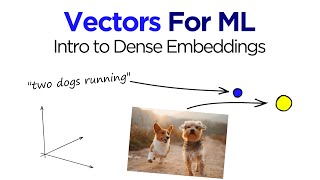
Intro to Dense Vectors for NLP and Vision
Explore dense vector representations in NLP and computer vision, from word2vec to modern transformer models, with practical Python implementations and applications.

How to Build a Bert WordPiece Tokenizer in Python and HuggingFace
Learn to build a custom BERT WordPiece tokenizer in Python using HuggingFace, essential for creating transformer models for specific languages or domains. Includes step-by-step walkthrough and code implementation.