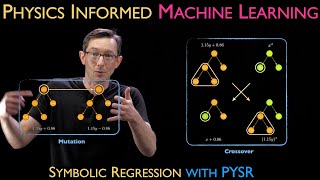
Python Symbolic Regression - Physics Informed Machine Learning
Explore Python Symbolic Regression for physics-informed machine learning. Learn algorithm basics, historical context, and PySR tool benefits for discovering interpretable mathematical models from data.

GPT-4o Mini: Analyzing Its Intelligence and Impact on AI Landscape
Analyzing GPT-4o Mini's capabilities, potential impact, and OpenAI's strategy. Explores tradeoffs, future directions in AI, and implications for users and the industry.

Learning and Unlearning Your Data in Federated Settings
Explore federated learning and unlearning approaches for collaborative AI model training while preserving data privacy. Analyze methods for removing data inputs in distributed settings to comply with regulations.
MAST: Global Scheduling of ML Training across Geo-Distributed Datacenters at Hyperscale
Intelligent global scheduling system for ML training workloads across datacenters, optimizing resource utilization and eliminating regional overload through innovative design principles.
USHER: Holistic Interference Avoidance for Resource Optimized ML Inference
Optimizes ML inference systems by maximizing GPU resource utilization and minimizing interference, resulting in higher goodput and cost-efficiency for deep learning model deployment.
Caravan - Practical Online Learning of In-Network ML Models with Labeling Agents
Practical online learning system for in-network ML models, addressing automatic labeling and efficient performance monitoring. Improves model adaptability to dynamic network environments.
ChameleonAPI: Automatic and Efficient Customization of Neural Networks for ML Applications
Automatic customization of neural networks for ML applications, reducing incorrect decisions by 43% compared to commercial APIs without changing application code.
nnScaler: Constraint-Guided Parallelization Plan Generation for Deep Learning Training
Innovative framework for efficient deep learning training parallelization, using primitives and constraints to generate optimized execution plans, outperforming existing solutions for popular DNN models.
ServiceLab: Preventing Tiny Performance Regressions at Hyperscale through Pre-Production Testing
Explore Meta's ServiceLab platform for detecting minute performance regressions in large-scale systems, addressing challenges in noisy cloud environments through statistical analysis and machine factor studies.
Chop Chop: Byzantine Atomic Broadcast to the Network Limit
Innovative Byzantine Atomic Broadcast system achieving high throughput and low latency through novel batching technique. Demonstrates superior performance in geo-distributed deployments for various applications.
Quant-LLM: Accelerating Large Language Model Serving via FP6-Centric Algorithm-System Co-Design
Innovative GPU kernel design enables efficient 6-bit quantization for large language models, significantly improving inference speed while maintaining quality across various applications.
Metis - Fast Automatic Distributed Training on Heterogeneous GPUs
Efficient distributed training system for heterogeneous GPUs. Optimizes parallelism plans, improves resource utilization, and achieves significant speed-ups for large deep learning models.
Accelerating the Training of Large Language Models - Efficient Activation Rematerialization and Optimal Hybrid Parallelism
Innovative strategies for accelerating large language model training: efficient activation rematerialization and optimal hybrid parallelism, boosting performance and resource utilization.
PUZZLE: Efficiently Aligning Large Language Models through Light-Weight Context Switching
Efficient system for aligning large language models, optimizing model orchestration and workload switching to minimize overhead and improve performance in AI alignment tasks.
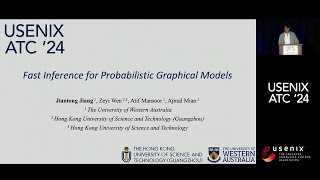
Fast Inference for Probabilistic Graphical Models
Innovative system for efficient probabilistic graphical model inference, offering significant speedup through optimized memory management, parallelization, and flexible integration with sampling algorithms.
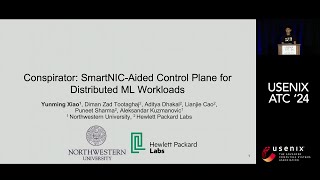
Conspirator - SmartNIC-Aided Control Plane for Distributed ML Workloads
Innovative control plane design using SmartNICs to optimize distributed ML workloads, reducing bottlenecks and improving resource utilization for enhanced performance and efficiency.
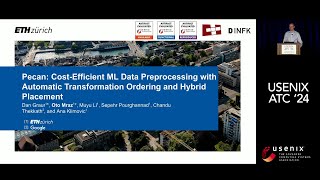
Pecan: Cost-Efficient ML Data Preprocessing with Automatic Transformation Ordering and Hybrid Placement
Optimize ML data preprocessing costs with Pecan's dynamic worker scheduling and transformation reordering, reducing preprocessing expenses by 87% and total training costs by up to 60%.
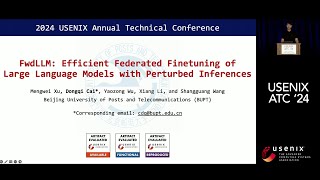
FwdLLM: Efficient Federated Finetuning of Large Language Models with Perturbed Inferences
Innovative federated learning protocol for efficient fine-tuning of large language models on mobile devices, addressing resource constraints through BP-free training and perturbed inferences.
Centimani - Enabling Fast AI Accelerator Selection for DNN Training
Innovative performance predictor for selecting optimal AI accelerators in DNN training, enhancing efficiency and decision-making in heterogeneous hardware environments.

Retrieval-Augmented Generation: Enhancing AI Models - Lecture 7
Explore Retrieval-Augmented Generation (RAG): theory, components, and practical implementation. Enhance AI models' capabilities with this comprehensive overview for beginners and enthusiasts alike.

Build a Q&A App with RAG Using Gemini Pro and LangChain
Learn to create an intelligent Q&A app using Retrieval-Augmented Generation, Gemini Pro, and LangChain. Master advanced retrieval techniques to enhance chatbot performance and build a powerful AI-driven application.