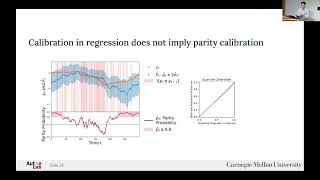
Parity Calibration in Sequential Regression - Forecasting Increase-Decrease Events
Explore parity calibration in sequential regression, focusing on predicting increase-decrease events rather than exact values. Learn its applications in epidemiology, weather forecasting, and nuclear fusion control.
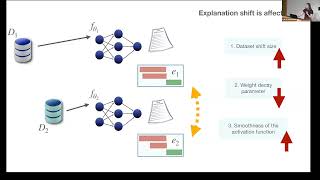
On Minimizing the Impact of Dataset Shifts on Actionable Explanations
Explore factors influencing explanation stability in AI models amid dataset shifts, focusing on model curvature, weight decay, and shift magnitude for robust actionable explanations.
MixupE: Understanding and Improving Mixup from Directional Derivative Perspective - Oral Session 1
Explore MixupE, an improved data augmentation technique for deep neural networks. Gain insights into its theoretical foundations and practical applications across various domains.
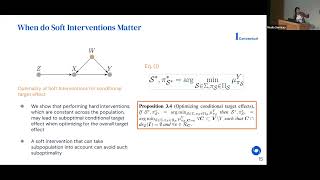
Functional Causal Bayesian Optimization - Lecture 3
Explore functional causal Bayesian optimization for optimizing interventions in causal graphs. Learn about extending CBO methods, modeling with Gaussian processes, and maximizing expected improvement.

Learning from Low Rank Tensor Data: A Random Tensor Theory Perspective - UAI 2023 Oral Session 4
Explore theoretical analysis of learning from low-rank tensor data in supervised and unsupervised settings, quantifying performance gains of tensor methods over standard vector approaches.
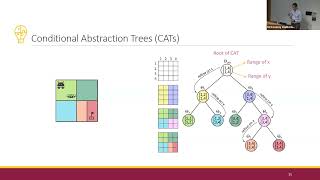
Conditional Abstraction Trees for Sample-Efficient Reinforcement Learning - Oral Session 4
Explore a novel approach for constructing state abstractions in reinforcement learning, improving sample efficiency and performance across multiple domains and problems.
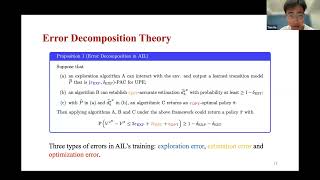
Provably Efficient Adversarial Imitation Learning with Unknown Transitions - Oral Session 4
Explore provably efficient adversarial imitation learning with unknown transitions. Discover a framework connecting reward-free exploration and AIL, and learn about the MB-TAIL algorithm's optimal performance and generalization ability.
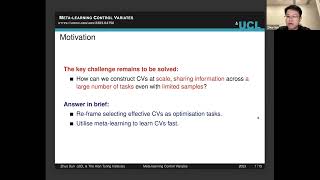
Meta Learning Control Variates for Variance Reduction with Limited Data
Explore meta-learning control variates for variance reduction in Monte Carlo estimators with limited data, leveraging similarities across multiple integration tasks for improved performance.
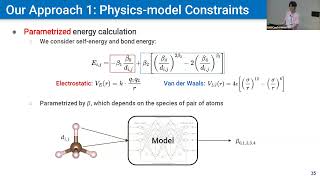
Towards Physically Reliable Molecular Representation Learning - UAI 2023 Oral Session 5
Explore innovative molecular representation learning for estimating energetic properties, combining physics-driven parameter estimation and self-supervised learning to enhance extrapolation beyond training data.
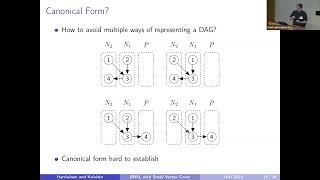
Revisiting Bayesian Network Learning with Small Vertex Cover
Explore Bayesian network structure learning with bounded vertex cover, analyzing complexity bounds and hardness results for optimization and counting problems.
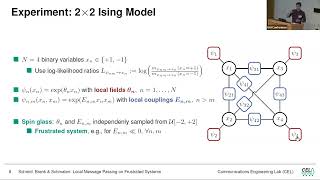
Local Message Passing on Frustrated Systems - UAI Oral Session 6
Explore an alternative message passing algorithm for cyclic graphs, challenging SPA's extrinsic principle and optimizing factor node updates for improved performance on complex networks.

On Inference and Learning With Probabilistic Generating Circuits
Explore efficient inference algorithms for Probabilistic Generating Circuits, addressing computational challenges and discussing implications for learning from data in probabilistic modeling.
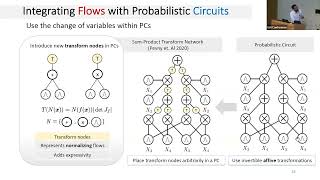
Probabilistic Flow Circuits: Towards Deep Models for Tractable Inference - Oral Session 6
Explore a novel approach combining probabilistic circuits with normalizing flows for enhanced expressivity while maintaining tractable inference in deep probabilistic models.
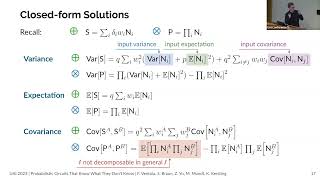
Probabilistic Circuits That Know What They Don't Know - UAI Oral Session 6
Explore probabilistic circuits' robustness to out-of-distribution data and learn about tractable dropout inference for improved uncertainty quantification in a single forward pass.

Challenges in Aligning Language Models
Explore challenges in aligning language models with developer intent. Analyze finetuning's impact on truthfulness and feedback-tuned models' effects on co-writing applications.

Continual Learning: Adapting Machine Learning to an Evolving World
Explore continual learning in machine learning, addressing dataset drift and real-world challenges. Discover recent advancements, including generative models for anticipating changes in dynamic environments.

The Rise of Neural Priors
Explore neural priors as a solution to AI challenges, including data scarcity and bias. Learn about their applications in augmented reality, autonomous driving, and signal recovery.

Cloud AI 100 High Performance Cloud-Edge Inferencing
Explore Qualcomm's Cloud AI 100 accelerator for high-performance cloud-edge inferencing, featuring leadership-class performance, power efficiency, and comprehensive software tools for production deployment.
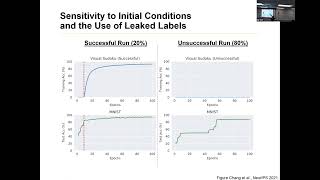
SAT Net: Issues with Symbol Grounding - Part 2 of 3
Explore critiques of SAT Net, focusing on the symbol grounding problem in neurosymbolic reasoning. Gain insights from Paulo Shakarian's lecture on this advanced AI topic.
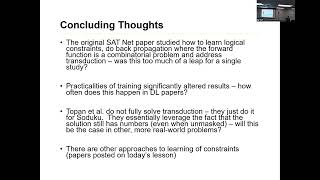
SAT Net: Resolving Symbol Grounding - Part 3
Explore symbol grounding in SAT Net through follow-on work, addressing key challenges in neurosymbolic reasoning and artificial general intelligence.
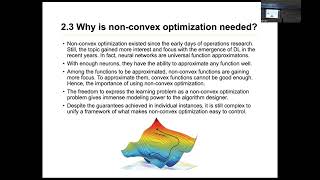
Training Logical Neural Networks via Primal-Dual Methods - Part 1
Explore primal-dual methods for training Logical Neural Networks in neuro-symbolic reasoning, based on Lu et al.'s 2021 IBM research paper.