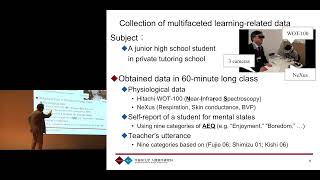
機械学習による学習者の生理情報と精神状態の関係性の形式化 - 2018
機械学習を活用した学習者の生理情報と精神状態の関係性について探求し、教育ビッグデータを用いた学習支援の可能性を解明する研究事例を紹介。
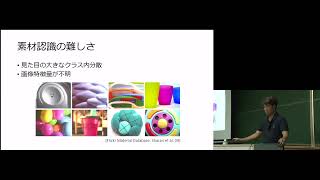
AIで視る: 素材認識 - 第2章
Discover how AI technology enables material recognition through advanced computer vision techniques, presented by Professor Nishino from Kyoto University's Graduate School of Informatics.
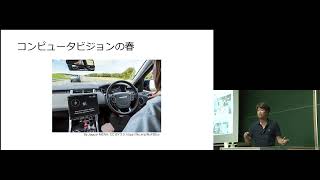
AIで視る - 人工知能とコンピュータビジョン入門 - 第1章
Discover 人工知能とコンピュータビジョンの基礎概念を学び、AIによる画像認識技術の可能性と応用について探求する14分の入門講座。
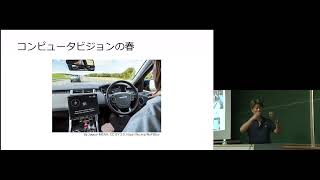
Introduction to AI and Computer Vision - Chapter 1
Discover 人工知能とコンピュータビジョンの基礎概念を学び、AIによる視覚認識技術の最新動向と応用可能性について探究する入門的な講座。
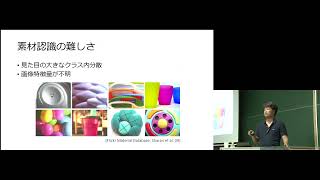
AIで視る: 素材認識 - 第2章
素材認識におけるAI技術の基礎と応用について学び、画像認識の最新技術と実践的な活用方法を探求する11分間の講義。
Desarrollos con Modelos de IA Generativa de Hugging Face
Descubre cómo implementar y utilizar los modelos de IA generativa de Hugging Face para crear aplicaciones innovadoras y soluciones tecnológicas avanzadas.
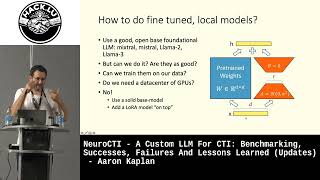
NeuroCTI - A Custom Large Language Model for Cyber Threat Intelligence: Benchmarking, Successes, Failures and Lessons Learned
Explore the development journey of a specialized LLM for Cyber Threat Intelligence, including key benchmarks, outcomes, and critical insights from real-world implementation.
Automating Dark Web CTI Reports with RAG Insight for MISP Sharing
Discover how to automate Cyber Threat Intelligence reports from the dark web using RAG Insight, enabling efficient MISP sharing and enhanced threat detection capabilities.
Unmasking Privacy: A Reproduction and Evaluation Study of Perturbation Techniques for Collaborative Filtering
Explore privacy-preserving techniques in collaborative filtering systems through a comprehensive reproduction study evaluating obfuscation methods and their effectiveness in data protection.

The Learning Machine: Demonstrating Machine Learning on Apple II
Explore fundamental machine learning concepts using an Apple II, demonstrating supervised learning, metaheuristics, and reinforcement techniques through practical examples.

Concrete Type Inference for Code Optimization using Machine Learning with SMT Solving
Explore innovative concrete type inference for dynamically typed languages, combining machine learning and SMT solving to enable code optimization without manual type annotations, significantly boosting performance.
PL4XGL: A Programming Language Approach to Explainable Graph Learning
Explore a novel programming language approach to explainable graph learning, addressing limitations in GNN explainability through a graph description language and interpretable classification model.
An Intrinsically-typed Probabilistic Programming Language in Coq - Extended Abstract
Explore formalization of intrinsically-typed probabilistic programming language in Coq, focusing on syntax, evaluation, and formal verification applications.
A Type System for Feature Engineering in Machine Learning
Explore a dependent type system for feature engineering, enhancing machine learning model inputs through advanced data operations and compiler techniques.

Embedding by Unembedding - Extending HOAS for Complex Semantic Domains
Explore a novel language development technique that extends HOAS, addressing limitations in semantic domains for open expressions, with applications in incremental computation and bidirectional languages.

Formal Specification and Testing for Reinforcement Learning
Explore formal specification and testing methods for reinforcement learning applications, focusing on temporal difference methods and property-based testing using functional programming techniques.
Effect Handlers for Programmable Inference - Haskell 2023
Explore effect handlers for modular inference programming in probabilistic algorithms, revealing high-level structures and enabling easy customization of Metropolis-Hastings and particle filtering methods.
HasTEE: Programming Trusted Execution Environments with Haskell
Explore HasTEE, a Haskell-embedded DSL for programming Trusted Execution Environments. Learn how it simplifies TEE application development with automatic partitioning and enhanced security features.

Language Model Agents Enable Semi-Formal Programming - LIVE23
Explore semi-formal programming using language model agents to capture semantic information and execute informal program elements, enhancing malleable programming environments.

Actix-Telepathy: Distributed Actor Programming in Rust
Explore Actix-Telepathy, an extension for Rust's Actix library enabling remote messaging and clustering support for distributed applications using the actor programming model.
Implementation and Synthesis of Math Library Functions
Explore MegaLibm, a domain-specific language for implementing, testing, and tuning math library functions. Learn how it enhances safety, modularity, and tunability in mathematical software development.