
Advances in Model Guided Surgery and Intervention
Explore the future of surgical technology through computational models, automation, and real-time data integration for enhanced procedural medicine and treatment delivery systems.

Number Theory Problems: Finding Patterns in the 1000th Row
Explore engaging number theory problems involving triangular patterns, consecutive integer sums, and pattern recognition through three concise mathematical challenges.
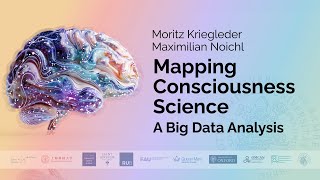
Mapping Consciousness Science: A Big Data Analysis
Explore the landscape of consciousness science through big data analysis of 60,000+ papers, revealing research clusters and interdisciplinary connections across psychology, philosophy, and computer science.
Resisting AI: Understanding Social and Political Dimensions of Artificial Intelligence
Explore the critical social and political implications of AI systems with Dr. McQuillan, examining how deep learning impacts society and discovering alternative approaches rooted in feminist and decolonial perspectives.
Securing Generative AI: Threats Old and New
Explore essential security concepts for generative AI and LLMs, understanding both traditional cybersecurity approaches and emerging threats in this evolving technological landscape.

mTLS: When Certificate Authentication Goes Wrong - Security Implementation Vulnerabilities
Dive into novel attacks on mTLS authentication systems, exploring implementation vulnerabilities, exploitation techniques, and secure coding practices for certificate-based authentication.

Attacks on GenAI Data and Using Vector Encryption for Protection
Explore cutting-edge vector encryption techniques and security measures to protect GenAI data from embedding inversion attacks while enabling privacy-preserving searches over encrypted vectors.
Exploiting Voice Cloning in Adversarial Simulation - Security Testing and Defense Strategies
Explore the security vulnerabilities of voice verification systems through deep learning voice cloning techniques, including practical demonstrations, risk assessment, and defensive countermeasures.

Lessons Learned from Building and Defending LLM Applications
Gain insights into real-world challenges and practical strategies for developing secure LLM applications, exploring vulnerabilities, defense mechanisms, and best practices for robust AI systems.

SUMO Simulations for Privacy-Preserving Federated Learning in Autonomous Vehicles
Explore privacy-preserving federated learning techniques for autonomous vehicles using SUMO simulations, focusing on balancing data protection and predictive model performance.
Scalable and Portable Federated Learning Simulation Engine
Discover a powerful simulation engine for federated learning that enables privacy-focused data analysis, offering scalable and hardware-independent implementation for research and production environments.
LinkEdge - Open-Source MLOps Integration with IoT Edge Devices
Discover how to integrate MLOps practices with edge devices using LinkEdge, an open-source toolkit for efficient model deployment, monitoring, and management in IoT environments.

Feature Estimation for Punching Tool Wear at the Edge
Discover how to monitor punching tool wear through acceleration measurement and edge processing, comparing TSFEL and MiniRocket algorithms for real-time classification of tool conditions in metal manufacturing.

Privacy and Security in Vehicular Data Aggregation Using Federated Learning - A Parking Occupancy Case Study
Explore privacy challenges in vehicular federated learning systems, focusing on data protection, route inference attacks, and security implications for intelligent city traffic prediction.

Methodology for Forecasting Election Results from Tweets
Discover advanced techniques for analyzing social media data to predict election outcomes using computational methods and Twitter sentiment analysis.
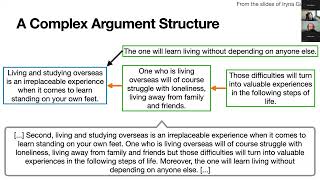
Analyzing Arguments from Political Debates
Explore advanced computational techniques for analyzing and understanding political debate arguments, focusing on AI-driven methods for extracting meaningful insights from political discourse.
Online Learning and Mistake Bound Analysis - Lecture 6B
Explore online learning algorithms and performance quantification through mistake bound methodology, focusing on mistake-driven learning approaches.

Introduction to the Perceptron Algorithm - Lecture 8
Dive into the fundamental concepts of the Perceptron algorithm, exploring its core mechanisms and applications in neural network foundations.
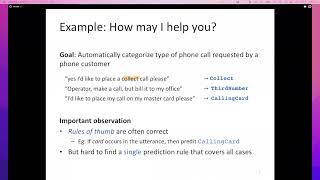
Boosting and Ensembles in Machine Learning - Lecture 18b
Discover how to transform weak learning algorithms into powerful predictive models through boosting and ensemble techniques in machine learning.
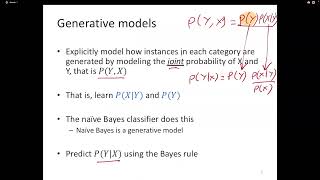
Discriminative and Generative Models in Machine Learning - Lecture 24B
Explore the key distinctions between discriminative and generative models in machine learning, focusing on their unique approaches and practical applications.
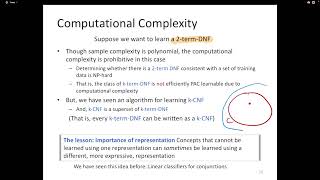
Positive and Negative Learnability Results in Machine Learning - Lecture 15
Delve into fundamental learnability concepts in machine learning, exploring both positive and negative results that shape our understanding of learning algorithms and their limitations.