Navigating Observability Challenges: Mitigating Deep Fake Risks
Explore deep fake risks and mitigation strategies in observability. Learn about technological advancements, media literacy, regulatory frameworks, and blockchain for authentication. Gain insights on collaborative approaches to address challenges.

Practical GraphRAG - Making LLMs Smarter with Knowledge Graphs
Discover how to enhance LLM accuracy using knowledge graphs, exploring GraphRAG implementation with Neo4j and LangChain for improved context-aware AI responses and reduced hallucinations.
Craft Complex Mock Data Using Graph-Based Configuration Files
Master the creation of complex, interconnected mock datasets using Python's graph-data-generator package through JSON configuration files for more efficient development and testing workflows.
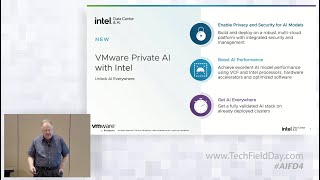
Using Intel AMX CPUs for AI and LLMs on VMware vSphere
Discover how to deploy private AI models using Intel AMX CPUs and VMware vSphere, enabling secure, cost-effective LLM implementations without dedicated GPUs in your existing data center infrastructure.
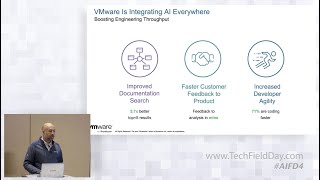
Private AI Implementation and Use Cases at VMware
Discover how VMware leverages private AI services internally, from coding assistance to document search using RAG, exploring their implementation of LLMs and cloud-smart approach to enterprise AI solutions.
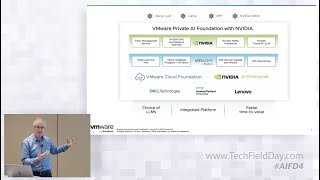
VMware Private AI Foundation with NVIDIA - Enterprise Generative AI Platform Overview
Discover how to deploy and manage enterprise-level generative AI applications with VMware's integrated solution, featuring NVIDIA NeMo for customization, enhanced security, and seamless data privacy controls.
Building a Mobile AI Platform at Facebook - F8 2019
Explore Facebook's approach to mobile AI, covering NLP, video, ASR, and content understanding. Learn about challenges, techniques, and optimizations for edge deployment.
Product Optimization with Adaptive Experimentation at Facebook
Discover adaptive experimentation: AI-powered testing for product optimization. Learn concepts, applications, and open-source tools like Ax and botorch to enhance products, infrastructure, and marketing campaigns.
Recognize Handwriting with Core ML - Days of Swift Tutorials
Implement handwriting recognition on iOS using Core ML, Vision Framework, and MNIST model. Learn to process touch drawings for real-time digit classification.

AI for Everyone - Face Recognition with OpenCV
Learn to implement face recognition using OpenCV and Python. Covers model training, face detection in images, and practical demonstrations with a webcam.
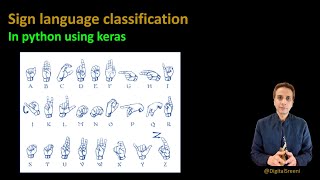
Classification of MNIST Sign Language Alphabets Using Deep Learning
Learn to classify hand sign language alphabets using deep learning, covering data preparation, model creation, and result analysis for 25 classes.

Skin Cancer Lesion Classification Using the HAM10000 Dataset
Learn to classify skin cancer lesions using HAM10000 dataset. Covers data preparation, model building with Auto Keras, and result analysis for 7 types of skin lesions.
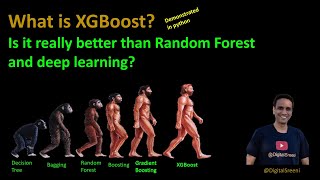
What Is XGBoost and Is It Really Better Than Random Forest and Deep Learning?
Explore XGBoost's advantages over Random Forest and Deep Learning, comparing performance and understanding its unique features for machine learning tasks.
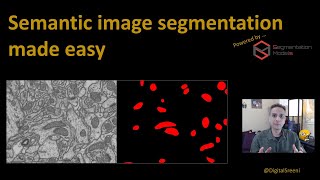
Semantic Segmentation Made Easy - Using Segmentation Models Library
Learn to implement semantic segmentation using the Segmentation Models library, covering model types, backbones, data augmentation, preprocessing, and training on electron microscopy datasets.
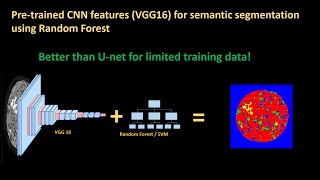
Pretrained CNN Features for Semantic Segmentation Using Random Forest
Explore semantic segmentation using VGG16 features and Random Forest, offering improved results for limited training data compared to U-net.
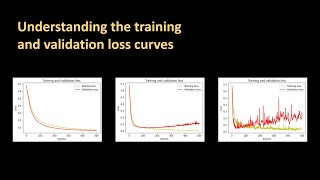
Understanding the Training and Validation Loss Curves
Interpret loss curves from neural network training using Wisconsin breast cancer dataset. Explore various scenarios including underfitting and good fit.
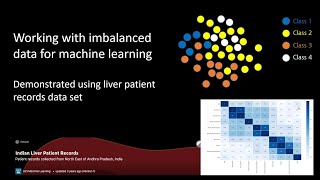
Working With Imbalanced Data for ML - Demonstrated Using Liver Disease Data
Learn techniques for handling imbalanced datasets in machine learning, demonstrated using liver disease data. Covers data up-scaling, SMOTE, and ROCAUC evaluation to improve model accuracy.
Regression Using Neural Networks and Comparison to Other Models
Explore neural network regression, compare with other models, and learn practical implementation using Python for data analysis and prediction.
Data Augmentation Using Keras
Explore image augmentation techniques using Keras, including reshaping and multiclass augmentation, to enhance your deep learning models.

How to Become an AI Music Expert
Explore academic and self-taught paths to master AI music, including key institutions, conferences, and journals. Learn essential skills and gain insights into the field's latest developments.
Inside TensorFlow - TF Filesystems
Explore TensorFlow Filesystems with a deep dive into its architecture, Python integration, saved model loading, and plugin system for efficient data handling and model management.