The Long Road to Autonomous Cybersecurity
Explore current research on autonomous cybersecurity systems, including challenges, training environments, and future prospects. Gain insights into AI's role in cybersecurity.
MLOps from Edge to On-Demand Visualization
Explore flexible MLOps architecture for Red Hat OpenShift, covering data collection, cloud storage, and on-demand visualization using accelerated hardware.
How Implementing Machine Learning Ended Up with an If-Else - Lessons from OpenShift Cluster Prediction
Explore pivotal decisions in ML projects, focusing on extracting value from OpenShift cluster data. Learn to define success metrics and prioritize business goals over trendy technologies.

Photonic Quantum Computing: A Bright Future for Many Applications
Explore photonic quantum computing architectures, applications, and future challenges. Discover quantum machine learning, reinforcement learning, and secure computing in quantum networks.
Minimization Problems for the Axisymmetric Neo-Hookean Energy
Explore minimization problems for axisymmetric neo-Hookean energy, focusing on existence of minimizers, energy concentration, and bounds for relaxed energy in critical Sobolev cases.

Non-interpenetration in Thin-film Models of Elastic Solids
Explore non-interpenetration in thin-film models for elastic solids, focusing on dimension reduction, membrane regimes, and suitable conditions for preventing material penetration.
Integral Representation and T-Convergence for Free-Discontinuity Problems
Explore integral representation and T-convergence for free-discontinuity problems in GSBV p(.) space, focusing on variable exponent energies and their asymptotic behavior.
Variational Methods for Hyperbolic Evolutions and Fluid-Structure Interactions
Explore variational approaches to hyperbolic evolutions and fluid-structure interactions, focusing on well-posedness results for solid evolutions and fluid-solid interactions.
Building the Fine-Tuning Pipeline for Alignment of LLMs
Explore key aspects of aligning LLMs and set up infrastructure for a versatile alignment pipeline. Learn data collection, prompt tuning, and workflow management techniques.
Traceability and Observability in Multi-Step LLM Systems - LLMOps
Explore advanced techniques for implementing traceability and observability in multi-step LLM systems, focusing on RAG systems and leveraging OpenTelemetry for deep insights.
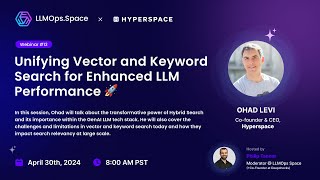
Vector and Keyword Search for Enhanced LLM Performance
Explore hybrid search techniques combining keyword and vector algorithms to enhance LLM performance, including metadata filtering, TF/IDF ranking, and advanced vector search methods.
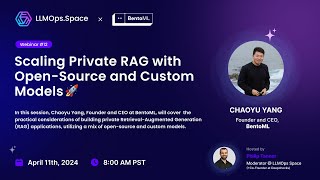
Private RAG with Open Source and Custom LLMs - BentoML and OpenLLM
Explore practical considerations for building private RAG applications using open source and custom LLMs. Learn about OpenLLM and optimize inference performance for RAG deployments.
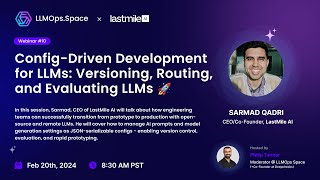
Config-Based Development for LLMs: Versioning, Routing, and Evaluating LLMs
Explore config-based development for LLMs, covering versioning, routing, and evaluation techniques to transition Generative AI apps from prototype to production efficiently.
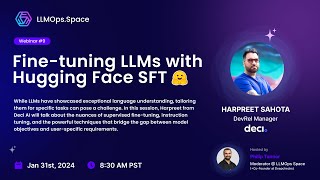
Fine-tuning LLMs with Hugging Face SFT and QLoRA - LLMOps Techniques
Explore advanced LLM fine-tuning techniques, from specialized tuning to instruction enhancement. Learn dataset preparation, model optimization, and leverage powerful libraries for efficient fine-tuning and deployment.

Orchestrating RAG: Retrieval, Canopy, and Pinecone
Explore orchestrating RAG pipelines, optimizing retrieval strategies, and leveraging Canopy and Pinecone for scalable AI applications with billions of documents.
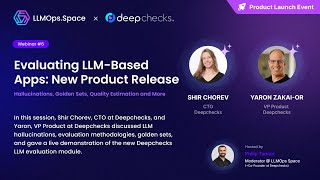
Evaluating LLM-Based Apps - Deepchecks LLM Validation
Explore LLM hallucinations, evaluation methodologies, and golden sets. Witness a live demo of Deepchecks' new LLM evaluation module for robust performance benchmarking and quality assurance.
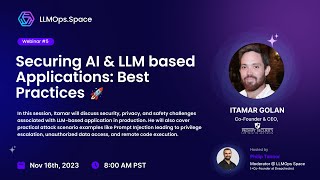
Securing AI and LLM-based Applications: Best Practices
Explore security challenges in AI and LLM applications, learn attack scenarios, and discover best practices for mitigating risks and maintaining application integrity.

Building LLM-Powered Apps: Best Practices for Vector Databases and LLMOps
Explore best practices for LLM-based app development, covering design considerations, technical aspects, and deployment strategies for optimal performance and scalability.
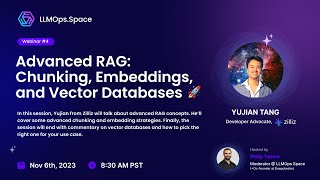
Advanced RAG: Chunking, Embeddings, and Vector Databases
Explore advanced RAG concepts: chunking for efficient retrieval, embeddings for text representation, and vector databases for optimized storage and retrieval in LLM applications.
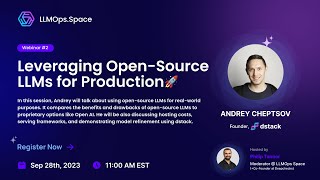
Leveraging Open Source Large Language Models for Production
Explore open-source LLMs, compare with proprietary options, understand economic aspects, evaluate performance, and learn to operate and fine-tune models using dstack.
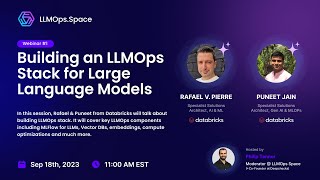
Building an LLMOps Stack for Large Language Models
Explore LLMOps architecture: MLFlow for LLMs, Vector Databases, RAG strategies, and prompt evaluation. Gain insights into optimizing and deploying large language models effectively.