
Implicit Regularization for General Norms and Errors - Lorenzo Rosasco, MIT
Explores implicit regularization in optimization methods, focusing on stability in estimation processes for non-Euclidean norms and non-quadratic errors, with emphasis on accelerated techniques.
Some Thoughts on Gaussian Processes for Emulation of Deterministic Computer Models
Explore Gaussian Process emulators for complex computer models in uncertainty quantification, focusing on theoretical aspects and applications to climate, tsunami, and earthquake problems.
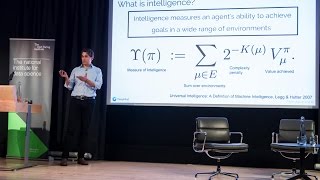
The Role of Multi-Agent Learning in Artificial Intelligence Research at DeepMind
Explore multi-agent learning in AI research, focusing on cooperation among self-interested agents and the AlphaGo project's breakthrough in defeating top Go players using self-play algorithms.

Masterclass for Optimisation - Professor Coralia Cartis, University of Oxford
Explore advanced optimization techniques for large-scale problems with Professor Coralia Cartis. Learn about algorithm development, analysis, and implementation for various problem classes in numerical optimization.
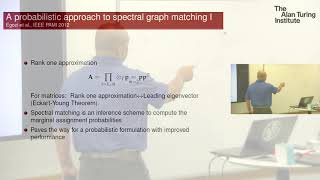
Deep Spectral Graph Matching
Explore high-level computer vision and machine learning concepts with a focus on deep spectral graph matching techniques, presented by an expert in the field.
Adaptive Sampling via Sequential Decision Making - András György
Explore adaptive sampling methods using multi-armed bandit algorithms and MCMC samplers to optimize resource allocation and improve sample quality in machine learning applications.
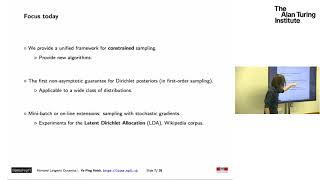
Mirrored Langevin Dynamics - Ya-Ping Hsieh
Explore posterior sampling in constrained distributions, focusing on Latent Dirichlet Allocation. Learn about a unified framework for deriving novel sampling schemes with improved convergence rates.

Building Efficient Learning Algorithms: A Computational Regularization Perspective - Lorenzo Rosasco
Explore efficient learning algorithms through a computational regularization lens. Unify algorithmic tricks in least squares learning for accuracy and resource efficiency.

Foundation Models: Strengths, Weaknesses, and Future Implications - Session 4
Experts discuss foundation models like GPT-3, exploring their strengths, limitations, and societal impact. Topics include knowledge representation, scaling, data choices, sustainability, and ethical concerns.

Ghost Work: The Human Labour Behind AI Technology
Explore the hidden workforce behind AI technology, examining ethical concerns and labor practices in data labeling and crowdsourcing platforms for AI development.

Towards Safe, Reliable and Trustworthy AI
Exploring challenges and frameworks for developing safe, reliable AI systems. Introduces spec-consistent machine learning to formalize desired AI behavior for real-world applications.

The Power of AI in Search - Transforming Digital Interactions
Richard Socher discusses AI's impact on search engines, exploring You.com's innovative approach, security measures, ethical considerations, and the future of AI in transforming digital interactions and work.
Vector Embeddings for Semantic Search Made Easy with Practical Tips
Explore vector embeddings for semantic search, learning techniques to create meaningful representations, efficient similarity search algorithms, and practical strategies for enhanced information retrieval.

Your AI Survival Guide - Navigating AI Challenges and Integration
Practical insights on navigating AI challenges, from democratization to integration strategies. Offers actionable advice for individuals and businesses venturing into AI, emphasizing hands-on learning and measured approaches.

How to Hack a Large Language Model Using PyReft - Fine-Tuning with Custom Data
Learn to fine-tune large language models with PyReft, using your own data to customize and enhance AI performance for specific tasks and domains.

Generative AI for Data Platforms - Cutting to the Chase
Explore AI-infused lakehouses: integrating generative AI with data platforms for enhanced code generation, natural language queries, and semantic search. Includes live demo of IoT event processing.
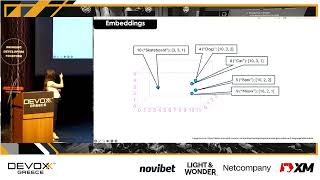
Unleashing the GenAI Magic - Building a Chatbot for Traders with Generative AI
Explore the creation of a trader-focused chatbot using Generative AI, covering prompt engineering, Retrieval Augmented Generation, and unconventional tech choices for robust, scalable solutions.
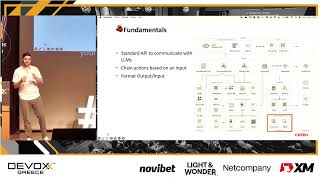
Meet Your New AI Best Friend: LangChain - Interacting with LLMs and APIs
Explore LangChain's versatility in developing AI-powered applications. Learn to interact with APIs and databases using natural language, and create unique AI tools with minimal code.
Fine-tuning Phi-3 for LeetCode: Dataset Generation and Unsloth Implementation
Learn to generate LeetCode datasets and fine-tune Phi-3 models using Unsloth for improved coding problem-solving performance. Explore dataset creation, model training, and result evaluation.
Taylor Swift and the Democratization of AI for Developers - React Miami 2024
Explore how AI tools like OpenAI and Vercel's AI SDK enable developers to create smart experiences, illustrated through the development of SwiftieGPT, a Taylor Swift-focused chatbot.
Shaping AI Benchmarks and Open-Source Development - Percy Liang Interview
Percy Liang discusses AI benchmarking advancements, HELM framework, open-source models' importance, and challenges in AI development. Insights on model selection, evaluation, and the future of AI technologies are shared.