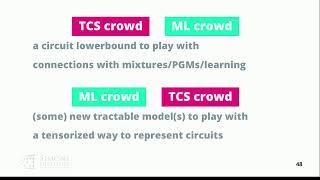
Subtractive Mixture Models: Representation and Learning
Exploring subtractive mixtures in probabilistic circuits: increased expressiveness, efficient learning, and inference for complex distributions. Theoretical and empirical advantages over traditional additive mixtures.
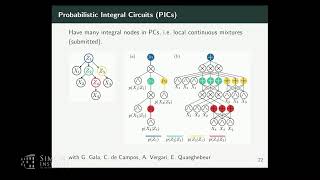
The Rise of Tractable Circuits - From Cryptography to Continuous Generative Models
Exploring tractable circuits' applications in cryptography and continuous generative models, showcasing advancements in neuro-symbolic approaches and probabilistic inference for AI reasoning.
Decision Diagrams for Efficient Inference and Optimization in Expressive Discrete-Continuous Domains
Explore extended algebraic decision diagrams (XADDs) for representing piecewise functions, enabling efficient computations and novel solutions in probabilistic inference, optimization, and decision-making.
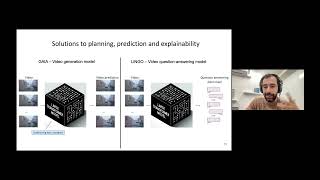
Language and Video-Generative AI in Autonomous Driving - Guest Lecture by Wayve
Explore Wayve's innovative approach to autonomous driving, featuring language and video-generative AI advancements. Learn about GAIA-1 and LINGO technologies, and their applications in self-driving vehicles.
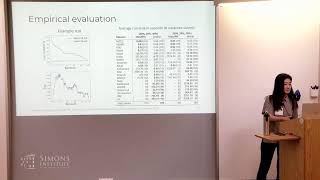
Solving Marginal MAP Exactly by Probabilistic Circuit Transformations
Efficient marginal MAP solver for probabilistic circuits using iterative transformations and pruning, enabling exact solutions without search for decision-making problems.
Leveraging Tree Automata Approximation Results for Efficient Sampling and Counting
Explore efficient approximation algorithms for counting and sampling satisfying assignments in structured DNNF circuits, leveraging recent tree automata results.
AI News: Open Source Advancements and Recent Developments
Explore latest AI advancements: new models, papers, and tools. Learn about HyperAttention, MemGPT, Self-RAG, PaLI-3, Fuyu-8B, MistralLite, and more. Stay updated on AI developments in various domains.
GPU Accelerated Deep Learning for Scala 3 with Storch
Discover Storch, a new PyTorch-based library for GPU-accelerated deep learning in Scala 3. Learn about tensor operations, automatic differentiation, and neural network APIs for building enterprise-grade machine learning applications.

Doubling Stable Diffusion Inference Speed with RTX Acceleration and TensorRT - A Comprehensive Guide
Comprehensive guide on boosting Stable Diffusion performance with RTX Acceleration TensorRT, covering installation, optimization, and troubleshooting for various models and extensions.
Common Voice: Mozilla's Multilingual Speech Dataset Initiative
Mozilla's Common Voice initiative expands to multiple languages, aiming to crowdsource diverse voice datasets for speech technology development. The project seeks global participation to make voice recognition accessible in various languages.
Mozilla's DeepSpeech and Common Voice Projects - Open and Offline-Capable Voice Recognition
Explore Mozilla's DeepSpeech and Common Voice projects for open, offline voice recognition. Learn about data preparation, development, and multilingual support in this FOSDEM presentation.

AI is Your New Design Material
Explore AI's impact on UX and product design, learning to leverage machine-generated content as a design material. Discover techniques to create innovative services and improve existing products using AI responsibly.
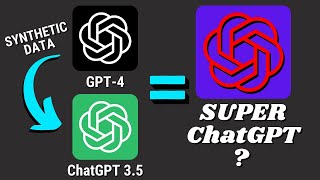
Fine-Tuning ChatGPT 3.5 with Synthetic Data from GPT-4 - Step-by-Step Guide
Explore step-by-step fine-tuning of ChatGPT 3.5 using GPT-4 synthetic data. Learn dataset selection, generation, model training, and evaluation for improved LLM results.
Learning from Multiple Data Sources
Explore multi-source data learning strategies and their implications for machine learning algorithms, focusing on challenges and potential solutions in diverse data environments.
A Data-Centric View on Robustness - IFDS 2022
Explore data-centric approaches to robustness in machine learning, examining strategies to enhance model reliability and performance across diverse scenarios.
Tracking Significant Changes in Bandit - IFDS 2022
Explores significant changes in bandit algorithms, focusing on adaptive procedures and random replays for tracking environmental shifts in reward and context distributions.

A Decade of Machine Learning Accelerators: Lessons Learned and Carbon Footprint
Exploring a decade of machine learning accelerators, lessons learned, and strategies to reduce the carbon footprint of deep neural networks through optimizing models, machines, mechanisms, and mapping.
Integrating AI and Machine Learning in Life Sciences - Allen School Colloquia
Exploring AI integration in life sciences, covering explainable AI, COVID-19 detection, cancer precision medicine, and biological discovery through advanced machine learning techniques.
Machine Learning-centric, Energy-Optimized Wireless Systems - Spring 2021 Research Seminar
Explore cross-layer optimization for energy-efficient AIoT systems, integrating machine learning, wireless communication, signal processing, and VLSI architecture for ultra-low power IoT applications.
Computer Vision to Phenotype Human Diseases Across Physical and Molecular Scales
Innovative computer vision algorithms for disease phenotyping across scales, from video-based heart function assessment to spatial transcriptomics and immune cell dynamics, with focus on robust and human-compatible AI.
Machine Learning-based Design of Proteins and Small Molecules
Explore machine learning approaches for protein engineering, focusing on data-driven design to create proteins with desired properties and the challenges of extrapolation in predictive modeling.