Non-Unitary Dynamics - Dissipative to Monitored - Vedika Khemani
Explore non-unitary dynamics in quantum systems, from dissipative to monitored, covering analytical approaches, entanglement scaling, and spacetime duality in quantum circuits and many-body physics.

Building Recommendation Systems Using Graph Neural Networks
Explore graph neural networks for recommendation systems, focusing on RECKON's encoder-decoder architecture to improve entity intelligence and personalize user experiences.
Quick to Production: Integrating Spark and TensorFlow for Efficient MLOps
Learn to quickly deploy deep learning models using Spark and TensorFlow, simplifying MLOps for data scientists. Explore distributed computing, feature engineering, and leveraging TensorFlow ecosystem libraries for efficient model production.
Identifying Sensitive Data and Mitigating Risk in Apache Spark and Databricks
Discover sensitive data in Apache Spark and Databricks using BigID's platform. Learn to scale discovery, label data, and apply necessary guardrails for compliance and risk mitigation in data analytics.
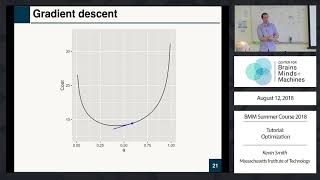
Optimization
Explore optimization techniques for machine learning, covering likelihood estimation, cost functions, gradient descent, and regularization methods for improved model performance.

Probabilistic Programming
Explore probabilistic programming concepts, from intuitive physics to computational theory of mind, with hands-on practice in web-based probabilistic programming languages.
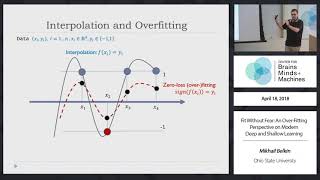
Fit Without Fear - An Over-Fitting Perspective on Modern Deep and Shallow Learning
Explore over-fitting in modern machine learning, challenging conventional wisdom and presenting kernel methods as a competitive alternative to deep learning. Insights on interpolation, generalization, and stochastic gradient descent.
Unsupervised Machine Learning for Scaling Data Quality Monitoring in Databricks
Explore unsupervised ML algorithms for scalable data quality monitoring in Databricks, covering implementation, strengths, weaknesses, and practical applications for effective data management.
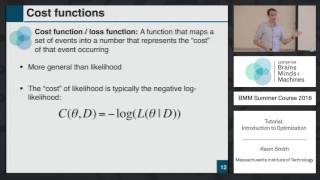
Introduction to Optimization
Learn optimization techniques for machine learning, including likelihood estimation, gradient descent, and regularization, with practical examples and applications.
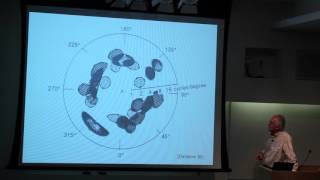
Filters and Other Potions for Early Vision and Recognition
Explore early vision and recognition techniques, including filters, deep networks, and multiscale processing. Learn about spacetime oriented filters and tensor factorization for improved visual analysis.
Compositional Models - Complexity of Representation and Interference
Explore compositional models, their representation complexity, and interference effects. Delve into data-driven approaches, feedforward/feedback mechanisms, and hierarchical structures in generative modeling.
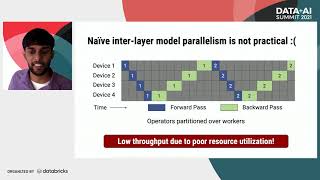
Efficient Large-Scale Language Model Training on GPU Clusters
Explores advanced techniques for efficient large-scale language model training on GPU clusters, discussing parallelism methods, novel scheduling, and performance optimization to achieve unprecedented model sizes and training speeds.
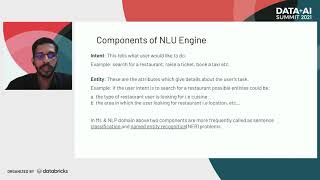
Conversational AI with Transformer Models - Building Blocks and Optimization Techniques
Explore building conversational AI agents using transformer models, covering advantages over RNN/LSTM, knowledge distillation, and model compression techniques for efficient production deployment.
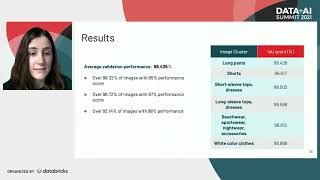
Automated Background Removal Using PyTorch - Wehkamp's Image Processing Pipeline
Discover an automated pipeline for efficient background removal in product images using PyTorch and machine learning, enhancing visual experiences for e-commerce customers.
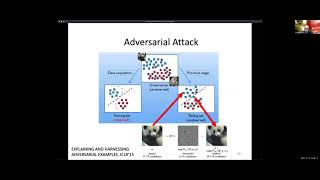
Practical Adversarial Attack Against Speech Recognition Platforms
Explore techniques for adversarial attacks on speech recognition systems, focusing on Amazon Echo and Kodi. Learn about blackbox approaches and philosophical implications.
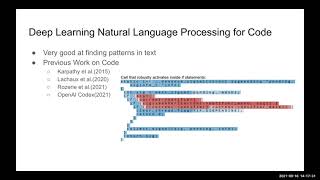
Automated Software Vulnerability Detection with Deep Learning for Natural Language Processing
Explore deep learning techniques for automated software vulnerability detection using natural language processing, covering data sets, pretraining, architecture, and results.
Quantum "Supremacy" - Lecture 25 of Quantum Computation at CMU
Explore quantum supremacy, its challenges, and implications in computational theory. Delve into error correction, threshold theorems, and the potential of quantum systems.

Analysis of Boolean Functions - Restrictions and the Goldreich-Levin Theorem
Explore restrictions and the Goldreich-Levin Theorem in Boolean function analysis, covering key concepts, proofs, and applications in this advanced computer science lecture.
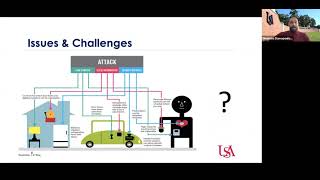
Security and Trustworthiness of Modern Cyber-Physical Systems - Dr. Dimitrios Damopoulos
Explore challenges and strategies for securing interconnected cyber-physical systems, focusing on machine learning, smartphone security, and AI trustworthiness in our increasingly digital world.

How to Use Aesthetic Gradients - Stable Diffusion Tutorial
Learn to train and use aesthetic embeddings in Stable Diffusion for personalized text-to-image generation. Covers installation, using pretrained embeddings, training new ones, and comparing results.

Stable Diffusion Dreambooth Tutorial - Just Like Corridor Crew
Learn to use Dreambooth SD Optimised for adding custom elements to Stable Diffusion. This tutorial covers setup, training, and inference, with tips for different hardware configurations.