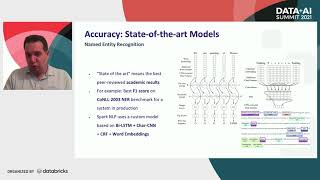
Advanced Natural Language Processing with Apache Spark NLP
Explore advanced NLP tasks using Apache Spark NLP, covering classification, named entity recognition, sentiment analysis, and more through hands-on Python notebooks and deep learning techniques.
Efficient Query Processing for Unstructured Data Using Machine Learning
Explore efficient query processing techniques for unstructured data using machine learning, including proxy scores and clustering methods to accelerate analysis and reduce costs.

Data Versioning and Reproducible ML with DVC and MLflow
Learn to enhance ML reproducibility using DVC and MLflow. Explore data versioning, model tracking, and artifact management for efficient ML development and deployment.
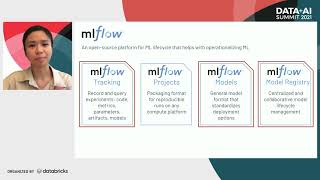
Testing ML Models in Production - Detecting Data and Concept Drift
Explore robust ML model testing in production using MLflow, SciPy, and statsmodels. Learn key statistical tests, metrics for drift detection, and gain practical insights for maintaining model effectiveness.
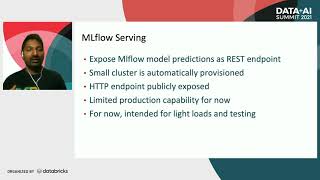
Productionizing ML Models Using MLflow Model Serving
Explore MLflow Model Serving for efficient ML model deployment, consumption, and monitoring. Learn to deploy versions, validate, connect to Power BI, and manage access rights.
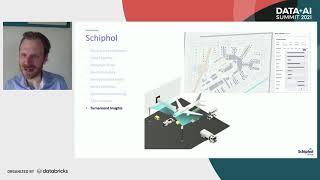
Consolidating MLOps at Schiphol Airport Using MLFlow
Explore how Schiphol Airport leverages MLFlow for rapid iteration, deployment, and monitoring of mission-critical machine learning models, enabling multiple weekly releases and efficient adaptation to changing dynamics.
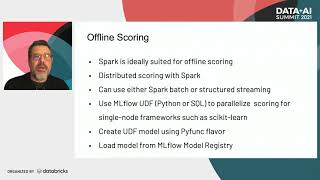
MLflow Model Serving - Methods and Best Practices
Explore MLflow model serving techniques, including batch and real-time scoring, open-source and Databricks-managed options, with emphasis on new production-ready model serving features.

Interpretable Machine Learning - Data Brew Season 2 Episode 7
Explore interpretable machine learning with Ameet Talwalkar, discussing its relation to data privacy, fairness, and practical applications in this insightful interview on cutting-edge ML research.
Monitoring ML Models, IoT Data, and Quality Checks on Delta Lake - Quby's Approach
Discover how Quby monitors IoT data, ML models, and data quality using Databricks. Learn about Delta Lake, MLflow, and Slack integration for efficient data processing and model performance tracking.

Generalized Pipeline Parallelism for DNN Training - PipeDream System Overview
Efficient multi-accelerator parallelization for DNN training using PipeDream, combining intra-batch parallelism with inter-batch pipelining to improve throughput and overcome challenges in bi-directional training.
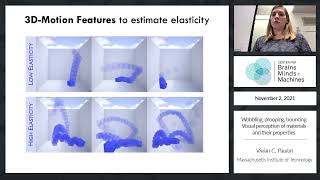
Wobbling, Drooping, Bouncing - Visual Perception of Materials and Their Properties
Explore visual perception of material properties through experiments on elastic bouncing objects, examining human estimation accuracy, motion features, and internal models for predicting object behavior.
Interpolation and Learning With Scale Dependent Kernels
Explore scale-dependent kernels in machine learning, covering overfitting, statistical theory, and practical applications in regression and interpolation.
Learning What We Know and Knowing What We Learn - Gaussian Process Priors for Neural Data Analysis
Explore Gaussian process priors for neural data analysis, covering latent variable models, Bayesian inference, covariance kernels, and factor analysis. Gain insights into advanced techniques for understanding complex neural datasets.
Question Answering for Language and Vision
Explore advanced techniques in question answering for language and vision, including joint models, multitask learning, and neural networks with Richard Socher from MetaMind.
Security and Information Assurance with Deep Learning
Explore deep learning applications in security, focusing on intrusion detection systems and common pitfalls. Learn about complex security data and real-world examples of machine learning challenges.
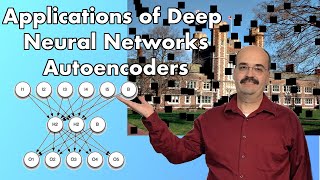
Deep Neural Network Autoencoders in TensorFlow and Keras - Part 1
Learn to create and implement autoencoders in Keras and TensorFlow, including denoising autoencoders, for deep neural network applications in image processing and function approximation.
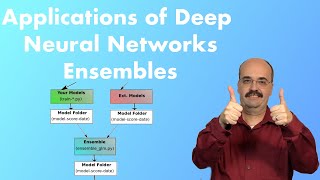
Neural Networks with Ensembles for TensorFlow and Keras
Learn to create and evaluate ensemble models using random forests and deep neural networks with TensorFlow, Keras, and scikit-learn. Explore feature importance and perturbation ranking techniques.
Deep Learning Cross Validation for TensorFlow and Keras
Learn to implement cross-validation techniques for deep learning models using TensorFlow and Keras, enhancing model evaluation and performance in regression and classification tasks.
Early Stopping and Encoding a Feature Vector for Deep Neural Networks
Learn to implement early stopping, encode feature vectors, and use validation sets in Keras neural networks for improved deep learning model performance and efficiency.
Introduction to TensorFlow and Keras with Anaconda Python
Learn to build neural networks using TensorFlow and Keras for classification and regression tasks. Covers key concepts, data handling, model creation, training, and evaluation.
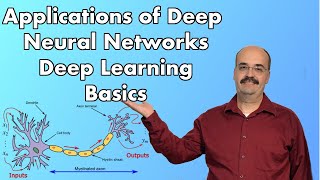
Deep Neural Network Basics for Keras and TensorFlow
Explore deep neural network fundamentals including activation functions, bias neurons, and output calculation for Keras and TensorFlow implementation.