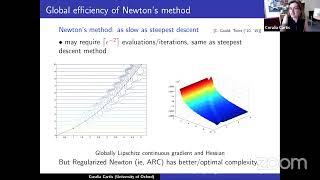
Evaluation Complexity of Algorithms for Nonconvex Optimization
Overview of global convergence rates and evaluation complexity for nonconvex smooth optimization methods, comparing steepest descent and Newton's method, and exploring benefits of higher-order regularization algorithms.

Topology of Surprisal - Information Theory and Vietoris-Rips Filtrations
Explore the fusion of information theory and Vietoris-Rips filtrations, focusing on Kullback-Leibler divergence and its applications in deep learning, with insights on overcoming non-symmetry challenges.

Introduction to Azure OpenAI Service
Explore Azure OpenAI Service capabilities, use cases, and enterprise readiness through a walkthrough and live demonstration of this powerful language model integration.

Diffrax - Numerical Differential Equation Solvers in JAX
Explore numerical differential equation solvers in JAX with Diffrax, covering implementation, features, and applications in machine learning and dynamical systems.
Dissipative Deep Neural Dynamical Systems
Explore dissipative deep neural dynamical systems and their applications in machine learning, presented by Jan Drgona from Pacific Northwest National Laboratory.
Machine Learning for Prediction of Terrestrial Climate and Weather
Explore cutting-edge applications of machine learning in predicting terrestrial climate and weather patterns, presented by a leading expert from the University of Maryland.
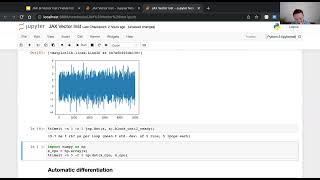
JAX- Accelerated Machine Learning Research via Composable Function Transformations in Python
Explore accelerated machine learning research using JAX, a Python library for composable function transformations, enhancing ML model development and experimentation.
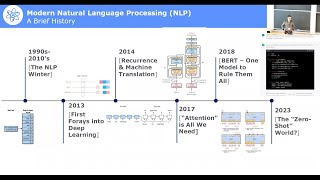
The Evolution of Natural Language Processing - Advice and Responsible Investing
Explore NLP's evolution, its impact on AI advisors, and ethical considerations in responsible investing through cutting-edge language models and representation learning.

Objective Driven Portfolio Construction Using Reinforcement Learning
Explore innovative portfolio construction techniques using reinforcement learning to optimize investment strategies and achieve specific financial objectives.
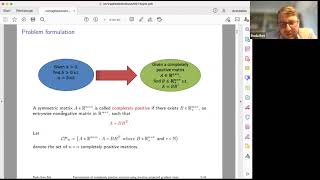
Factorization of Completely Positive Matrices Using Iterative Projected Gradient Steps
Explore iterative projected gradient steps for factorizing completely positive matrices in this advanced mathematical lecture from the University of Vienna.

AI Rap Bot: Creating Lyrics and Vocals with Tacotron 2 and ChatGPT
Explore AI-powered rap generation using Tacotron 2 and ChatGPT. Learn to create a user-friendly interface with Gradio for generating lyrics and vocals.
Information-Theoretic Foundations of Generative Adversarial Models
Explore information-theoretic methods for trustworthy machine learning, focusing on generative adversarial models and their foundations for enhanced reliability and performance.
Generalization Bounds for Neural Network Based Decoders
Explore generalization bounds for neural network decoders, examining their implications for information-theoretic approaches in trustworthy machine learning.

Optimal Neural Network Compressors and the Manifold Hypothesis
Explore the intersection of neural network compression and the manifold hypothesis, examining optimal compressors and their implications for machine learning efficiency and performance.
Secure Distributed Matrix Multiplication
Explore information-theoretic methods for secure distributed matrix multiplication, focusing on trustworthy machine learning applications and techniques.
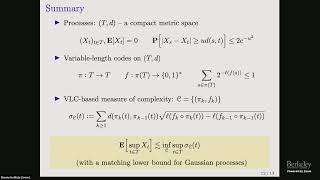
Majorizing Measures, Codes, and Information
Explore the connections between majorizing measures, coding theory, and information theory in machine learning, with insights from Maxim Raginsky.
A -Con-Sequential View of Information for Statistical Learning and Optimization
Explore information-theoretic approaches to statistical learning and optimization, focusing on sequential methods for improved trustworthiness in machine learning.
Improving Accuracy-Privacy Tradeoff via Model Reprogramming
Explore innovative techniques for enhancing the balance between model accuracy and data privacy through advanced model reprogramming strategies.
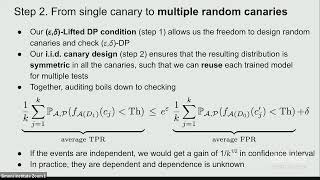
Fundamental Trade-Offs in FL-FA - Sparsity - DP - Communication Constraints
Explore trade-offs in federated learning, focusing on sparsity, differential privacy, and communication constraints. Gain insights into balancing these factors for effective machine learning.
Train a PyTorch Neural Network Step-by-Step - PyTorch Deep Learning
Learn to build and train a PyTorch neural network for image classification, achieving 85% accuracy on Fashion MNIST. Covers data preparation, network architecture, loss functions, optimization, and model visualization.

PyTorch Datasets, DataLoaders and Transforms - GPU Series Part 3
Explore PyTorch's data handling tools: Datasets, DataLoaders, and Transforms. Learn to prepare, visualize, and optimize data for GPU-accelerated deep learning using Fashion-MNIST dataset.