On the Foundations of Deep Learning - SGD, Overparametrization, and Generalization
Explore foundations of deep learning, focusing on SGD, overparametrization, and generalization. Delve into optimization dynamics, margin theory, and the impact of network architecture on performance.
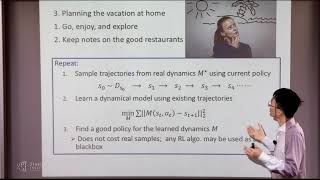
Practical Model-Based Algorithms for Reinforcement Learning and Imitation Learning
Explore efficient model-based algorithms for reinforcement and imitation learning, addressing challenges in learning dynamics and uncertainty, with practical examples and evaluations.
Nearest Neighbors I
Explore nearest neighbor algorithms in machine learning, covering regression, classification, consistency, and convergence rates in metric spaces. Gain insights into statistical learning frameworks and smoothness conditions.
Generalization I
Explore deep learning generalization with experts Peter Bartlett and Sasha Rakhlin, covering perceptron algorithms and key concepts in machine learning theory.
K-Means and K-Medians Under Dimension Reduction
Explore k-means and k-medians clustering algorithms under dimension reduction, examining distortion graphs, cost analysis, and combinatorial lemmas for robust high-dimensional statistics.
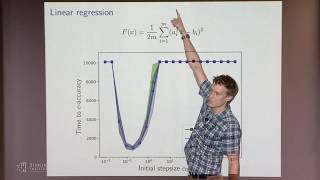
The Importance of Better Models in Stochastic Optimization
Explore stochastic optimization models, focusing on robustness, stability, and asymptotic minimax theory. Learn about weak convexity, sharp growth problems, and practical experiments.
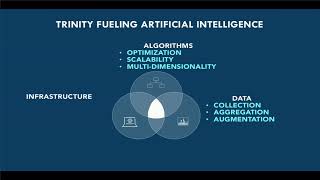
The AI Trinity - Data + Algorithms + Infrastructure
Explore the AI trinity: data, algorithms, and infrastructure. Learn about named entity recognition, active learning, crowdsourcing, data augmentation, and neural rendering models.
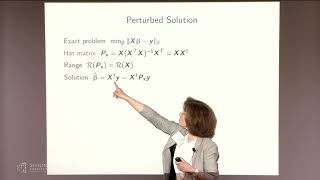
Randomized Least Squares Regression - Combining Model- and Algorithm-Induced Uncertainties
Explore randomized least squares regression, combining model and algorithm uncertainties for improved statistical analysis and numerical linear algebra applications.

The Future of Wireless and What It Will Enable
Explore the future of wireless technology, its potential, and innovative approaches like millimeter waves, small cells, and software-defined networks to overcome current limitations.
First-Order Stochastic Optimization
Explore first-order stochastic optimization techniques for machine learning, covering gradient descent, adaptive learning, and convergence rates in data science applications.
A Classical Algorithm Framework for Dequantizing Quantum Machine Learning
Explore dequantization of quantum machine learning algorithms, focusing on classical techniques for approximating quantum linear algebra and their implications for QML speedups.
How Hard Is It to Train Variational Quantum Circuits?
Explores challenges in training variational quantum circuits, comparing them to classical neural networks and examining quantum generative models, with a focus on robust training methods and circuit compression.
Flexible Neural Networks and the Frontiers of Meta-Learning
Explore cutting-edge approaches in meta-learning and flexible neural networks for rapid skill acquisition in AI agents, with applications in few-shot image classification and real-world scenarios.
Studying Generalization in Deep Learning via PAC-Bayes
Explore PAC-Bayes theory's application to deep learning generalization, focusing on risk bounds, optimal priors, and SGD prediction for neural networks.
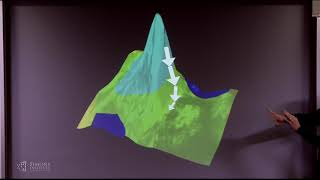
Lessons Learned from Evaluating the Robustness of Defenses to Adversarial Examples
Explore robustness of AI defenses against adversarial examples, evaluating threat models and defense strategies to improve security in deep learning systems.
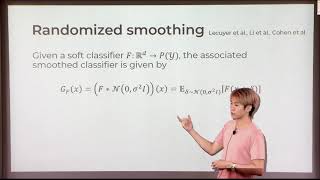
Provably Robust Deep Learning via Adversarially Trained Smoothed Classifiers
Explore adversarially trained smoothed classifiers for robust deep learning, covering theory, implementation, and experimental results in this technical talk.
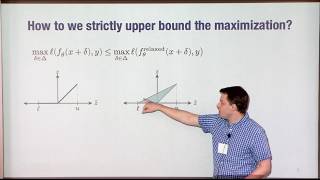
Provable Robustness Beyond Bound Propagation
Explore adversarial robustness in deep learning, focusing on randomized smoothing as a defense strategy and its theoretical guarantees for certified robustness.
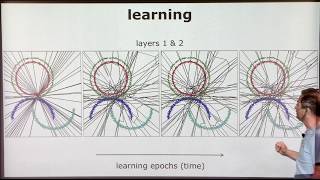
Mad Max - Affine Spline Insights into Deep Learning
Explore deep learning through spline theory, focusing on max-affine splines and their role in neural networks, data memorization, and network complexity.
Computation in Very Wide Neural Networks
Explore infinite-width neural networks, their correspondence to Gaussian processes, and implications for deep learning performance and dynamics in parameter space.
Training on the Test Set and Other Heresies
Explore unconventional approaches to machine learning, challenging traditional wisdom on generalization, model size, and dataset usage in deep learning research.
Representation Learning of Grounded Language and Knowledge - With and Without End-to-End Learning
Explore representation learning for grounded language and knowledge, covering end-to-end learning, procedural language challenges, and applications in cooking instructions and dialogue generation.