
Self-Supervised Learning in Computer Vision
Explore advanced self-supervised learning techniques in computer vision, including PIRL, SwAV, AVID+CMA, and Barlow Twins, to enhance your understanding of representation learning and model training.

Unsupervised Learning - Autoencoding the Targets
Explore unsupervised learning and generative models, covering topics like latent space interpolation, style transfer, super resolution, and autoencoders. Gain insights into advanced machine learning concepts and techniques.

Latent Variable Energy Based Models - Inference
Explore Latent Variable Energy Based Models and inference techniques, focusing on energy functions, manifold generation, and free energy computation in unconditional cases.
Tools, Classification with Neural Nets, PyTorch Implementation
Explore neural network classification, PyTorch implementation, and advanced concepts like space-fabric stretching and regression uncertainty estimation in this comprehensive tutorial.
Supervised and Self-Supervised Transfer Learning With PyTorch Lightning
Explore supervised and self-supervised transfer learning techniques using PyTorch Lightning, comparing their implementation, training, and generalization capabilities in deep learning applications.
Structured Prediction with Energy Based Models
Explore energy-based models for structured prediction, covering factor graphs, efficient inference, Graph Transformer Networks, loss functions, and variational inference in deep learning applications.
Deep Learning for Natural Language Processing
Explore NLP architectures, transformers, language models, and advanced techniques for text generation and embedding learning in this comprehensive deep learning lecture.
PyTorch Activation and Loss Functions
Explore activation and loss functions in PyTorch, including kink vs. smooth activations, margin-based losses, and designing effective loss functions for Energy-Based Models (EBMs).
Self-Supervised Learning in Computer Vision
Explore self-supervised learning in computer vision, covering pretext tasks, clustering, and contrastive learning. Gain insights into PIRL framework and its evaluation across various applications.

Group Sparsity, World Model, and Generative Adversarial Networks
Explore advanced deep learning concepts: sparse auto-encoders, world models for autonomous control, and generative adversarial networks (GANs). Gain insights into cutting-edge AI techniques and their applications.
Contrastive Methods and Regularised Latent Variable Models
Explore contrastive methods and regularized latent variable models in energy-based models, covering self-supervised learning, autoencoders, sparse coding, and variational techniques for advanced machine learning applications.
Energy Based Models and Self-Supervised Learning
Explore energy-based models, latent variables, and self-supervised learning. Dive into EBM training, inference, and comparison with probabilistic models. Discover contrastive methods and applications like K-means and BERT.
Optimisation
Explore optimization techniques for neural networks, including gradient descent, SGD, momentum, adaptive methods, and normalization layers, with real-world applications in MRI technology.
Convolutional Neural Networks
Explore convolutional neural networks, from basic concepts to modern implementations. Learn about kernels, biological inspirations, CNN evolution, and their advantages in image processing and feature extraction.
Stochastic Gradient Descent and Backpropagation
Explore stochastic gradient descent, backpropagation, and neural network implementation in PyTorch. Learn practical tricks, basic modules, and gradient computation for effective deep learning.
History, Motivation, and Evolution of Deep Learning
Explore the history, motivation, and evolution of deep learning, covering key concepts like gradient descent, backpropagation, CNNs, and feature extraction in neural networks.

CNN Loss
Explore convolutional neural network loss functions, including mean square error, cross-entropy, and negative log likelihood, with practical examples and implementation insights.

YC Tech Talks - Machine Learning
Explore ML startups through tech talks on recommendation models and 3D RL simulators, followed by pitches from innovative companies in the field. Gain insights into cutting-edge ML applications and career opportunities.

CS480-680 - K-Nearest Neighbours
Learn about k-nearest neighbours algorithm for classification and regression, including examples, machine learning concepts, and accuracy considerations.
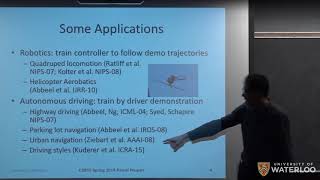
Inverse Reinforcement Learning
Explore inverse reinforcement learning, transfer learning, and apprenticeship learning techniques to uncover underlying reward functions and improve AI decision-making processes.
Feudal Networks for Hierarchical RL
Explore hierarchical reinforcement learning with FeUdal Networks, covering architecture, results, and applications in complex environments like Water Maze.