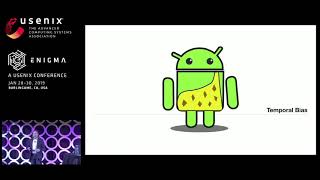
When the Magic Wears Off - Flaws in Machine Learning for Security Evaluations
Explores biases in machine learning for malware classification, proposing constraints and metrics for realistic evaluation. Introduces TESSERACT framework to improve classifier performance and ensure fair comparisons.

Moderating End-to-End Encrypted Content - Balancing Privacy and Control
Exploring end-to-end encryption challenges, balancing privacy with content moderation needs. Proposes user-centric definitions and analyzes improvement strategies to maintain security while enhancing user experience.

Gaming for Military Precision Decisions - Simon Lucas
Explore how Game AI and statistical forward planning algorithms can enhance military decision-making and operational planning, with insights from Simon Lucas.
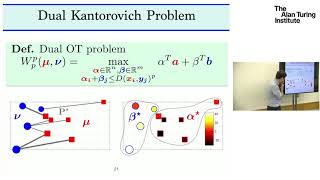
Optimal Transport for Machine Learning - Gabriel Peyre, Ecole Normale Superieure
Explore optimal transport in machine learning, covering Kantorovitch's formulation, entropic regularization, and applications in generative models and GANs. Gain insights into cutting-edge advances in data science.
The Mother of All Representer Theorems for Inverse Problems and Machine Learning - Michael Unser
Explore the mathematical foundations of inverse problems and machine learning, focusing on representer theorems, Banach spaces, and kernel methods for advanced data science applications.
Clustering and Classification From the Core to the Edge - Thomas Strohmer, California University
Explore unsupervised learning, spectral clustering, and edge AI through diffusion maps, graph cuts, and compressive techniques. Gain insights into data shape, community detection, and on-device machine learning challenges.
Approximation with Deep Networks - Remi Gribonval, Inria
Explore deep network approximation, focusing on expressivity, universal properties, sparse networks, and the impact of network architecture and activation functions on performance.
Learning How to Learn Efficiently - Nando de Freitas, DeepMind
Explore efficient learning techniques for neural networks to solve multiple tasks with limited data, focusing on developing adaptable "prior" networks for rapid task-specific learning.
Glimpsing Our AI Future - Howard Covington, The Alan Turing Institute
Explore AI's impact on industries, economies, and society with insights on technological advancements, global competition, and ethical considerations in this forward-looking talk.

Making Machines That See - Geometry, Uncertainty and Deep Learning
Explore computer vision advancements, from 3D object reconstruction to real-time deep learning systems incorporating geometry and uncertainty, with applications in robotics and mobile technology.
Language Learning in Humans and Machines - Making Connections to Make Progress
Exploring connections between human and machine language learning to develop better computational methods for understanding and processing diverse languages.
Counterfactual Fairness
Explore causal inference tools for modeling fairness in machine learning, addressing bias and ensuring equitable decisions across demographic groups.
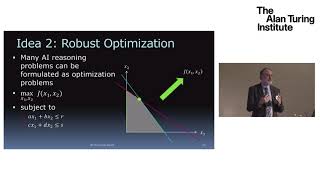
Steps Toward Robust Artificial Intelligence - Thomas G Dietterich, Oregon State University
Explore methods for developing robust AI systems capable of handling known and unknown threats in high-stakes applications, including probabilistic inference, anomaly detection, and causal modeling.
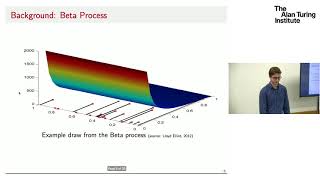
Poisson Random Fields for Dynamic Feature Models
Explore dynamic feature allocation models using Poisson random fields. Learn about the Wright-Fisher Indian Buffet Process and its application to topic modeling for time-stamped documents, with a focus on NIPS papers.
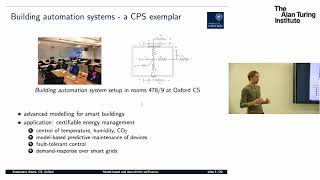
Formal Verification and Learning of Complex Systems - Professor Alessandro Abate
Exploring formal verification techniques for complex systems, combining model-based and data-driven methods to address scalability issues and provide system-level assertions in Cyber-Physical Systems.
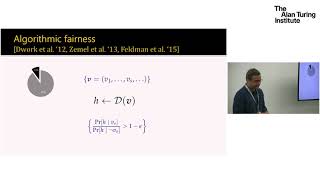
Fairness and Robustness in Machine Learning – A Formal Methods Perspective - Aditya Nori, Microsoft
Explore fairness in machine learning through formal methods. Learn techniques for verifying probabilistic properties and certifying fairness in decision-making programs using FairSquare.
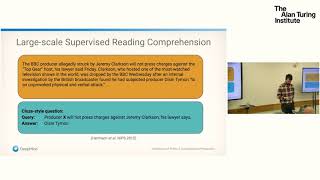
Recurrent Neural Networks and Models of Computation - Edward Grefenstette, DeepMind
Exploring recurrent neural networks and memory-enhanced architectures, analyzing their computational capabilities and efficiency in relation to traditional models of computation.

Multilevel Weighted Least Squares Polynomial Approximation – Sören Wolfers, KAUST
Explore multilevel weighted least squares polynomial approximation for high-dimensional function reconstruction, addressing the curse of dimensionality and leveraging structural assumptions for improved accuracy.
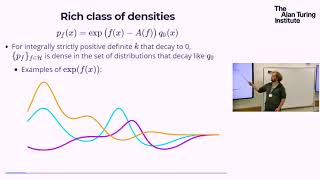
Score Estimation with Infinite-Dimensional Exponential Families – Dougal Sutherland, UCL
Explore score estimation in infinite-dimensional exponential families, covering reproducing kernel Hilbert spaces, maximum likelihood, and Nystrom approximation. Includes theoretical overview and experimental results.
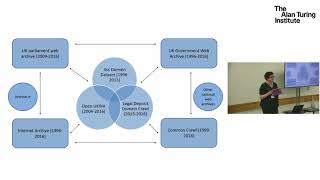
Small Data and Big Data - Web Archives and Research in the Humanities
Explore web archives' potential for humanities research, examining challenges and opportunities in using digital collections to study social and cultural phenomena.
Regularization for Optimal Transport and Dynamic Time Warping Distances - Marco Cuturi
Explore regularization techniques for optimal transport and dynamic time warping distances, focusing on smoothing strategies to enhance machine learning applications and Fréchet mean computation.