
Building Machine Learning-Powered Applications with JavaScript
Explore techniques for building ML-powered applications using JavaScript, from fully abstracted to customized solutions. Learn tools, services, and packages for implementing ML in JS environments.

U.S. Healthcare with AI: Cost Transparency and Affordability - Conf42 KN 2024
Explore AI-driven solutions for healthcare cost transparency, addressing challenges and showcasing an innovative platform's features, benefits, and future potential in the U.S. healthcare system.

The Role of AI in Transforming Dialysis Healthcare
Explore AI's transformative impact on dialysis healthcare, from predictive analytics to personalized treatments and operational efficiency. Gain insights into remote monitoring, machine maintenance, and future directions.

Exploring AI-Powered Chatbots and Their Transformative Role in Platform Engineering
Descubre cómo los chatbots impulsados por IA transforman la ingeniería de plataformas, explorando beneficios, casos de uso, arquitectura, desafíos y tendencias emergentes.

Building ML-Enhanced Event Streaming Apps with Java Microservices
Explore building ML-enhanced event streaming applications using Java microservices and Apache Pulsar. Learn about Pulsar's architecture, functions, and programming model through a practical coding demo.
A Hitchhiker's Guide to the MLOps Experience
Explore MLOps essentials: data versioning, visualizations, experiment tracking, and model registry. Learn key components and UX tips for streamlining machine learning workflows.

Introduction to MLOps at the Edge
Explore MLOps at the edge: benefits, challenges, and real-world applications. Learn about edge computing's advantages over cloud and its synergy with AI and cloud technologies.

AI-Driven DevOps CI/CD Pipelines
Explore AI-driven DevOps CI/CD pipelines, enhancing software delivery efficiency and automation through innovative technologies and best practices.

Lower Bounds for Possibly Divergent Probabilistic Programs
Explore a new proof rule for verifying lower bounds on quantities of probabilistic programs, applicable to possibly divergent programs and non-trivial cases like three-dimensional random walks.

Turaco: Complexity-Guided Data Sampling for Training Neural Surrogates of Programs
Explore a novel methodology for sampling datasets to train neural network-based program surrogates, focusing on complexity-guided sampling for improved accuracy in real-world applications.

A Gradual Probabilistic Lambda Calculus
Explore a gradual probabilistic lambda calculus combining static and dynamic typing for probabilistic programming, enhancing flexibility in machine learning and differential privacy applications.

A Deductive Verification Infrastructure for Probabilistic Programs
Explore a novel deductive verification infrastructure for probabilistic programs, featuring an intermediate verification language and real-valued logic for quantitative property verification.

Data Extraction via Semantic Regular Expression Synthesis
Explore semantic regexes for advanced data extraction, combining syntactic and semantic reasoning. Learn about a novel algorithm synthesizing these regexes from minimal examples.
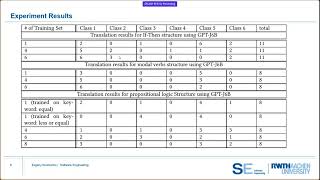
Neural Language Models and Few-Shot Learning for Systematic Requirements Processing in Model-Driven Software Engineering
Explore neural language models and few-shot learning for efficient processing of automotive engineering requirements in model-driven software engineering.

Automatic Differentiation - Session Preview at POPL 2023
Explore automatic differentiation techniques and their applications in programming languages, presented by expert Sasa Misailovic at POPL 2023.

Probabilistic Inference - Session Preview at POPL 2023
Explore probabilistic inference concepts with expert Alexandra Silva in this POPL 2023 session preview, enhancing accessibility of advanced programming language topics.

Synthesizing Precise Static Analyzers for Automatic Differentiation
Explore Pasado, a technique for synthesizing precise static analyzers for Automatic Differentiation, improving precision in nonlinear operations and demonstrating applications in various domains.

Languages with Decidable Learning: A Meta-theorem
Explore finite-aspect checkable languages and their role in decidable learning, connecting expression syntax tree evaluation to finite tree automata for new learning results.

Deep Learning Robustness Verification for Few-Pixel Attacks
Explore a novel L0 robustness verifier for neural networks, addressing few-pixel attacks through dynamic programming, sampling, and covering designs to enhance verification efficiency.

WheaCha: An Explanation Method for Models of Code
Explore WheaCha, a novel method for explaining code model predictions by separating input programs into 'wheat' and 'chaff', demonstrating its efficiency and usefulness in identifying defective models.

Mixed and Verified Consistency with Propel and ConOpY
Explore mixed consistency in distributed systems using ConOpY language and Propel type system for verifying CRDTs, enhancing data replication and local-first applications.