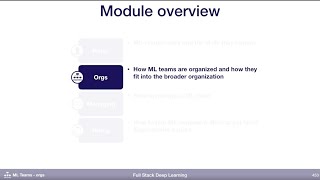
Orgs - ML Teams - Full Stack Deep Learning
Explore ML team structures in organizations, from nascent to ML-first, covering key aspects like software engineering, data ownership, and model deployment responsibilities.

Xavier Amatriain on Practical Deep Learning Systems - November 2019
Practical insights on deep learning systems, covering data handling, model selection, architecture engineering, and real-world implementation challenges in various domains.
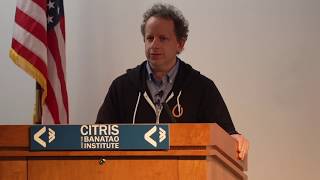
Jeremy Howard on Platform.ai and Fast.ai - Full Stack Deep Learning - March 2019
Explore machine learning innovations with Jeremy Howard, covering data labeling, deep learning successes, and insights from Fast.ai and Platform.ai for effective AI development.

Troubleshooting Deep Neural Networks - Full Stack Deep Learning - March 2019
Learn effective strategies for diagnosing and fixing issues in deep neural networks, including a decision tree for systematic troubleshooting and performance optimization.

Data Management - Full Stack Deep Learning - March 2019
Explore data management essentials: labeling, storage, versioning, and processing. Learn about data flywheels, annotation techniques, and efficient workflows for deep learning projects.

Machine Learning Teams - Full Stack Deep Learning - March 2019
Explore AI talent challenges, ML roles, team structures, and hiring strategies for building effective machine learning teams in today's competitive landscape.

Lukas Biewald on Founding Weights & Biases and FigureEight - Full Stack Deep Learning - March 2019
Insights from AI industry pioneer on founding data labeling and ML tools companies, exploring challenges, breakthroughs, and the future of machine learning applications.

Tracking Experiments - Full Stack Deep Learning - March 2019
Learn to track deep learning experiments using Weights & Biases for a text recognizer project, enhancing your model development workflow and results analysis.

Infrastructure and Tooling - Full Stack Deep Learning - March 2019
Explore infrastructure and tooling for deep learning projects, covering GPU machines, experiment tracking, and all-in-one solutions like AWS SageMaker.

Setting Up Machine Learning Projects - Full Stack Deep Learning - March 2019
Learn best practices for planning and setting up machine learning projects, including prioritizing projects, choosing metrics, and creating baselines. Gain insights into the lifecycle of ML projects and practical examples.
Efficient AutoML with Ludwig, Ray, and Nodeless Kubernetes
Explore efficient AutoML using Ludwig and Ray, leveraging heuristics for model production. Learn how Nodeless Kubernetes optimizes GPU resource management, reducing costs in cloud environments.
Component Registry for Kubeflow Pipelines
Explore a component registry for Kubeflow Pipelines, enhancing ML workflow collaboration on Kubernetes. Learn how shared components can streamline common tasks and improve efficiency in machine learning projects.
Debugging Machine Learning on the Edge with MLExray
Explore MLExray for efficient debugging of edge-deployed machine learning models, covering benefits, deployment challenges, and practical demonstrations.
Computer Vision Dog Breed Classification with Convolutional Neural Networks, TensorFlow and Kubeflow
Develop a dog breed classification system using TensorFlow, Kubeflow, and convolutional neural networks. Compare AI predictions with DNA results for accuracy.
Efficient Deep Learning Training with Ludwig AutoML, Ray, and Nodeless Kubernetes
Explore efficient deep learning training using Ludwig AutoML and Ray on nodeless Kubernetes, optimizing GPU resource management for cost-effective and scalable model development.
Building an ML Inference Platform with Knative - Serverless Containers on Kubernetes
Leveraging Knative for scalable ML inference platforms: simplifying deployment, enabling serverless containers, and optimizing performance for production-ready machine learning applications.
MLExray - Observability for Machine Learning on the Edge
Explore MLExray, an open-source framework for debugging ML models on edge devices. Learn to identify and solve common deployment issues, ensuring optimal performance across diverse environments.

Volcano: Introduction and Deep Dive into High-Performance Workload Management on Kubernetes
Explore Volcano: a powerful batch scheduling system for high-performance workloads on Kubernetes. Learn key concepts, features, and real-world use cases for ML/DL, big data, and bioinformatics applications.
Exploring ML Model Serving with KServe - Features and Use Cases
Discover KServe's ML model deployment capabilities, from basic serving to advanced features like inference graphs and ModelMesh, enhancing efficiency for data scientists and engineers.
A Deep Dive into Kubeflow Pipelines
Explore Kubeflow Pipelines' architecture and components for executing cloud-native ML workflows on Kubernetes. Gain insights into the platform's inner workings and integration of ML pipeline elements.

Alerting and Anomaly Detection - Best Friends Forever?
Explore the relationship between alerting and anomaly detection in monitoring systems, discussing their strengths, limitations, and optimal integration for effective system management.