The Art of Text to Vector Transformation - A Comprehensive Look at AI and NLP Transformers
Dive into the fundamentals of converting text to mathematical vectors, understanding tokenization methods like BERT and BPE for NLP applications and AI transformer models.
Running Flan-T5-XL Model on Google Colab - A Free Self-Explaining Language Model
Discover how to implement and optimize the Flan-T5-XL language model on Google Colab, exploring its capabilities in reasoning, essay writing, and translation tasks while working within free resource constraints.
Train a Domain-Specific BERT Tokenizer Using SBERT - Part 50
Master BERT tokenizer training for scientific domains using SBERT, focusing on byte-pair encoding and specialized pre-training for complex domain-specific knowledge like bio-pharmacological content.
Domain-Specific AI Models - Creating Customized BERT and SBERT Models for Business Applications
Discover how to effectively train and fine-tune BERT and SBERT models for specialized domains, focusing on medical and biochemical terminology, with practical solutions for business applications.
Feature Vectors - Understanding BERT and SBERT Transformer Models
Dive into feature vectors and their crucial role in BERT and SBERT transformer models, exploring vectorization techniques, Python implementation, and practical applications in NLP.

Panoptic Image Segmentation - Understanding Mask2Former
Dive into Mask2Former's universal approach to image segmentation, covering instance, semantic, and panoptic segmentation techniques with practical examples and implementations.
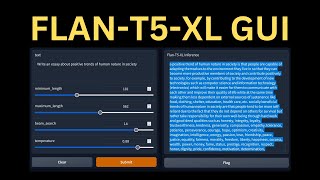
Building a FLAN-T5 XL Model GUI with Gradio in Google Colab - A Step-by-Step Tutorial
Learn to build a Gradio GUI for FLAN-T5-XL model on Google Colab, enabling free text generation, summarization, and translation capabilities with minimal computational resources and step-by-step implementation.
On the Role of Entanglement and Statistics in Learning in Quantum Statistical Query Models
Delve into quantum statistical query models and explore the intricate relationships between learning systems using entangled, separable, and statistical measurements in quantum computing.
Classical Verification of Quantum Learning
Explore the verification framework enabling classical clients to reliably delegate learning tasks to quantum servers, focusing on parity learning and Fourier-sparse functions with mixture-of-superpositions examples.
Proper vs Improper Quantum PAC Learning
Explore quantum PAC learning theory through a comparative analysis of proper and improper learning methods, focusing on the Quantum Coupon Collector problem and its padded variant.
Provable Advantage in Quantum PAC Learning
Discover groundbreaking research on quantum PAC learning, exploring provable advantages over classical methods with square root improvements in sample complexity and theoretical quantum information science.

Building a RAG Movie Recommendations Chatbot with Qdrant and n8n - No-Code Tutorial
Learn to build a personalized movie recommendation chatbot using RAG technology, Qdrant Cloud, and n8n's AI starter kit - no coding needed. Create custom filters for genres, themes, and preferences.
Learning Low-Degree Quantum Objects
Dive into theoretical quantum information science through an exploration of low-degree quantum objects, featuring cutting-edge research presented at the prestigious TQC 2024 conference in Japan.
Information-Theoretic Generalization Bounds for Quantum Learning
Explore a unified mathematical framework for quantum learning theory, covering state discrimination, PAC learning, and generalization bounds using quantum mutual information and optimal transport concepts.
Parity vs. AC0 with Simple Quantum Preprocessing
Delve into quantum computation theory exploring the limitations of QNC0 and AC0 circuits in computing parity functions, with insights into decision tree complexity and nonlocal channels.
Sample-Efficient Constrained Reinforcement Learning with General Parameterized Policies
Delve into advanced reinforcement learning concepts with Dr. Mondal as he explores sample-efficient algorithms for Constrained Markov Decision Processes, focusing on parameterized policies and practical applications.
Risk-Sensitive Bandits - Arm Mixtures Optimality and Regret-Efficient Algorithms
Delve into risk-aware sequential decision-making through distortion riskmetrics, exploring optimal arm mixture strategies and new algorithms for tracking these mixtures in multi-armed bandit problems.
Closed-form Analytic Expressions for Shadow Estimation with Brickwork Circuits
Explore closed-form analytical expressions for quantum shadow estimation using brickwork circuits, focusing on two-layer parallel two-local Haar-random unitaries and their practical implementations.
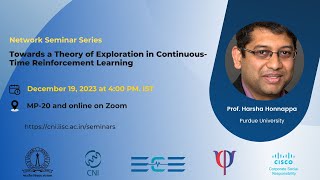
Towards a Theory of Exploration in Continuous-Time Reinforcement Learning
Delve into advanced theoretical frameworks for continuous-time reinforcement learning, exploring relaxed controls and rough path theory for modeling exploration processes in stochastic environments.
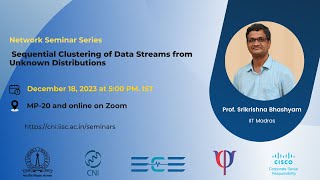
Sequential Clustering of Data Streams from Unknown Distributions
Explore sequential nonparametric clustering techniques for data streams, focusing on universal tests that efficiently group streams based on distribution proximity, with applications in statistical analysis.
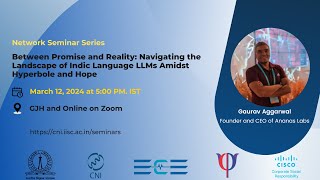
Between Promise and Reality - Navigating the Landscape of Indic Language LLMs Amidst Hyperbole and Hope
Explore the current state, challenges, and real-world implications of Indic language LLMs, separating ambitious claims from actual achievements in linguistic AI development.