Upscaling High-Resolution Core-Based Facies to Basin-Scale Stratigraphic Models
Learn to integrate core-based datasets with wireline logs using machine learning for upscaling high-resolution facies to basin-scale stratigraphic models in the Delaware Basin's Third Bone Spring Sand and Wolfcamp units.
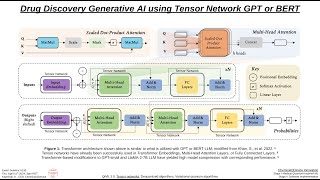
Drug Discovery Generative AI Using Tensor Network GPT or BERT
Explore generative AI applications in drug discovery using GPT and BERT models, focusing on ProtGPT2 for protein sequence generation and ProtBert for protein structure analysis.
Can LLMs Help Researchers Automate Individual Disease Drug Design?
Explore how Large Language Models enhance drug discovery through molecular simulation, reaction prediction, and database interaction for individual disease treatments.
Myriad LLM Approaches to Drug Discovery Generative Artificial Intelligence
Explore diverse LLM approaches in drug discovery GenAI, empowering medicinal chemists to enhance the process through informed prompts and molecule generation techniques.
Seismic Velocity and Depth Conversion
Explore seismic velocity and depth conversion techniques in petroleum engineering, enhancing geological interpretation and petrophysical analysis skills.
Modelling Physical Phenomena in Alloys and Polymers with Quantum Mechanical Accuracy
Explore data-driven interatomic potentials and Hyperactive Learning for modeling alloys and polymers with quantum accuracy. Gain insights into precipitate formation and chemical ordering.
Combinatorial Quantization and BV Structures of Moduli of Flat Connections - Part 1
Explore quantization of moduli spaces through combinatorial methods and BV structures, focusing on flat connections in mathematical physics.
Quantum Analytic Langlands - Quantisation of Moduli Spaces
Explore quantisation of moduli spaces through diverse perspectives, delving into the intricacies of Quantum Analytic Langlands theory.
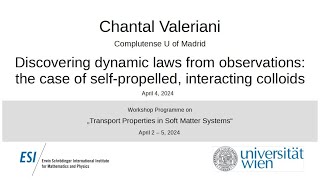
Discovering Dynamic Laws from Observations: The Case of Self-Propelled Particles
Explore machine learning techniques for uncovering forces in active matter systems, from cellular to animal scales. Learn to extract local dynamics crucial for understanding collective phenomena.
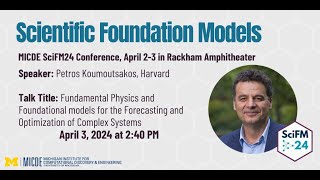
Fundamental Physics and Foundational Models for the Forecasting and Optimization of Complex Systems - Lecture 12
Explore fundamental physics and foundational models for forecasting and optimizing complex systems, enhancing your understanding of advanced scientific concepts.
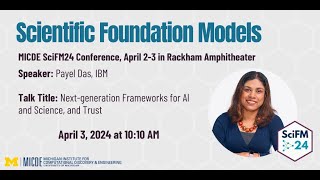
Next-generation Frameworks for AI and Science, and Trust - Lecture 8
Explore next-gen AI frameworks in science, examining their potential benefits, safety concerns, and trust mechanisms through recent advancements and scientific applications.
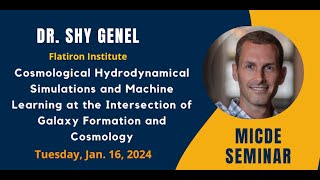
Cosmological Hydrodynamical Simulations and Machine Learning in Galaxy Formation and Cosmology
Explore cosmological hydrodynamical simulations and machine learning applications in galaxy formation and cosmology. Gain insights into extracting cosmological information from non-linear processes.
AI Foundation Models for Materials Science
Explore AI foundation models' applications in materials science, focusing on advancements and potential breakthroughs in the field.
Does Having a Big Brain Make You Smarter?
Explore the mathematical approach to brain size and intelligence, examining scaling laws and statistical principles in humans and animals to uncover connections between brain size and cognitive abilities.
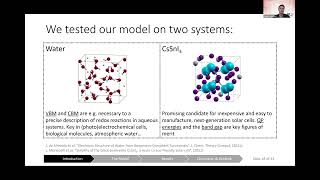
Accelerating the Calculation of Koopmans Screening Parameters Using Machine Learning
Accelerate Koopmans screening parameter calculations with machine learning techniques in Quantum ESPRESSO, enhancing efficiency in computational materials science.
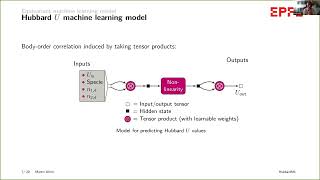
Accelerating the Calculation of Hubbard Parameters Using Machine Learning - QE Tutorial 2022
Learn advanced techniques for accelerating Hubbard parameter calculations in Quantum ESPRESSO using machine learning, with a focus on linear response methods and transferability.
Chemical Foundation Models for Drug Discovery
Explore chemical foundation models for drug discovery, focusing on innovative approaches and potential breakthroughs in pharmaceutical research.
Learning the Language of Chemistry
Explore chemical language through AI, focusing on molecular transformations and retrosynthesis. Gain insights into cutting-edge applications in organic synthesis.
Protein Design Workflows Employing Reinforcement Learning and Preference Optimization - Tutorial 4
Explore protein design workflows using reinforcement learning and preference optimization techniques for advanced molecular engineering.
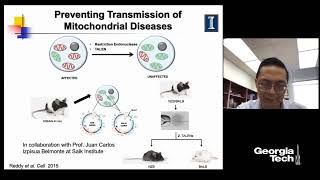
Challenges and Opportunities at the Nexus of Synthetic Biology, Machine Learning, and Automation
Explore challenges and opportunities at the intersection of synthetic biology, machine learning, and automation for rapid prototyping and manufacturing of biological systems in bioproduct synthesis.
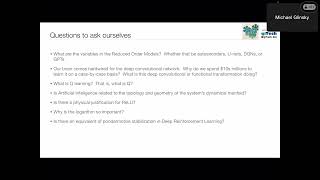
A Physics-Based Reduced Order Model Capturing the Topology of Dynamical Manifolds
Explore a transformational approach to dynamics using the Heisenberg Scattering Transformation, applied to create fast surrogate models for 2D pulsed power liner implosions in MagLIF.