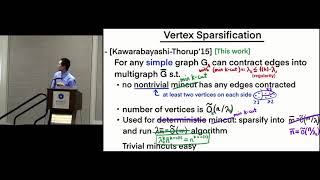
Faster Minimum k-cut of a Simple Graph
Explore efficient algorithms for finding minimum k-cuts in simple graphs, improving computational speed and complexity for graph partitioning problems.
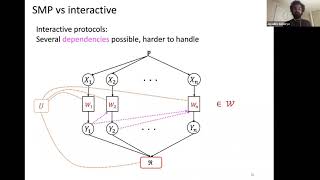
Cookbook Lower Bounds for Statistical Inference in Distributed and Constrained Settings - Part 2
Explore advanced statistical inference techniques for distributed and constrained environments, focusing on lower bounds and their applications in complex data analysis scenarios.
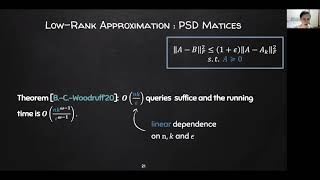
Robust and Sample Optimal Algorithms for PSD Low-Rank Approximation
Explore efficient algorithms for positive semidefinite low-rank approximation, focusing on robustness and sample optimality in matrix computations.
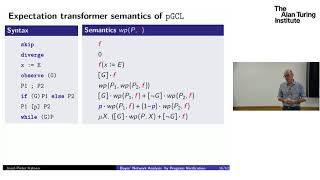
Bayesian Inference by Program Verification - Joost-Pieter Katoen, RWTH Aachen University
Explore Bayesian inference through program verification, learning how weakest precondition reasoning can be applied to exact inference and analyzing expected sampling times in Bayesian networks.

Concentration of Tempered Posteriors and of Their Variational Approximations – Pierre Alquier
Explores concentration of tempered posteriors and variational approximations in high-dimensional function reconstruction, addressing challenges in approximation theory and non-parametric regression.
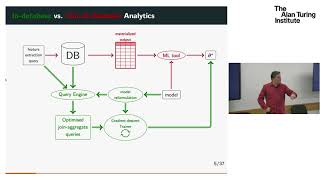
In-Database Factorised Learning - Professor Dan Olteanu
Explore in-database factorised learning techniques for efficient data analysis and machine learning, covering integration approaches, advantages, and practical applications in relational databases.
Structured Dynamic Graphical Models & Scaling Multivariate Time Series
Explore advanced Bayesian methods for multivariate time series forecasting, focusing on scalability and model complexity. Learn about dynamic dependency networks and graphical dynamic linear models with real-world applications.
Statistics for Data Analysis with Exercises - Case 2: Normalization Error - Lecture 4
Explore normalization errors in statistical data analysis through practical exercises, enhancing your skills in handling and interpreting complex datasets for high-energy physics research.
Statistics for Data Analysis with Exercises - Lecture 1
Comprehensive introduction to statistical methods for data analysis in high-energy physics, covering fundamental concepts and practical applications through exercises and examples.
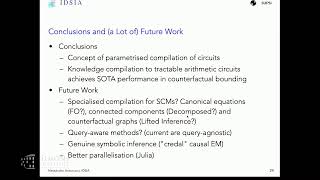
Tractable Bounding of Counterfactual Queries by Knowledge Compilation
Explores bounding partially identifiable queries in causal models using knowledge compilation, offering computational advantages for inference in Bayesian networks with shared structures.
Sketching and Projecting
Explore sketching and projecting methods for linear systems and linear discriminant analysis, focusing on stochastic gradient approaches to achieve efficient solutions with reduced computational burden.

Variational Bayesian Approximation of Inverse Problems Using Sparse Precision Matrices
Explore Variational Bayes as an efficient alternative to MCMC for solving inverse problems in PDEs, using sparse precision matrices and stochastic optimization for improved computational tractability.
Uncertainty Quantification with Physics-Informed Machine Learning
Exploring uncertainty quantification in physics-informed machine learning, focusing on architecture and learning approaches for scientific applications and complex real-world phenomena.

PECANNs - Physics and Equality Constrained Artificial Neural Networks
Innovative approach to physics-informed neural networks using constrained optimization, addressing hyperparameter challenges and improving accuracy for scientific applications involving multi-dimensional PDEs.
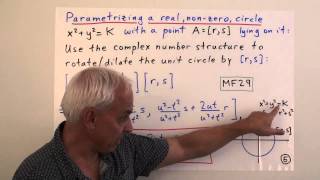
The Projective Line, Circles and the CQQ Theorem - Part 2
Explores advanced geometry concepts including general circles, complex numbers, and the Cyclic Quadrilateral Quadrea theorem, emphasizing projective parametrization and transformations in the complex plane.
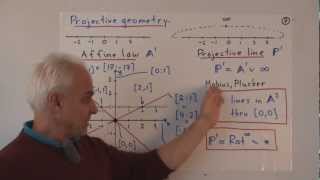
Extended Rational Numbers in Practice - Real Numbers and Limits
Explore extended rational numbers, their applications in mathematics, and connections to projective geometry. Gain insights into graphing polynomials, parametrizing circles, and visualizing infinity in novel ways.
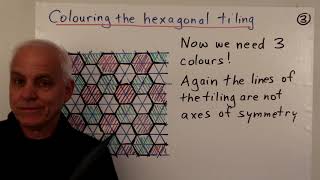
Regular Colourings of Regular Tilings - Elementary Mathematics K-6 Explained - Lecture 39
Explore symmetry and patterns through regular colourings of plane tilings. Learn about reflection, translation, and rotation while creating visually pleasing designs. Ideal for developing spatial awareness and creativity in young learners.
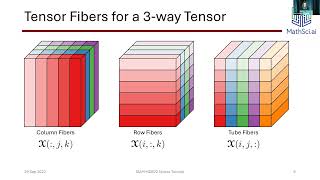
Tensor Decompositions - A Quick Tour of Illustrative Applications
Explore tensor decompositions for data analysis and dimensionality reduction. Learn fundamentals, applications in various fields, and hands-on examples using real-world datasets.
Mathematics at the Roots: Empowering Agriculture with Artificial Intelligence
Explore how AI revolutionizes agriculture, enhancing crop yields and sustainability through data-driven insights and innovative mathematical models.

Probabilistic Methods in Hyperbolic Geometry
Explore probabilistic approaches to solve geometric and topological questions in hyperbolic manifolds, bridging mathematics domains through innovative analytical techniques.

Complexity of Sparse Linear Regression
Explore new methods for solving sparse linear regression, overcoming limitations of traditional approaches and exploiting structural properties of covariance matrices in machine learning and statistics.