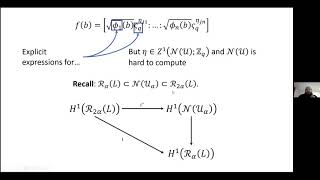
Data Driven Torsion Coordinates and Wasserstein Stability
Explore data-driven torsion coordinates in finite Lens spaces, LPCA dimensionality reduction, and Wasserstein stability for topological data analysis and nonlinear dimensionality reduction.
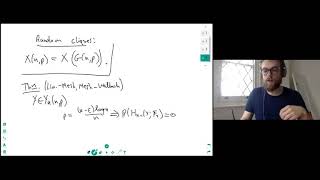
From Large to Infinite Random Simplicial Complexes
Explore two models of random simplicial complexes extending the Erdos-Renyi model, examining their Alexander duality relation and the unique infinite Rado simplicial complex.
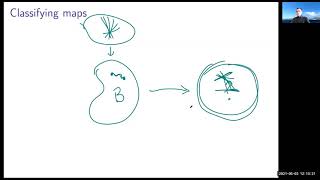
Approximate and Discrete Vector Bundles
Explore synchronization problems and dimensionality reduction through vector bundles. Learn how characteristic classes provide insights into global synchronization and data analysis challenges.
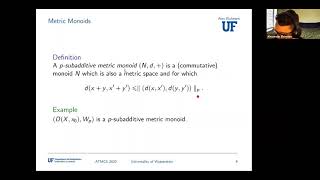
Universality of Persistence Diagrams and Bottleneck & Wasserstein Distances
Explore the mathematical foundations of persistence diagrams and their associated metrics, focusing on universality properties and distance calculations in topological data analysis.
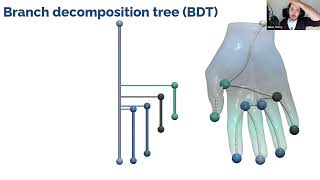
Wasserstein Distances, Geodesics and Barycenters of Merge Trees
Explore computational frameworks for merge trees, including Wasserstein distances, geodesics, and barycenters. Learn efficient algorithms and applications in visualization, feature tracking, and ensemble clustering.
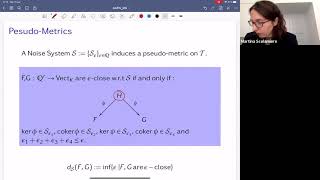
Extracting Persistence Features with Hierarchical Stabilisation
Explore hierarchical stabilisation for extracting stable invariants from persistence modules, focusing on the stable rank and its applications in data analysis and classification tasks.
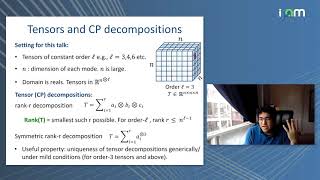
Smoothed Analysis for Tensor Decompositions and Unsupervised Learning
Explore smoothed analysis for tensor decompositions and unsupervised learning, focusing on polynomial time guarantees and robust decompositions of symmetric overcomplete tensors.
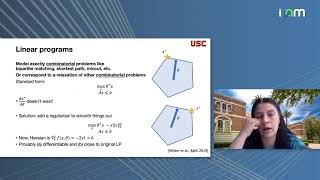
Decision-Focused Learning - Integrating Downstream Combinatorics in ML
Explore the integration of machine learning and discrete optimization to enhance problem-solving in real-world scenarios, focusing on decision-focused learning and tailored solution strategies.
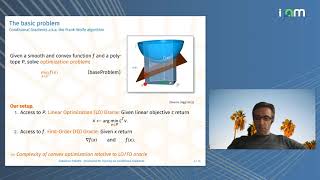
Structured ML Training via Conditional Gradients
Explore conditional gradient methods for structured optimization in machine learning, covering applications in traditional and deep learning, with a focus on incorporating polyhedral structures into solutions.
Positivity for Symmetric Functions and Vertex Models
Explore connections between symmetric function homomorphisms and stochastic six-vertex model positivity, linking to RSK correspondence in algebraic combinatorics.
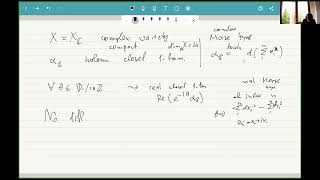
Stability Structures in Holomorphic Morse-Novikov Theory
Explore complex symplectic manifolds, Floer theory, and Morse-Novikov theory. Delve into analytic questions of convergence and generalization to almost-complex cases in this advanced mathematical lecture.
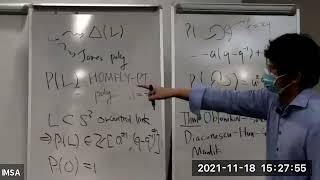
Hilbert Schemes of Plane Curve Singularities and Matrix Factorizations
Explore connections between algebraic geometry and topology through plane curve singularities, Hilbert schemes, and matrix factorizations in this advanced mathematics lecture.
Danny Ruberman- Diffeomorphism Groups of 4-Manifolds
Exploring unique 4-dimensional phenomena: infinite families of homeomorphic but non-diffeomorphic manifolds, and exotic behavior in diffeomorphism and homeomorphism groups.

Calculus 2 - Approximation of Functions by Taylor Polynomials
Explore the approximation of functions using Taylor polynomials, a powerful mathematical tool for estimating complex functions with simpler polynomial expressions.
Calculus 2 - Representation of Functions by Taylor Series and Maclaurin Series
Explore Taylor and Maclaurin series for representing functions, enhancing your understanding of advanced calculus concepts and their practical applications.
Special Products of Polynomials
Learn efficient techniques for multiplying specific polynomial types, exploring patterns and formulas to simplify complex algebraic expressions.
Causal Inference for Earth System Sciences - Jakob Runge
Exploring causal inference techniques for Earth system sciences, focusing on advanced methods to uncover complex relationships in climate data and improve understanding of multi-scale processes.
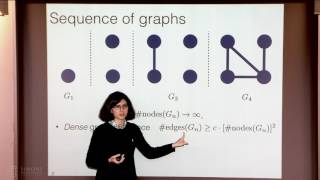
Nonparametric Bayesian Methods - Models, Algorithms, and Applications IV
Explore probabilistic models for graphs, edge exchangeability, and graph paintbox representations in this advanced machine learning lecture on nonparametric Bayesian methods.
Machine Learning Inside MIP Solvers - IPAM at UCLA
Explore machine learning applications in MIP solvers, focusing on cutting planes and numerical stability. Gain insights into enhancing solver performance for general MIP benchmarks.
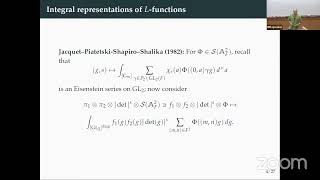
Yiannis Sakellaridis- Spherical Varieties, Functoriality, and Quantization
Explore spherical varieties, functoriality, and quantization in algebraic geometry and representation theory with Yiannis Sakellaridis' advanced mathematical lecture.
Regularization by Noise for the Stochastic Transport Equation
Explore regularization by noise for stochastic transport equations, focusing on uniqueness and regularity of solutions under different drift conditions and the impact of Brownian motion.