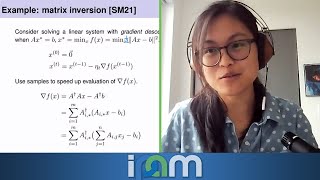
On Quantum Linear Algebra for Machine Learning - IPAM at UCLA
Explore quantum singular value transformation for machine learning, its applications, limitations, and connections to classical algorithms in this technical talk on quantum linear algebra.

Uncertainty Quantification of Quantum Chemical Methods - IPAM at UCLA
Explore uncertainty quantification in quantum chemistry, covering error estimation, benchmarking, and machine learning approaches for improved accuracy in computational methods.
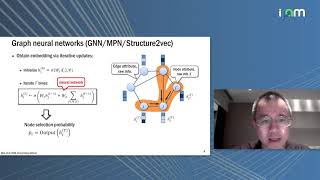
A Framework for Differentiable Discovery of Graph Algorithms
Explore graph algorithm discovery using deep learning and tree decomposition. Learn effective techniques for NP-complete problems with interpretable results and expanded search space.
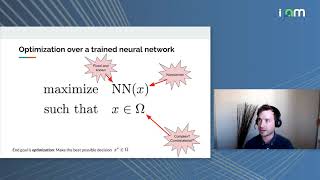
Neural Network Verification as Piecewise Linear Optimization
Neural network verification as piecewise linear optimization: exploring robust methods to prove model reliability against attacks, using LP and MIP formulations for efficient problem-solving in various network types.
Solving High Dimensional HJ Equations Using Generalized Hopf-Lax Formulas vs Using Machine Learning
Explore advanced techniques for solving high-dimensional Hamilton-Jacobi equations, comparing generalized Hopf-Lax formulas with machine learning approaches in control and differential games.
The Convex Geometry of Blind Deconvolution and Matrix Completion Revisited
Explores convex geometry in blind deconvolution and matrix completion, analyzing dimensional factors in noise bounds and proposing alternative error scaling approaches for low-rank matrix recovery problems.
Optimal Learning from Data
Explore optimal learning from data, including error recovery, discrete optimization, and handling noisy measurements. Insights on deep learning and stochastic settings provided.
Machine Learned Regularisation for Solving Inverse Problems
Machine learned regularization techniques for solving inverse problems, focusing on image reconstruction from tomographic and blurred measurements. Explores data-driven approaches and discusses open mathematical challenges.
Regression Analysis in Machine Learning - Linear Regression - Logistic Regression
Comprehensive exploration of regression analysis, covering linear and logistic techniques. Learn to leverage data relationships for informed decision-making in various business contexts.
Introductory Lectures on First-Order Convex Optimization - Lecture 1
Explore first-order convex optimization, covering gradient descent, complexity, smoothness, and Nesterov's accelerated algorithm. Gain insights into theoretical foundations and practical applications in machine learning.
Deep Learning and Computations of PDEs by Siddhartha Mishra
Explore deep learning applications in PDEs, uncertainty quantification, and optimization. Learn about operator learning, DeepOnet decomposition, and high-dimensional PDEs in this advanced lecture.
Discrete Optimization-Aided Structured Learning at Scale - IPAM at UCLA
Explore discrete optimization techniques for structured learning, featuring algorithmic aspects, statistical setups, and approaches to feature selection and learning trees.

Using Machine Learning to Formulate Mathematical Conjectures - IPAM at UCLA
Explore how machine learning aids mathematicians in formulating conjectures, focusing on a discovery linking low-dimensional topology and geometry, with insights on the method's potential and limitations.
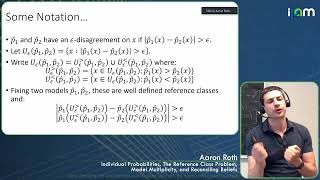
Individual Probability, Reference Class Problem, Model Multiplicity, Reconciling Belief
Explore individual probabilities, reference class problem, and model multiplicity in machine learning. Gain insights on reconciling beliefs and addressing challenges in probability estimation for individuals and groups.

Enhancing Markov Chain Monte Carlo Sampling Methods with Deep Learning
Explore advanced techniques combining Markov Chain Monte Carlo sampling with deep learning, focusing on importance sampling, normalizing flows, and non-equilibrium methods for enhanced efficiency in high-dimensional problems.
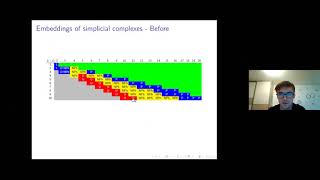
Embeddings and Tverberg-Type Problems: New Algorithms and Undecidability Results
Explore computational topology: algorithmic embeddability, undecidability in higher dimensions, and polynomial-time decidability of r-Tverberg problem in metastable range.
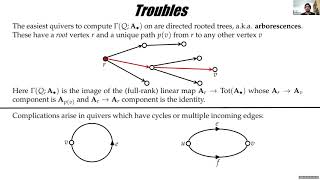
Vidit Nanda - Principal Components Along Quiver Representations
Principal components analysis for quiver representations: dimensionality reduction, comparison, and optimization techniques for vector-space valued representations across pure and applied mathematics.
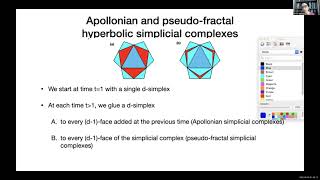
The Topological Dirac Operator and the Dynamics of Topological Signals
Explore topological signals, higher-order Laplacians, and the Dirac operator in network science. Learn about spectral properties, diffusion dynamics, and topological synchronization in simplicial complexes and multiplex networks.
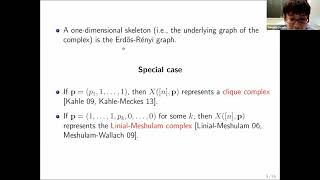
Takashi Owada - Limit Theorems for Topological Invariants of the Dynamic Multi-Parameter Simplicial Complex
Explore topological invariants in dynamic multi-parameter simplicial complexes, covering connectivity, probability, and limiting processes in applied algebraic topology.
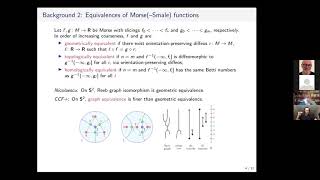
Moduli Spaces of Morse Functions for Persistence
Exploring Morse functions on surfaces, focusing on decomposition, elementary moves, and embeddings. Insights into persistence barcodes and the inverse problem through nesting posets of level sets.
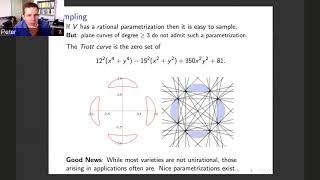
Bernd Sturmfels - Learning Algebraic Varieties from Samples
Explore algebraic varieties through sampling, focusing on topology and geometry. Learn algorithms for determining dimensions and polynomials, with practical applications in Julia.