Adaptive Regularization and Linearization for Nonsmooth and Degenerate Problems
Explore advanced mathematical techniques for solving nonsmooth and degenerate problems in flow and transport, focusing on adaptive regularization methods and Newton-based linearization approaches.
In-Context Learning Over Graphs for Large Language Models - PRODIGY Method
Explore PRODIGY, Stanford's innovative approach to graph machine learning that enables in-context learning for classification tasks on unseen graphs, advancing LLM reasoning capabilities.
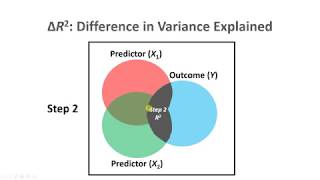
Conceptual Overviews of Statistical and Data-Analytic Tools and Techniques
Explore key statistical and data analysis methods, from hierarchical regression to survival analysis, with conceptual overviews of advanced techniques and tools.
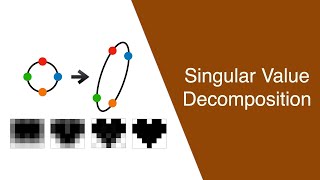
Singular Value Decomposition and Image Compression
Learn singular value decomposition (SVD) and its application in image compression. Explore matrix transformations, dimensionality reduction, and practical implementation techniques.

A Friendly Introduction to Linear Algebra for ML
Explore key linear algebra concepts for machine learning, including data representations, vector embeddings, and dimensionality reduction, with insights from a postdoc at X.

From Causal Inference to Autoencoders, Memorization & Gene Regulation - Caroline Uhler, MIT
Exploring causal inference, autoencoders, and gene regulation through genomics and 3D genome organization. Integrates data modalities, analyzes overparameterized autoencoders, and links memorization to real-valued data retrieval.

Fast and Optimal Low-Rank Tensor Regression via Importance - Garvesh Raskutti, UW-Madison
Explore low-rank tensor regression using importance sketching for efficient high-dimensional data analysis, with theoretical guarantees and practical applications in neuroimaging.

Pragmatically Ambitious Multiscale Global Temperature Reconstruction - Finn Lindgren, Edinburgh
Explore pragmatic approaches to global temperature reconstruction using multiscale models, data sources, and statistical techniques for uncertainty quantification and bias correction.
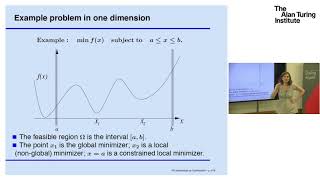
Optimisation - An Introduction: Professor Coralia Cartis, University of Oxford
Explore optimization techniques, from basic concepts to advanced methods, covering minimizers, derivatives, quadratic functions, and gradient methods for solving complex mathematical problems.

Complex Numbers for Audio Signal Processing
Explore complex numbers visually for audio signal processing, covering Cartesian and polar representations, Euler's formula, and their application in Fourier transforms.
Understanding Audio Signals for Machine Learning
Explore audio digital signals, analog-to-digital conversion, and key concepts like sampling, quantization, and aliasing for machine learning applications.
Why Does Maths Give Humans the Edge Over Machines? - With Junaid Mubeen
Exploring human mathematical intelligence and its advantages over machines, highlighting reasoning, imagination, and questioning as key principles that give humans an edge in problem-solving.
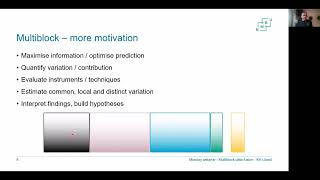
Multiblock Data Fusion
Explore multiblock data analysis techniques for integrating diverse data sources in natural and life sciences, covering key methods, applications, and interpretation strategies.
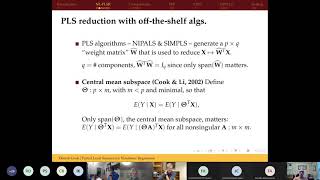
Partial Least Squares for Nonlinear Regression
Explore dimension reduction in PLS regression for nonlinear relationships, challenging traditional views and proposing new insights into PLS-like methods for predictive modeling.

Statistical Rethinking 2022 - Multi-Multilevel Models
Explore advanced statistical concepts including multiple cluster types, multilevel predictions, and non-centered priors in this comprehensive lecture on multi-multilevel models.

Statistical Rethinking 2022 - Modeling Events
Explore statistical modeling of events, covering generative models, generalized linear models, logistic regression, and binomial regression. Learn to analyze gender applications and calculate marginal causal effects.
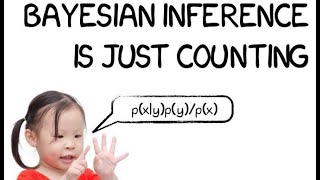
Bayesian Inference Is Just Counting
Explore foundations of Bayesian data analysis, focusing on conceptual understanding and causal inference. Learn key principles from renowned expert Richard McElreath's book, covering topics like T-tests and machine learning.
Finding Low-Rank Matrices - From Matrix Completion to Recent Trends
Explore low-rank matrix recovery, from matrix completion to recent trends, covering theoretical foundations and applications in signal processing and machine learning.
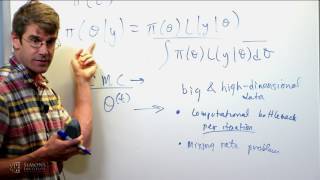
Scaling Up Bayesian Inference for Big and Complex Data
Explore advanced Bayesian inference techniques for large-scale datasets, focusing on computational challenges and innovative solutions in machine learning and deep learning applications.

Perceptual Organization From a Bayesian Point of View
Explore Bayesian approach to perceptual organization, examining how the visual system groups images into distinct units through inverse inference and mixture estimation techniques.
Kernel Methods for Causal Inference
Explore kernel ridge regression for causal inference, covering dose responses, treatment effects, and extensions to various settings. Learn about consistency, efficiency, and robustness in estimation.