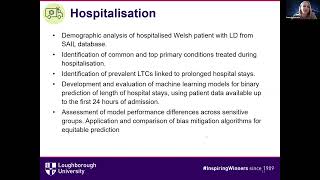
AI-Based Modeling of Electronic Health Records for Patients with Learning Disabilities
Explore AI-based modeling of electronic health records for individuals with learning disabilities, focusing on predicting hospital stays and analyzing long-term condition trajectories.
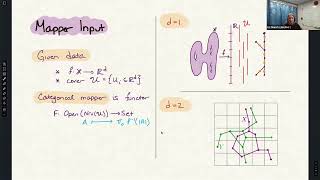
Bounding the Interleaving Distance for Mapper Graphs with a Loss Function
Exploring interleaving distance for Mapper graphs, introducing a loss function to measure assignment quality and enable polynomial-time computation for data comparison and clustering.
Vector Databases Explained - Insights, Applications, and Pinecone Tutorial
Explore vector databases, embeddings, and advanced search techniques. Learn how to leverage Pinecone for powerful vector search solutions, with real-world applications and hands-on experience.
Bootstrapping the Right Way - Data Science Best Practices
Learn effective bootstrapping techniques for data analysis, including proper resampling, package selection, and considerations for parametric Bayesian approaches from a distinguished data scientist.
Bringing CI/CD Practices to Machine Learning with MLOps
Learn how to apply CI/CD practices to machine learning pipelines, enhancing model development from data exploration to deployment for better, faster results in MLOps.
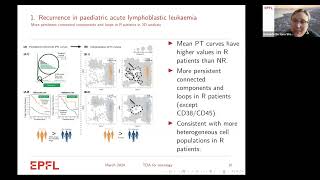
Applications of Topology to Oncology Data
Exploring Persistent Homology in oncology: predicting leukaemia relapse risk and analyzing tumor microenvironments using topological data analysis and machine learning techniques.
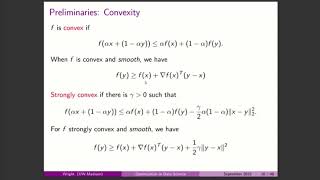
Optimization for Data Analysis
Explore optimization techniques for data analysis and machine learning, covering kernel learning, regression, graph analysis, neural networks, and matrix analysis. Learn about regularization and gradient methods.
Unstable Log Sequence Anomaly Detection - Introducing Vocabulary-Free BERT
Innovative anomaly detection method for unstable log data in cybersecurity, improving on BERT models to reduce false positives and enhance SOC efficiency.
The Case for Alien AI
Exploring the potential of diverse, "alien" AI to revolutionize scientific discovery and societal progress, challenging our perspectives on artificial intelligence and human knowledge.

Data Science: Complete Roadmap to Become a Data Scientist
Comprehensive roadmap to becoming a data scientist, covering essential skills, tools, and resources. Includes job prospects, learning strategies, and recommended books for career advancement.
Understanding AlphaFold - AI in Protein Structure Prediction
Explore AlphaFold's revolutionary impact on protein structure determination with Dame Janet Thornton. Discover how this AI program is transforming bioinformatics and its potential future applications.
When AI Became ML, and Then AI Again - Tracing the Evolution of Terms and Technologies
Explore the evolution of AI and ML terminology, from early ambitious goals to specialized algorithms, and their recent convergence, reflecting the field's dynamic nature and growing demand for specialized infrastructure.
Enterprise LLM Applications - Not Just a Technological Challenge
Explore prevalent approaches and architecture for building custom large language model applications, including tools and technologies for enterprise use cases and challenges.
Docker for Machine Learning, AI, and Data Science - DockerCon 2023 Workshop
Comprehensive workshop on containerizing and deploying generative AI models, covering fine-tuning techniques, multi-modal use cases, and building a complete GenAI vertical using Docker.
Advancing Earth System Predictability with Machine Learning Methods
Explore machine learning methods for improving Earth system predictions, featuring insights from Dan Lu of Oak Ridge National Laboratory on enhancing climate modeling and forecasting.

The Truth About AI - How to Build an Intelligent Machine - Lecture 1
Professor Mike Wooldridge explores the nature of artificial intelligence through experiments and demonstrations, investigating how AI learns and what it can do in this Royal Institution Christmas Lecture.
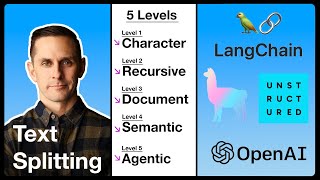
The 5 Levels of Text Splitting for Retrieval
Explore five text splitting techniques for efficient information retrieval, from basic character splits to advanced semantic and agentic methods, enhancing your data processing capabilities.
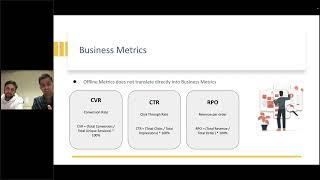
Building Robust and Scalable Recommendation Engines for Online Food Delivery
Unlock the power of recommendation engines for food delivery. Learn data preprocessing, feature engineering, and scalable algorithms to create personalized recommendations using the DHRD dataset.
Can AI Save Our Planet? - Environmental Applications of Artificial Intelligence
Exploring AI's potential to address climate change through monitoring and predicting environmental responses, discussing challenges in applying these methods to our complex natural world.

Turning the Light of Truth - Data Science as a Practice of Resistance
Exploring data science's dual role in oppression and resistance, highlighting its potential for uncovering truth and addressing societal inequalities through real-world examples and critical analysis.

From AI to GX: The Quantum Leap in Algorithmic Evolution
Explore the evolution from AI to Generative Algorithms (GX) and its impact on algorithm design, creativity, and innovation in technology and society with insights from industry expert Jepson Taylor.