
Using Scikit-Learn Pipelines for Data Preprocessing with Python
Deep dive into Scikit-Learn Pipelines for efficient data preprocessing in Python, enhancing your machine learning workflow and streamlining model development.

Introduction to AI and Machine Learning
Learn the basics of machine learning and data science, explore AI's role in cybersecurity, and discover how to augment your practice with data. Ideal for beginners interested in applying AI to security challenges.
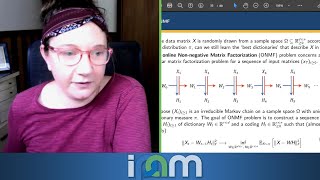
Using Algebraic Factorizations for Interpretable Learning - IPAM at UCLA
Explore Non-negative Matrix Factorization for interpretable learning in imaging, medicine, forecasting, and collaborative filtering. Learn implementation, online, and streaming variations.
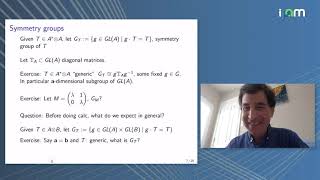
Introduction to the Geometry of Tensors
Explore the geometric perspective of tensors, their applications, and how this viewpoint enhances understanding in various fields. Gentle introduction suitable for beginners.
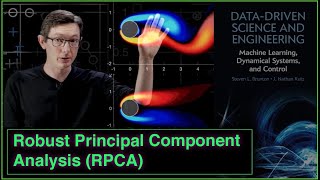
Robust Principal Component Analysis
Explore robust PCA for handling corrupted data in fields like fluid mechanics and image processing. Learn its applications and importance in data-driven science and engineering.

Robust, Interpretable Statistical Models - Sparse Regression with the LASSO
Explore sparse regression and LASSO algorithm for building interpretable, robust models with minimal variables. Learn key concepts and applications in data science and machine learning.

A Topological Study of the Space of Planar Pentagons
Exploring topology of planar pentagons as a model for molecular conformation spaces, using topological data analysis for dimensionality reduction and visualization.
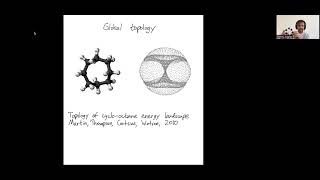
Henry Adams - Topology in Machine Learning
Explore persistent homology in machine learning, covering applications in materials science, computer vision, and agent-based modeling. Learn how topology relates to dataset geometry and explainable AI.
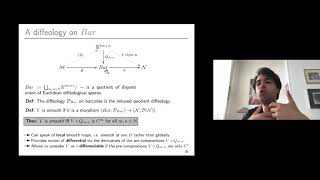
Differential Calculus on Persistence Barcodes
Explore differential calculus on persistence barcodes, covering differentiability concepts, lifts to ordered barcodes, and applications in topological data analysis.
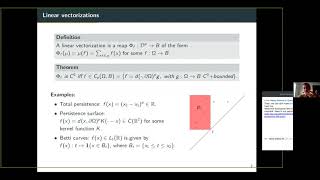
Studying the Space of Persistence Diagrams Using Optimal Partial Transport II
Exploring persistence diagrams through optimal transport theory, bridging topological data analysis with measure spaces to characterize convergence and prove new results in random settings.
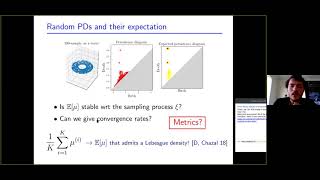
Studying the Space of Persistence Diagrams Using Optimal Partial Transport - Part I
Exploring persistence diagrams through optimal partial transport, bridging topological data analysis with measure theory. Novel approach enables new insights into convergence, continuity, and random settings in TDA.
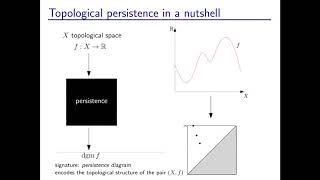
On the Metric Distortion of Embedding Persistence Diagrams into RKHS
Explores embedding Persistence Diagrams into Reproducing Kernel Hilbert Spaces, analyzing metric properties and stability guarantees for machine learning applications in Topological Data Analysis.
Lab-in-the-Loop De Novo Antibody Design - What Are We Missing From Machine Learning?
Explore lab-in-the-loop de novo antibody design, focusing on computational aspects. Discover generative modeling, computational oracles, and active learning in molecular systems research.
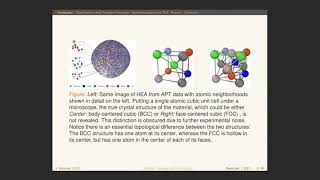
Statistics, Topology and Data Analysis
Explore the synergy between statistics and topological data analysis for solving real-world problems, with a focus on supervised learning and applications in materials science.
Topological Data Analysis Based Machine Learning Models for Drug Design
Explores TDA-based models for effective molecular representation in drug design, combining persistent homology, spectral models, and Ricci curvature with machine learning for improved performance.
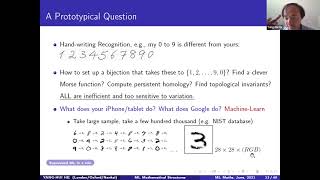
Universes as Bigdata- From Geometry, to Physics, to Machine-Learning
Explore the intersection of string theory, geometry, and machine learning in physics, examining how AI aids mathematical research across various fields.
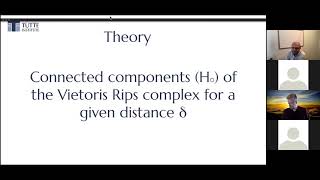
Practical Clustering and Topological Data Analysis
Explore clustering algorithms and topological data analysis from a data science perspective, covering techniques from k-means to DBSCAN and dimensionality reduction methods like UMAP.
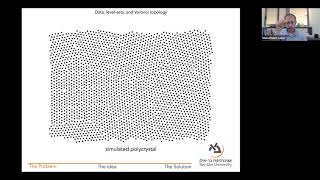
High-Dimensional Data, Level-Set Geometry, and Voronoi Analysis of Point Sets
Explore spatial point sets, high-dimensional data analysis, and Voronoi cell topology to understand complex physical systems and classify data structures in innovative ways.
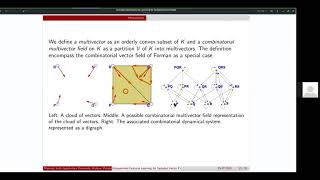
Unsupervised Features Learning for Sampled Vector Fields
Explore innovative techniques for analyzing sampled vector fields using graph structures and unsupervised learning, revealing hidden features correlated with known dynamics in analytical models.
Modern Regularization Methods in Inverse Problems and Data Science
Explores recent developments in variational methods for inverse problems and machine learning, discussing convergent regularization schemes, quantitative estimates, and connections between classical regularization theory and risk minimization.

Building and Maintaining High-Performance AI
Learn strategies for developing and maintaining high-performance AI models, including testing methods, drift detection, and systematic debugging. Gain insights on model monitoring and iteration for optimal performance.