
Machine Learning and Data Science for Medicine - A Vision, Some Progress and Opportunities
Explore machine learning and data science applications in medicine, focusing on AutoPrognosis - an automated system for creating tailored, interpretable, and accurate prognostic models for various diseases.
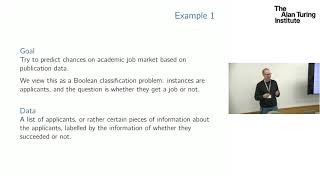
Learning Logically Defined Hypotheses - Martin Grohe, RWTH Aachen University
Explore a declarative framework for machine learning using logic-defined hypotheses, discussing learnability results for various logics over strings, trees, and graphs.
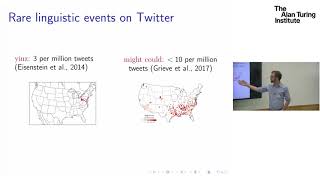
Finding More Needles by Building Bigger Haystacks - Dr. Jacob Eisenstein
Exploring large-scale text data for social and cultural insights, focusing on rare linguistic events, language change dynamics, and online hate speech detection using innovative computational methods.
Simulation - The Challenge for Data Science
Exploring the fusion of simulation models and machine learning for policy analysis, addressing challenges in parameter estimation and initialization for complex systems forecasting.
Introduction to Data Ethics - Brent Mittelstadt
Explore data ethics with Dr. Mittelstadt, covering algorithmic fairness, accountability, transparency, and privacy. Learn about ethical challenges in AI and data analytics, with real-world examples and regulatory insights.
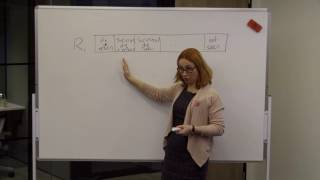
Data Science Applications - Environment/Ecology
Explore statistical modeling techniques for ecological data, focusing on hidden Markov models, Bayesian inference, and capture-recapture methods. Learn to analyze and interpret complex environmental datasets.

Inference with Neural Nets
Explore neural network inference, covering mathematical foundations, data science concepts, and practical tools like PyTorch. Gain insights into advanced topics and real-world applications.
Affine Spline Insights into Deep Learning - Richard Baraniuk, Rice University
Explore deep learning through affine splines, understanding neural networks as matched filterbanks and partition-based signal distances. Gain insights into data augmentation and future research directions.
Insights from Predictive Policing - Tobias Brandt, Rotterdam School of Management
Explore data-driven decision-support in policing, examining the complex relationship between prediction quality and decision outcomes. Learn about end-to-end frameworks for model selection in smart city operations.
Geospatial Standards for Data Science - Dr. Gobe Hobona, OGC
Explore geospatial data standards for efficient sharing across sectors. Learn about OGC's role in developing interface standards and their impact on data science and defense applications.
The Defence Context - Geospatial Standards for Data Science
Explore geospatial standards in data science for defense, covering interoperability, machine learning, and emerging technologies to enhance information sharing and decision-making.
Be Prepared to Show Your Working! - Professor Sir David Spiegelhalter
Explore algorithmic decision-making transparency, validation, and explainability with Professor Spiegelhalter. Learn about the importance of demonstrating trustworthiness and intelligent transparency in automated advice systems.
Convolutional Neural Networks Explained Easily
Explore CNNs, their components, and application to audio data. Learn about convolutions, pooling, and architectural decisions for effective deep learning in sound processing.
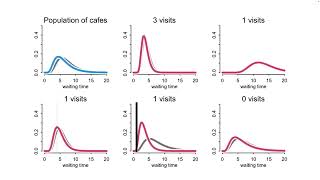
Statistical Rethinking 2023 - Multilevel Models
Explore multilevel models, partial pooling, and hyperparameter tuning through practical examples like reedfrogs. Learn advanced techniques for statistical analysis and model optimization.

Candlestick Pattern Recognition with Python and TA-Lib
Learn to recognize candlestick reversal patterns using Python and TA-Lib. Practical implementation of Japanese Candlestick Charting Techniques for market analysis and trading strategies.
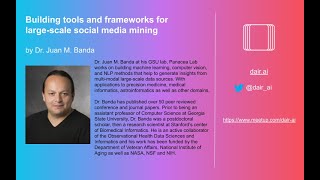
Building Tools and Frameworks for Large-Scale Social Media Mining
Learn to build tools and frameworks for large-scale social media mining, focusing on creating data infrastructure for COVID-19 research using Twitter data. Gain insights on challenges, solutions, and best practices.

CS480-680 - Hidden Markov Models
Explore Hidden Markov Models, their assumptions, and applications in robot localization. Learn about monitoring tasks, hindsight reasoning, and finding the most likely explanation.

Support Vector Machines
Learn about support vector machines, margin classifiers, and linear separators. Explore dual representation, Lagrangian optimization, and practical applications in classification problems.
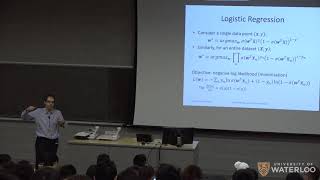
Logistic Regression and Generalized Linear Models
Explore exponential family models, logistic regression, and Newton's method for classification tasks, with applications in app recommendation and sparse data analysis.
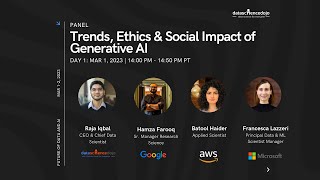
Generative AI- Trends, Ethics and Societal Impact
Explore the latest trends, ethical considerations, and societal impacts of generative AI with industry experts. Gain insights into its applications, challenges, and future potential across various sectors.
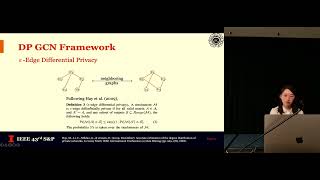
LinkTeller: Recovering Private Edges from Graph Neural Networks via Influence Analysis
Explore techniques for recovering private edges in graph neural networks through influence analysis, addressing privacy risks in vertically partitioned graph data.