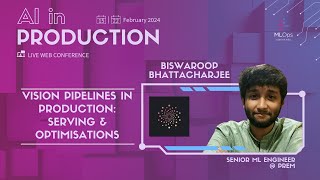
Vision Pipelines in Production: Serving and Optimizations - AI in Production
Explore vision model production: fine-tuning LORAs, upscaling pipelines, constraints-based generations, and step-by-step enhancements for optimal performance and quality in production-ready services.
Fine-tuning Llama 2 for Tone or Style Using Shakespeare Dataset
Fine-tune Llama 2 for Shakespearean style using custom datasets. Learn LoRA, parameter settings, and inference techniques to adapt language models for specific tones or styles.
Top Ten Tips for Fine-tuning Large Language Models
Discover ten essential tips for effective fine-tuning of language models, from starting small to advanced techniques like LoRA and preference tuning. Gain practical insights for optimal results.
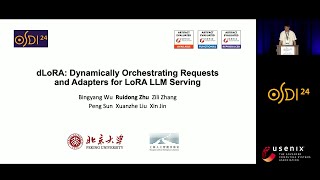
dLoRA - Dynamically Orchestrating Requests and Adapters for LoRA LLM Serving
Innovative system for efficient LoRA model serving, dynamically orchestrating requests and adapters to improve throughput and reduce latency in LLM inference.
Easy Guide to Ultra-Realistic AI Images with Flux
Learn to create ultra-realistic AI images using FLUX.1 and LoRAs. Explore techniques for enhancing image quality and achieving lifelike results in AI-generated visuals.

Creating Your Own Flux AI Model with LoRA Fine-Tuning
Learn to create and fine-tune a custom Flux AI model using LoRA, including dataset preparation, cost-effective training on Replicate, and generating AI images with your personalized model.
Flux-1 Dev - Photorealistic Image Generation Tutorial Using LoRA Adapters
Learn to generate photorealistic images using Flux-1 (Dev) model and LoRA adapters. Explore setup, inference steps, guidance, and output variety in this hands-on tutorial using Google Colab.
LoRA Explained - Efficient Fine-Tuning of Large Language Models
Explore LoRA, a technique for efficient fine-tuning of large language models. Learn about its low-rank matrix decompositions and reduced trainable parameters for task-specific adaptations.
Fine-Tuning Self-Rewarding Language Models with Mistral 7B
Dive into implementing Meta's Self-Rewarding Language Model with Mistral 7B, covering fine-tuning techniques, data preparation, prompt generation, and practical demonstrations.
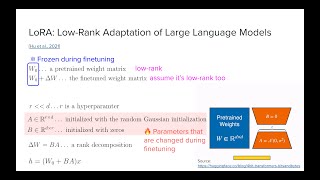
Parameter-Efficient Finetuning - QLoRA and LoRA Methods
Explore parameter-efficient fine-tuning techniques with LoRA and QLoRA, learning how to optimize large language models while maintaining performance and reducing computational costs.
QLoRA - How to Fine-tune an LLM on a Single GPU with Python Code
Learn to fine-tune large language models on a single GPU using QLoRA. Explore quantization techniques, LoRA, and practical implementation with Python code for custom YouTube comment responses.
Fine-Tuning LLMs: Best Practices and When to Go Small - Lecture 124
Explore best practices for fine-tuning LLMs, including strategies for improving performance, overcoming challenges, and determining when to use smaller models for specific tasks.
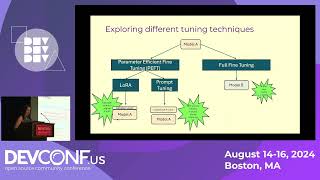
Creating Your Own LLM Tuning Platform with Open Source Technologies
Explore open-source LLM tuning techniques using FMS HF Tuning. Learn architectural integration, various tuning methods, and deployment on Open Data Hub for enhanced AI solutions.
Fine-tuning LLMs Without Maxing Out Your GPU - LoRA for Parameter-Efficient Training
Discover parameter-efficient fine-tuning of large language models using LoRA. Learn to classify consumer finance complaints with RoBERTa on Google Colab's V100 GPU.
Fine-tuning Optimizations - DoRA, NEFT, LoRA+, and Unsloth
Explore advanced fine-tuning techniques like DoRA, NEFT, LoRA+, and Unsloth to optimize language models. Learn implementation, comparisons, and practical applications through code examples and demonstrations.
Full Fine-Tuning vs LoRA and QLoRA - Comparison and Best Practices
Explore full fine-tuning vs (Q)LoRA techniques, comparing VRAM usage, training time, and quality. Learn parameter selection, tips for QLoRA, and step-by-step guidance for TinyLlama and Mistral 7B fine-tuning.
Very Few Parameter Fine-Tuning with ReFT and LoRA
Explore advanced fine-tuning techniques ReFT and LoRA for efficient parameter optimization in transformer models. Learn implementation, comparison, and practical tips for improved model performance.

Fine-tuning Llama 3 on Wikipedia Datasets for Low-Resource Languages
Learn to fine-tune Llama 3 on Wikipedia datasets for low-resource languages. Master dataset creation, LoRA setup, blending techniques, and parameter optimization for improved language model performance.
Fine-Tuning a Diffusion Model with Your Photos
Learn to fine-tune a diffusion model using your own photos. Explore Flux Schnell, set up GPU environments, create datasets, and understand the intricacies of diffusion models and their architectures.
Training LoRA with SimpleTuner and AI-Toolkit for FLUX.1 - Art Style and Concept Development
Comprehensive guide on training LoRA models for FLUX.1 [dev], covering techniques, experiments, and analysis for art style and concept generation in Stable Diffusion.
Fine-Tuning Large Language Models with Limited Resources - NeurIPS Hacker Cup AI
Strategies for fine-tuning large language models with limited resources: memory optimization, gradient accumulation, activation checkpointing, LoRa, and dataset quality. Practical advice for 40 GB VRAM GPU constraints.