Big Data in Biology - How EMBL Delivers Big Data for Biology, and Some Highlights
Explore how EMBL manages and utilizes big data in biology, with insights on key developments and applications in genomics and bioinformatics.

Statistical Rethinking 2022 - Modeling Events
Explore statistical modeling of events, covering generative models, generalized linear models, logistic regression, and binomial regression. Learn to analyze gender applications and calculate marginal causal effects.
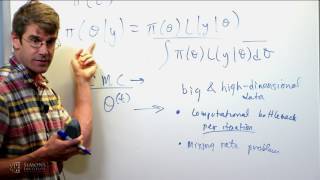
Scaling Up Bayesian Inference for Big and Complex Data
Explore advanced Bayesian inference techniques for large-scale datasets, focusing on computational challenges and innovative solutions in machine learning and deep learning applications.
Regression Analysis in Machine Learning - Linear Regression - Logistic Regression
Comprehensive exploration of regression analysis, covering linear and logistic techniques. Learn to leverage data relationships for informed decision-making in various business contexts.

Kurdyka-Łojasiewicz Exponent for Hadamard-Difference-Parameterized Models
Explore Kurdyka-Łojasiewicz exponents in L1-regularized optimization, focusing on Hadamard difference parametrization and its impact on local convergence rates of gradient methods.

Multinomial Regression Model - Part I: Introduction to MRM and Multinomial Logit Model
Explore multinomial regression models, including types and the multinomial logit model. Learn key concepts and applications in statistical analysis.
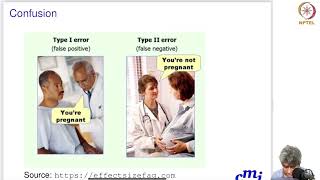
Statistical Inference of Logistic Regression: Confusion Matrix, Errors, and Model Selection
Explore statistical inference in logistic regression, covering confusion matrices, error types, and model selection techniques for improved predictive accuracy.
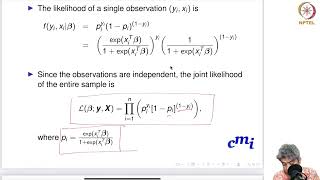
Maximum Likelihood Estimate for Logistic Regression
Explore maximum likelihood estimation for logistic regression, covering likelihood functions and gradient descent techniques.
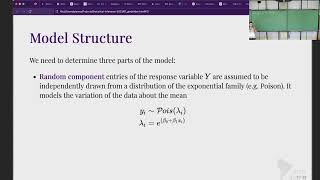
Statistical Models: Linking Data to Theory - Class 9
Explore statistical models linking data to theory, focusing on generalized linear models, binary data, logistic regression, and Poisson distribution in quantitative ecology.
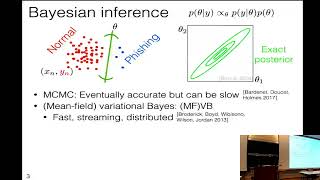
Automated Scalable Bayesian Inference via Data Summarization - 2018
Explore scalable Bayesian inference techniques using data summarization. Learn about coresets, theoretical guarantees, and practical applications in large-scale data settings.
Artificial Intelligence in Medical Imaging for Precision Medicine by Vaanathi Sundaresan
Explore AI applications in medical imaging for precision medicine, covering deep learning techniques, image analysis, and their impact on diagnosis and treatment planning.
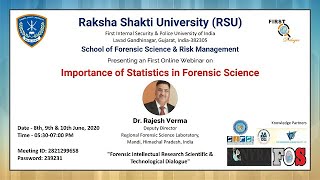
Importance of Statistics in Forensic Science - Dr. Rajesh Verma
Explore multiple and logistic regression in forensic science with detailed examples. Builds on previous sessions to enhance statistical knowledge for evidence interpretation.
Lung Disease and AI Applications - From Cough Sounds to CT Scan by Anurag Agrawal
Explore AI applications in lung disease diagnosis, from analyzing cough sounds to interpreting CT scans. Learn how machine learning enhances detection and treatment of respiratory conditions.
Cause of Obesity, Diabetes & CVD Epidemic by Ponnusamy Saravanan
Explores the role of Gestational Diabetes Mellitus in obesity, diabetes, and cardiovascular disease epidemics, discussing its causes, impacts, and potential interventions.
The Healthy Life Trajectories Initiative - Implementation, Challenges and Future
Exploring the Healthy Life Trajectories Initiative's implementation, challenges, and future prospects, focusing on improving health outcomes through data-driven approaches and collaborative research.
Predicting Diabetes with Logistic Regression in TensorFlow.js - Deep Learning for JavaScript Hackers
Learn to build and train logistic regression models in TensorFlow.js for diabetes prediction. Covers data visualization, dataset creation, model evaluation, and advanced techniques.
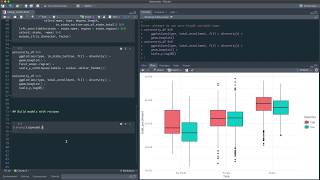
Data Preprocessing and Resampling Using Tidymodels
Explore data preprocessing and resampling techniques using tidymodels in R, focusing on college tuition and diversity data to build effective models and improve analysis skills.
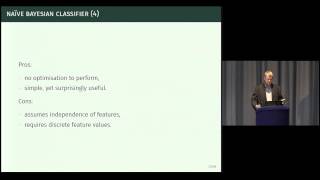
A Primer in Machine Learning
Explore machine learning fundamentals, including hypotheses, data representation, algorithms like regression and classification, and practical implementation using MATLAB.

Python Projects for Beginners in 2024
Explore diverse Python applications: data visualization, game development, mobile apps, and web development. Gain hands-on experience through practical projects and enhance your programming skills.
Machine Learning Applications in Healthcare - Saudi Arabian Hospital Case Studies
Explore real-world applications of machine learning in Saudi Arabian healthcare through case studies focusing on breast cancer classification and predictive modeling techniques.
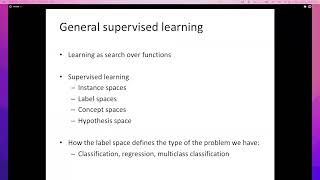
Machine Learning Mid-Semester Review - Lecture 15
Dive into a comprehensive mid-semester review of fundamental machine learning concepts, covering key principles and techniques explored throughout the academic term.