
Geometry - An Interactive Journey to Mastery
Explore geometric concepts like polyhedrons, volume, and surface area through interactive lessons. Master logical reasoning and problem-solving skills applicable to various fields and everyday life.
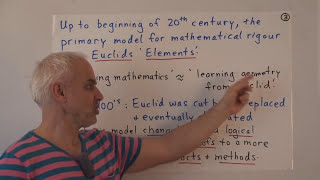
The Decline of Rigour in Modern Mathematics - Real Numbers and Limits
Explores the decline of mathematical rigor, discussing Euclid's Elements, proof concepts, and problematic topics in modern mathematics. Examines reasons for this decline and its impact on mathematical foundations.
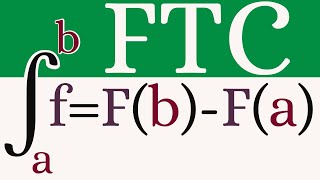
Real Analysis - The Fundamental Theorem of Calculus
Comprehensive proof of both parts of the Fundamental Theorem of Calculus, demonstrating the relationship between differentiation and integration in real analysis.

The Notorious Question Six - Cracked by Induction
Explore the infamous Question Six from the 1988 Math Olympiad, solved using induction. Zvezdelina Stankova breaks down this challenging problem, offering insights into advanced mathematical reasoning.
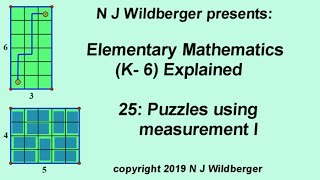
Puzzles with Measurement - Elementary Mathematics Explained - Lecture 25
Explore engaging measurement puzzles using weights and balances, enhancing problem-solving skills and introducing key mathematical concepts in a fun, interactive way.
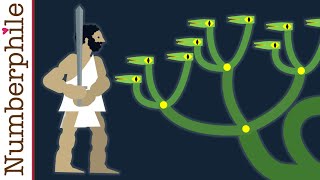
The Hydra Game - Hercules vs the Mathematical Monster
Explore the fascinating Hydra Game with mathematician Tom Crawford, delving into its connection to Hercules and its intriguing mathematical properties in this engaging Numberphile video.
Neuro-Symbolic Graph Reasoning and Knowledge Graph Analysis - From Theory to Implementation
Explore neuro-symbolic AI frameworks and graph-based reasoning through practical examples, from biomedical research applications to Python implementations and logical rule learning.
Chain of Thought and Instruction Fine-Tuning for Enhanced Language Model Performance
Explore how Chain of Thought and instruction fine-tuning techniques enhance language models' performance, from basic reasoning tasks to simulating human behavior and decision-making processes.
Testing GPT-3's Ability to Solve Complex Riddles and Logical Problems
Explore GPT-3's ability to solve complex riddles and logical problems in this engaging video, testing the limits of AI's reasoning capabilities across 10 challenging puzzles.
SAT-Solving
Explore the theory and practice of SAT-solving, delving into satisfiability concepts and advanced techniques in this comprehensive lecture by Armin Biere.
Scallop: A Language for Neurosymbolic Programming
Explore Scallop, a language combining deep learning and logical reasoning for efficient neurosymbolic programming. Learn its key features and applications in diverse AI tasks.
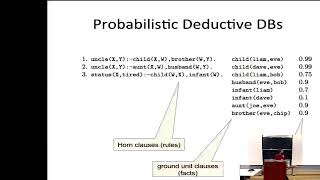
Deep Learning and Reasoning - 2018
Explore integrating logical reasoning with neural systems using TensorLog, a probabilistic first-order logic system for scalable symbolic reasoning and neural learning in AI tasks.
Simulation and Indexical Function Individuation - Why the Diagonal Argument Does Not Establish the Impossibility of Machine Consciousness
Explores diagonal arguments against algorithmic consciousness, challenging Penrose's conclusions on machine consciousness and simulation of human mathematicians through question-answering systems and indexical function individuation.
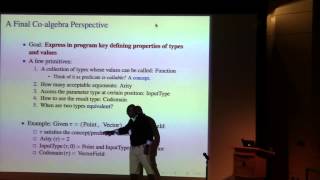
Axiomatic Programming - From Euclidean Deductions to C++ Templates and Beyond
Explore the evolution of axiomatic programming, tracing its roots from Euclidean deductions to modern C++ templates and their future implications in software development.

The Argument Matrix - Introduction to Logical Reasoning
Explore the Argument Matrix concept, its structure, and application in crafting persuasive ideas and arguments.
Logical Reasoning: Syllogistic Logic - Part 1
Explore probabilistic and defeasible deductive reasoning, delving into the fundamentals of syllogistic logic for enhanced logical analysis skills.
Logical Reasoning: Deductive Logic - Part 1
Explore inductive reasoning, propositional logic, and probabilistic inductive reasoning methods to enhance logical thinking and problem-solving skills.

Logical Reasoning: Syllogism Logic, Truth and Validity - Lecture 12
Explore syllogistic logic, distinguishing between valid and invalid reasoning to enhance critical thinking and argument analysis skills.
Logical Reasoning: Deductive Logic - Part 2
Explore probabilistic and defeasible deductive reasoning, along with syllogistic logic, to enhance your logical thinking skills and argumentation abilities.
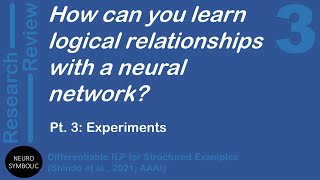
Learning Logical Relationships with Neural Networks - Part 3
Explore experimental evaluation of Differentiable Inductive Logic Programming for Structured Examples, examining its application in learning logical relationships using neural networks.
Microsoft Phi-3 vs Llama 3 8B: Performance Comparison and Azure Deployment
Explore Microsoft Phi-3's performance vs. Llama 3 8B in coding tests. Learn about benchmarks, technical details, and how to deploy Phi-3 in Azure for Python applications.