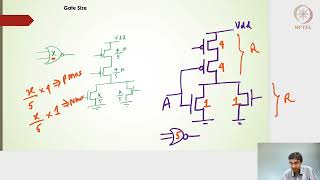
Optimizing Gate Size for Single-Path Digital Design - Lecture 5.4
Optimize gate sizes and transistor widths to minimize delay in single-path digital designs through practical examples and techniques.

Visualizing Data with 7-Segment Displays
Explore data visualization using 7-segment displays, covering binary-to-decimal conversion, Boolean algebra, and the double dabble algorithm for efficient number representation in digital systems.
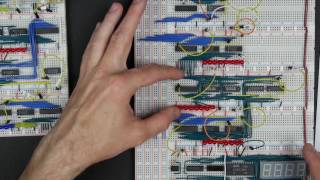
8-Bit Computer Build - Connecting the Bus and Output Register
Learn to build an 8-bit register and connect components through a common bus and clock signal, advancing your understanding of computer architecture and digital logic design.
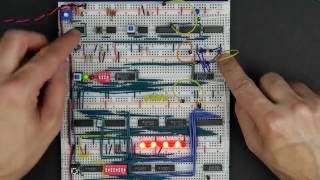
RAM Module Testing and Troubleshooting - Fixing Issues and Modifying Clock Edge Triggering
Learn to test, troubleshoot, and modify a RAM module, focusing on fixing issues and improving clock-triggered writes in digital circuit design.
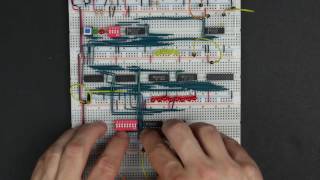
RAM Module Build for 8-Bit Computer - Part 3
Constructing a RAM module with DIP switches and logic for manual data input in program mode, while enabling bus-to-RAM data writing in run mode.
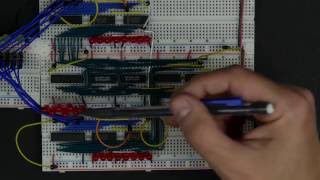
Building the ALU for an 8-Bit Computer
Construct an 8-bit computer's ALU using basic electronic components. Learn about binary addition, logic gates, and digital circuit design principles.

Making Logic Gates from Transistors
Learn how transistors form the building blocks of digital logic, from basic inverters to complex XOR gates, in this hands-on exploration of fundamental computer architecture.
Binary and Computer Science All-in-One Tutorial Series
Comprehensive exploration of binary systems and computer science fundamentals, covering essential concepts and practical applications in a detailed, accessible format.

Skewed Gates and Best P/N Ratio - Lecture 6.5
Estimate logical effort and normalized parasitic delay for 2-NOR gate. Apply Elmore delay method to determine optimal P/N ratio for gate designs.
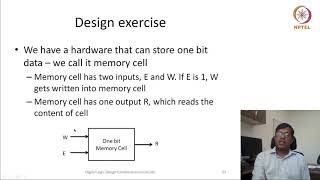
Decoders and Demultiplexers - Part 1
Explore decoder and demultiplexer concepts in digital logic, enhancing understanding of fundamental circuit components.
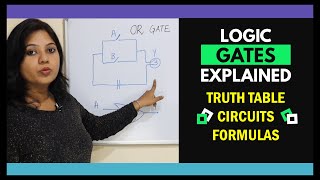
Logic Gates A to Z - Truth Tables, Circuits, Formulas, and Applications
Explore logic gates from A to Z, covering truth tables, circuits, formulas, and real-world applications. Master essential concepts through step-by-step explanations and examples.
I ♥️ Form Controls!
Explore innovative uses of form controls and CSS to create interactive widgets without JavaScript. Learn lateral thinking for lightweight interfaces and discover surprising applications of web technologies.

Using Basic Logic Gates - With and Without Arduino
Explore basic logic gates, their families, and practical applications. Learn to emulate gates with Arduino and build a simple intruder alarm combining hardware and software.
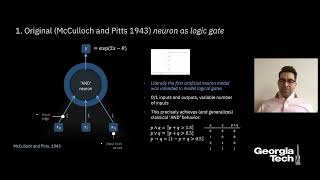
Logical Neural Networks: Unifying Statistical and Symbolic AI
Explore unifying statistical and symbolic AI through Logical Neural Networks, a framework combining neural networks with logical inference for improved knowledge representation and reasoning.

Computing Majority of N Using Majority-K Circuits with Logarithmic Depth
Delve into probabilistic constructions and computational complexity, exploring Valiant's theorem on majority functions using Maj-k circuits and their depth analysis.