
Forward Porting Google Nexus 5X and 6P - Lessons and Future Directions
Explore mainlining efforts for Nexus devices, including challenges, lessons learned, and tips for community participation in board support development.
Code Review Training for Kernel Patch Reviewers
Comprehensive guide for Linux kernel patch reviewers, covering policies, conventions, and best practices to ensure code quality, supportability, and correctness in kernel development.

A Conversation with Linus Torvalds on Linux Development
Exclusive conversation with Linux creator Linus Torvalds, exploring kernel development, open source innovation, and the future of Linux technology.
Kernel Development Learning Pipeline (KDLP)
Explore Red Hat's program addressing the shortage of entry-level kernel developers through specialized training and industry insights.
Devicetree
Explore Devicetree tooling updates, overlay progress, and future developments. Engage with a maintainer to address questions and issues in this interactive session on Linux kernel device management.
Linux on RISC-V with Open Hardware
Explore RISC-V architecture, its global impact, and implementation in Linux systems. Learn about open hardware, SBI, and FPGA toolchains for RISC-V development.

Writing Linux Kernel Modules in Safe Rust
Explore safe Rust for Linux kernel module development, addressing memory vulnerabilities, binary compatibility, and C integration. Learn techniques for creating secure kernel APIs and potential upstream integration.

Overview and Recent Developments - Namespaces and Capabilities
Explore recent developments in Linux namespaces and capabilities, focusing on new features, open problems, and their impact on container technology and system security.

Bring Your Camera into 2018 - Forward Porting Image Sensor Drivers
Guidance for forward porting image sensor drivers in Linux, covering obsolete frameworks, modern approaches, and evolving hardware complexities in embedded camera systems.
Rapid Developing and Testing Linux Kernel in Docker Containers
Learn efficient Linux kernel development using Docker containers, featuring rapid compilation, continuous integration, and emulated VM testing for enhanced productivity and performance.
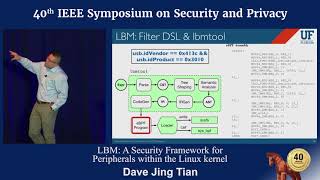
LBM - A Security Framework for Peripherals within the Linux Kernel
Unified security framework for Linux kernel to protect against malicious peripherals, leveraging eBPF for efficient packet filtering across USB, Bluetooth, and NFC protocols.

The Kernel Report
Comprehensive overview of Linux kernel development, covering recent updates, challenges, and future directions. Explores hardware vulnerabilities, stable kernels, testing initiatives, and mobile Linux progress.
Making C Less Dangerous in the Linux Kernel
Exploring strategies to enhance C safety in the Linux kernel, including removing Variable Length Arrays, enforcing stack variable initialization, and implementing Control Flow Integrity measures.
Kernel Hacking Like It's 2020
Explore modern tools and techniques for Linux kernel development, including advanced editors, code completions, linters, debuggers, and automated testing suites.
Landing a Large Series
Insights on navigating complex kernel development, addressing challenges in large infrastructure changes, and strategies for successful collaboration in open-source projects.
Large Pages in Linux
Explore the evolution, benefits, and challenges of large pages in Linux, including performance improvements, hardware optimizations, and future limitations for kernel developers.
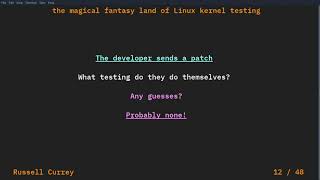
The Magical Fantasy Land of Linux Kernel Testing
Explore automated Linux kernel testing methods, from CI to hardware tests, aiming for a bug-free, efficient development process in this comprehensive overview.
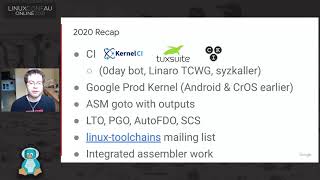
ClangBuiltLinux - What's Next?
Explore LLVM's adoption for Linux kernel builds, 2020 achievements, and future focus. Learn about tradeoffs, upcoming work, and how to contribute to kernel and toolchain development.
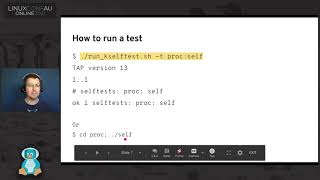
How to Write Your First Kernel Selftest
Learn to create Linux kernel selftests: understand their purpose, location, and mechanics. Gain confidence in writing simple tests, even without kernel development experience. Opportunity for assisted upstream submission.
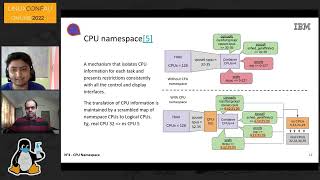
A Mechanism to Isolate CPU Topology Information in the Linux Kernel - CPU Namespace
Proposes a CPU namespace mechanism for isolating CPU topology information in containerized environments, addressing coherency, security, and fair use concerns in multi-tenant systems.
Kernel Testing with KUnit - Bridging the Gap
Explore KUnit for Linux kernel testing, comparing it with other tools, and learn about test result standardization, QEMU support, and techniques for testing complex kernel code.