
Callsite Trampolines for Memory Allocation Profiling
Exploring compiler support for instrumenting call sites to store additional data, focusing on memory allocation profiling and its implications for Linux kernel development.

Speeding Up Kernel Testing and Debugging with virt-meng
Streamline kernel testing with virtme-ng: a standardized tool using QEMU/KVM, virtio-fs, and overlayfs to create virtualized snapshots for efficient debugging and development workflows.

DTrace and eBPF: New Challenges - Pitfalls and Solutions
Explore technical challenges and creative solutions in Linux kernel tracing, focusing on DTrace and eBPF implementation pitfalls and potential improvements for enhanced system observability.

Blinking Lights in Network Devices - Common Mistakes and New APIs
Exploring network device LED configuration challenges, common mistakes in netdev, and new APIs for PHY and MAC-driven LEDs. Insights for driver developers and users on proper LED support and configuration.
Simplifying Livepatch Callbacks, Shadow Variables, and State Handling
Propuesta para mejorar el manejo de callbacks, variables shadow y estados en livepatches de Linux. Unifica estos elementos, simplifica su uso y resuelve problemas de compatibilidad entre parches acumulativos.

Plumbing Challenges in Dynamic Capacity Device - Linux Plumbers Conference
Explore challenges in implementing CXL 3.0 Dynamic Capacity Device, including memory interleaving, sharing, and asynchronous release. Discuss current architecture and potential improvements for memory pooling in Linux systems.
Kbuild Support for KLP Relocation Generation
Exploring Kbuild support for klprelocation generation in Linux kernel live patching, discussing challenges, proposed solutions, and community feedback for improving livepatch symbol resolution.
Run ILP32 on RV64 ISA - RV64ILP32
Exploring RV64ILP32: advantages, performance comparisons, and implementation across platforms. Demonstrates potential for improved RISC-V hardware performance and cost-effectiveness.
The Path to Achieve a Bug-Free Build on the Mainline
Exploring strategies to achieve bug-free builds in Linux kernel development, focusing on build issues, community testing efforts, and new practices to improve mainline quality.
Implementing sync_state() and Handoff for Common Clock Framework
Exploring challenges and solutions for implementing sync_state()/handoff in the common clk framework to maintain enabled clocks during Linux boot, focusing on display splash screens and edge cases.

Function Return Hook Integration with Function Graph Tracer
Explore integrating function return hook mechanisms to improve efficiency in Linux kernel tracing, addressing challenges of concurrent usage and memory allocation.

KDLP: Kernel Development Learning Pipeline
Innovative program bridging academia and industry to train new Linux kernel developers, addressing the shortage of qualified entry-level engineers in low-level software development.

Detecting Failed Device Probes - Improving Kernel Stability
Explore a proposed approach for detecting device probe regressions in Linux, improving kernel stability and enabling quicker issue resolution across platforms.

Quality Assurance for Embargoed Kernel Patches
Exploring strategies to improve testing and quality assurance for embargoed kernel patches, addressing challenges in the current process and proposing solutions for enhanced security.
Unifying and Improving Test Regression Reporting and Tracking in Kernel CI Systems
Exploring strategies to enhance kernel CI systems for better regression detection, analysis, and reporting. Discusses standardizing workflows, improving data processing, and addressing challenges in regression tracking.
Make ftrace_regs a Common Trace Interface for Function Entry/Exit Tracing
Exploring ftrace_regs as a unified interface for function tracing, addressing limitations of pt_regs and improving efficiency across architectures. Discusses integration with fprobe, eBPF, and function-graph tracer.
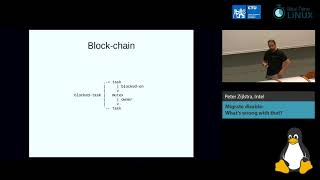
Migrate Disable in Linux Kernel - Challenges and Considerations
Explore the intricacies and potential issues of migrate_disable() in Linux kernel development, focusing on its impact on system performance and scheduling.
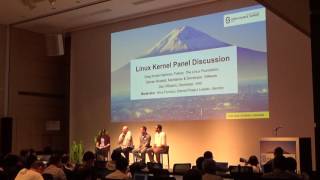
Linux Kernel Development - Panel Discussion
Expert panel discussion on Linux kernel development, featuring insights from leading developers on various aspects of kernel maintenance and innovation.
Linux Kernel Development - A Fireside Chat with Greg Kroah-Hartman
Insightful discussion on Linux kernel development, corporate involvement, and open-source compliance with Greg Kroah-Hartman, exploring challenges and opportunities in the evolving tech landscape.
Surviving with an Old Linux Kernel - Challenges and Benefits
Insights on developing with an outdated Linux kernel, exploring challenges, unexpected benefits, and lessons learned from working with a 2.6.28 kernel in modern times.

ARM64 SoC Linux Support Checklist
Comprehensive guide for integrating ARM64 SoC support into the Linux kernel, covering essential steps, ARM64-specific requirements, and updates for both ARM32 and ARM64 architectures.