Operations Research
Learn essential Operations Research techniques: linear programming, network analysis, integer programming, nonlinear optimization, game theory, Markov chains, and inventory management. Gain practical skills using AMPL software.
Linear Programming for Data Science - Data Science Tutorial
This video explains Linear Progression for Data Science with a variety of demonstrations & examples to help you learn this topic effectively and efficiently.

CBSE 12th 2022 - Term 1 - New Syllabus
Comprehensive revision for CBSE 12th Math Term 1, covering key topics with MCQ tricks, one-shot lessons, and mock tests to help students score high in board exams.

Basic Excel Business Analytics - Intro to Linear Programming Using Algebra, Pencil & Paper
Introduction to linear programming using algebra and graphing methods to solve manufacturing problems and maximize contribution margin, with focus on mathematical modeling and feasible region analysis.
Deux utilisations de l'apprentissage machine pour accélérer la résolution de problèmes de planification d'équipages aériens
Découvrez comment l'apprentissage machine accélère la résolution de problèmes complexes de planification d'équipages aériens grâce à deux méthodes innovantes d'optimisation assistée.
Decomposition Methods for the Unsplittable Flow Problem
Explore decomposition methods for the unsplittable flow problem in satellite constellations. Learn efficient algorithms for large-scale instances and dynamic scenarios, focusing on strengthening linear relaxations.

Algorithms for Rank-1 Bimatrix Games
Explore algorithms for solving rank-1 bimatrix games efficiently, including polynomial-time methods for finding Nash equilibria and path-following techniques. Discusses complexity, uniqueness, and parameterized approaches.
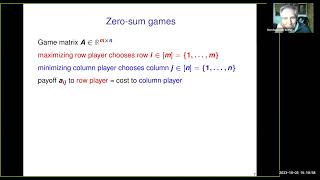
Zero-Sum Games and Linear Programming
Explore zero-sum games and their connection to linear programming in this insightful mathematical seminar by Bernhard von Stengel.
Minimal Cycle Representatives in Persistent Homology Using Linear Programming
Explores optimization techniques for selecting minimal cycle representatives in persistent homology, comparing effectiveness and computational costs of various algorithms using linear programming methods.
Randomized Linear Algebra for Interior Point Methods
Explore randomized linear algebra techniques for efficient interior point methods in linear programming, focusing on applications in data science and scientific computing.
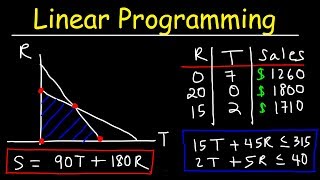
Linear Programming
Introduction to linear programming: write objective functions, find corner points, solve inequalities, determine maximum profit, and optimize production. Includes examples and practice problems.

Constructing Extended Formulations
Explore advanced techniques for constructing extended formulations in combinatorial optimization, focusing on polytopes, matchings, cycles, and spanning trees in various graph types.
The SDP Relaxation for Max-Cut - Lecture 19b of CS Theory Toolkit
Explore SDP relaxation for Max-Cut, transforming a quadratic program into a semidefinite program solvable by the Ellipsoid Algorithm. Part of CMU's graduate-level CS Theory Toolkit course.
Linear Programming - Bit Complexity - Lecture 17c of CS Theory Toolkit
Explore bit complexity in Linear Programming, feasible solutions, and the implications for NP ∩ coNP. Delve into fundamental concepts for theoretical computer science research.
Near-Optimal Fully Dynamic Densest Subgraph
Explore near-optimal algorithms for dynamic densest subgraph problems, covering applications, definitions, and techniques for efficient graph orientation and load balancing.
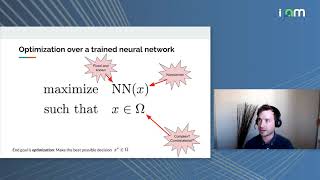
Neural Network Verification as Piecewise Linear Optimization
Neural network verification as piecewise linear optimization: exploring robust methods to prove model reliability against attacks, using LP and MIP formulations for efficient problem-solving in various network types.
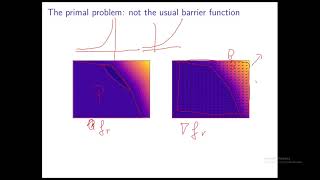
Francisco Criado - The Dual 1-Fair Packing Problem and Applications to Linear Programming
Explore proportional fairness in resource allocation, its dual problem, and applications to linear programming algorithms, focusing on geometric relationships and potential improvements.
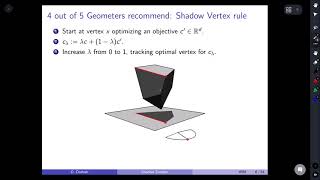
Probabilistic Analysis of the Simpler Method and Polytope Diameter
Probabilistic analysis of simplex method and polytope diameter, exploring smoothed, well-conditioned, and random polytopes. Discusses improvements in complexity analysis and diameter bounds using shadow paths.
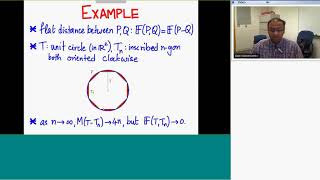
Bala Krishnamoorthy: Linear Programming in Geometric Measure Theory
Explore geometric measure theory through linear programming, examining integral currents, simplicial flat norm, and polyhedral approximation. Discover applications in median shape analysis.

Neil Olver: On the Integrality Gap of the Prize Collecting Steiner Forest LP
Explores the integrality gap of the prize collecting Steiner forest LP, disproving the belief it was 2 and showing it's at least 9/4, with implications for approximation algorithms in combinatorial optimization.

Viswanath Nagarajan - Stochastic Load Balancing on Unrelated Machines
Explores stochastic load balancing on unrelated machines, presenting a constant factor approximation algorithm for minimizing expected makespan. Discusses LP relaxation and rounding techniques.