From OpenAI to Open Source AI: Navigating Between Commercial Ownership and Collaborative Openness
Explore the evolution of generative AI, examining the balance between commercial interests and open collaboration. Analyze openness levels, computing power dynamics, and diverse projects shaping AI's future.
Visual Introduction to Transformers and GPTs - Deep Learning Chapter 5
Visual introduction to transformers and GPTs, covering key concepts like word embeddings, deep learning premise, and softmax. Explores the inner workings of these models with clear animations and explanations.

Creating, Building, and Releasing Gemma - Google's Open Model Family
Explore Gemma, Google's open model family, with engineer Kathleen Kenealy. Discover the journey from concept to release, the importance of open technology, and the future of AI development.

37% Better Output with 15 Lines of Code - Llama 3 Improved RAG
Improve RAG performance for Llama 3 models with simple code modifications, enhancing output quality by 37% for both local 8B and cloud-based 70B versions.
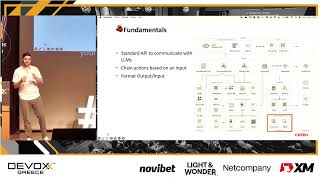
Meet Your New AI Best Friend: LangChain - Interacting with LLMs and APIs
Explore LangChain's versatility in developing AI-powered applications. Learn to interact with APIs and databases using natural language, and create unique AI tools with minimal code.
Shaping AI Benchmarks and Open-Source Development - Percy Liang Interview
Percy Liang discusses AI benchmarking advancements, HELM framework, open-source models' importance, and challenges in AI development. Insights on model selection, evaluation, and the future of AI technologies are shared.
Gemma-2 9B: Introduction and Chain of Thought Prompt Testing
Explore Gemma-2, Google's new language model. Compare sizes, formats, and test Chain of Thought capabilities through IT-focused prompts. Hands-on demonstration included.
Gemini API Function Calling with Python SDK - Machine Learning and Data Science
Explore function calling with Gemini API's Python SDK to enhance language model interactions and streamline development workflows.
Prompt Engineering Techniques for Microsoft Phi3-mini 128k Instruct
Explore prompt engineering techniques for Microsoft Phi3-mini 128k Instruct, including zero-shot, few-shot, CoT, and RAG approaches.
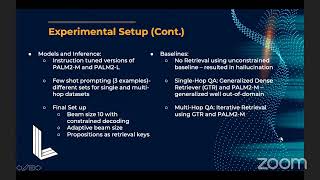
From RAG to RICHES - Retrieval Interlaced with Sequence Generation
Innovative AI approach integrating retrieval into sequence generation, simplifying RAG systems. Adapts to new tasks through prompting, supports multi-hop retrievals, and excels in Open Domain Question Answering.
What is ChatGPT Doing and Why Does it Work?
Explore ChatGPT's inner workings and functionality in this unscripted AMA session with Stephen Wolfram. Gain insights into AI language models and their impact on technology.
What Is ChatGPT Doing and Why Does It Work?
Explore the inner workings and underlying principles of ChatGPT, delving into its functionality and effectiveness in natural language processing and generation.
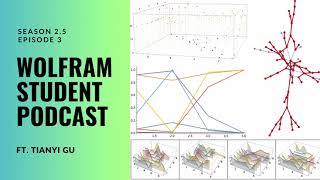
Analyzing the Temperature-Varied Syntactic Structures of GPT 3.5
Explore how temperature affects grammatical structures in AI-generated text, applying graph theory to language and comparing human vs. machine writing.
Generative Language Models in Molecular Discovery: Regression Transformer, GT4SD and Beyond
Explore generative language models for molecular discovery, focusing on the Regression Transformer and GT4SD toolkit. Learn about multitask approaches bridging regression and conditional generation for scientific applications.
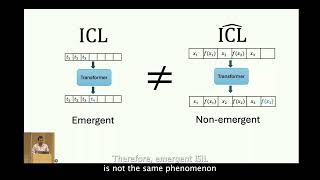
Do Pretrained Transformers Learn In-Context by Gradient Descent?
Explore the relationship between In-Context Learning and Gradient Descent in large language models, examining theoretical connections and empirical evidence from pre-trained transformers.
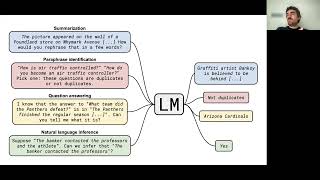
Building Better Language Models - Paradigms and Techniques
Explore advanced techniques for building and improving language models, covering paradigms, zero-shot learning, and multitask prompted training.
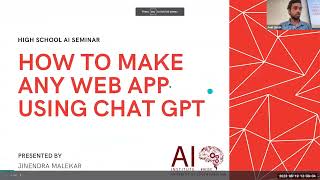
Introduction to ChatGPT and Its Applications
Explore ChatGPT's capabilities and practical applications in various fields, gaining insights into its potential impact on industries and everyday tasks.
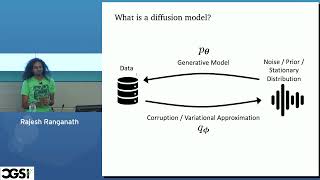
Digging into the Foundations of Generative AI for Healthcare
Explore foundations of generative AI in healthcare, focusing on automated learning for multivariate diffusions, denoising score matching, and targeted updates of language models.
Interpreting Emergent Communication in Nonhuman Species
Explore techniques for decoding and interpreting emergent communication patterns in non-human species, with insights from cutting-edge research and AI applications.
Symbolic Behavior in AI - Lessons for Whale Communication Research
Explore AI's symbolic behavior and its potential implications for understanding whale communication, drawing insights from recent research and diverse perspectives.
Linguistic Interaction in Humans and Machines - Understanding Higher-Level Intelligence
Exploring methods from cognitive science to study ML models and human cognition, focusing on language-based projects that analyze adaptation and generalization in linguistic interactions.