Extending OpenPOWER Boot Security to Guests
Explore secure boot design for KVM and PowerVM guests on OpenPOWER, addressing unique challenges and leveraging open source solutions to enhance OS boot security.
Getting Your Patches in Mainline Linux - What Not to Do and What to Try Instead
Insights on effectively submitting Linux kernel patches from a contributor-turned-maintainer. Explores common pitfalls, successful strategies, and the trust-building process between submitters and maintainers.
KVM-devirt - Extending KVM to a Zero-Overhead Partition Hypervisor
Explore KVM-devirt, an extension of KVM for zero-overhead server partitioning. Learn about techniques to eliminate VM exits and address translations, achieving bare-metal performance.
Scaling KVM and Its Community
Explore KVM's growth, challenges, and future prospects in cloud computing, including new ports, increased complexity, and strategies for scaling contributors and use cases.
The Challenges of Asynchronous Teardown of KVM Guests
Explore challenges and solutions for asynchronous teardown of large KVM guests, focusing on memory cleanup approaches, implementation issues, and potential improvements for faster VM termination.
Exploring an Architecture-neutral KVM MMU
Dive into the architecture-neutral KVM MMU, exploring its scalability improvements, performance tuning, and potential application to ARM VMs for enhanced cloud computing capabilities.
Exploring Intel Sub-Page Protection for Live VM Migration
Discover Intel's sub-page write protection feature for optimizing VM live migration, reducing network congestion, and improving efficiency in KVM and QEMU pre-copy migration algorithms.
AIA Virtualization in KVM RISC-V - Advanced Interrupt Architecture Overview
Explore RISC-V's Advanced Interrupt Architecture (AIA) and its virtualization features in KVM, covering MSIs, IPIs, and wired interrupts for scalable CPU support.
vCPU Stall Detection for KVM Guests
Explore a para-virtualised vCPU stall detector device for KVM guests, its design, implementation, and future use in Android for detecting VM hangs on the host.
KVM/ARM at Scale - Improvements to the MMU for Hardware Scaling Challenges
Explore ARM architecture scaling challenges in datacenters and learn about KVM/ARM MMU improvements to enhance virtual machine performance and efficiency.
Nesting Secure VM Hosts - Exploring Benefits and Drawbacks
Explore nesting secure hosts in virtualization, examining benefits, drawbacks, and technical aspects of KVM using secure firmware APIs to emulate secure VM firmware for hosting secure VMs.
QEMU and KVM Automated Performance Benchmarking Framework
Explore SUSE's automated framework for benchmarking virtualized workloads, its capabilities, and potential applications in assessing performance of KVM, QEMU, and Linux virtualization.
Leveraging KVM as a Debugging Platform
Explore KVM's potential as a powerful debugging platform for efficient software development and troubleshooting in virtualized environments.
Host and Guest Tracing in Virtualization - To Sync or Not to Sync
Explore host-guest tracing in virtualization, focusing on time synchronization methods, tools, and validation techniques for accurate kernel event analysis.
KVM Dirty Page Tracking - Optimizing VM Migration
Explore KVM's dirty page tracking mechanisms, including synchronous and asynchronous methods, and their impact on VM migrations and performance optimization.
KVM PV Feature Enablement up the Virtualization Stack
Explore KVM paravirtualization feature enablement across the virtualization stack, uncovering complexities and challenges in optimizing virtual machine performance.
Know Your QEMU and KVM Test Frameworks
Explore QEMU and KVM test frameworks with Thomas Huth from Red Hat, gaining insights into effective virtualization testing strategies and best practices.

KVM Status Update and Kata Containers - Keynote Sessions
Explore KVM's latest developments and the intersection of Kata, containers, and KVM in these insightful keynote sessions from industry experts.
KVM vCPU Priority Boosting via BPF
Explore KVM vCPU priority boosting using BPF technology to optimize virtual machine performance and resource allocation in Linux environments.
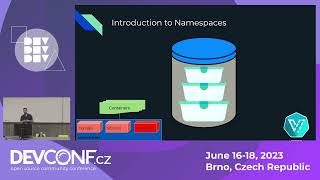
A Journey Through Supporting VMs with Dedicated CPUs on Kubernetes - Lecture
Explore dedicated CPU support for VMs on Kubernetes, delving into resource allocation models, cgroups, and the challenges of implementing true CPU pinning in Kubevirt.
The Modern Operating System - A Clear Choice
Explore Clear Linux OS: a modern, secure, and high-performance Linux distribution optimized for edge-to-cloud computing, featuring innovative approaches to updates, security, and customization.