Software Testing
Comprehensive exploration of software testing techniques, covering structural, data flow, logic, and functional approaches, with practical applications using tools like JUnit and methodologies for various software types.
JUnit 5 Basics
Master JUnit 5 fundamentals, from creating and running tests to advanced features like lifecycle hooks, conditional executions, and nested classes. Improve your Java testing skills and code quality.
Advanced Appium Tutorials - Creating Mobile Automation Framework
Learn to build a comprehensive mobile automation framework using Appium, covering basics to advanced topics like ADB integration, logging, page objects, and parallel testing in Java.

JUnit Complete Tutorial for Beginners
Comprehensive JUnit tutorial covering setup, annotations, assertions, parallel testing, cross-browser testing, geolocation testing, and Page Object Model implementation for Selenium automation testing.
Camunda BPM Online Training - API and Testing
Learn to use Camunda BPM's Java API, create JUnit tests, and implement BPMN elements. Explore process variables, testing scopes, and mocking techniques for efficient workflow automation.

Process Testing with Camunda
Learn best practices for automated testing of process applications using Camunda BPM, including unit testing, assertions, test coverage, and system integration mocking, with live demos and Q&A.
Java Unit Testing with JUnit - How to Create and Use Unit Tests
Learn to create and use JUnit tests in Java to verify code correctness. Covers test creation, complex scenarios, edge cases, and best practices for confident Java development.

Testing Activities in Isolation with Espresso - Part 2
Learn to test Android activities using Espresso, covering ActivityScenario, text matching, and view visibility checks for effective UI testing in isolation.

IntelliJ IDEA and JUnit - Writing, Finding, and Running Tests
Learn to write, locate, and execute tests using IntelliJ IDEA and JUnit 5. Explore IDE features, Java assertions, JUnit Jupiter, and the Mainrunner test engine for efficient software testing.

IntelliJ IDEA - Writing Tests with JUnit 5
Explore JUnit 5 features for effective and readable automated tests in Java, covering setup, assertions, assumptions, data-driven tests, and test organization.
JUnit 5 by Marc Philipp
Explore JUnit 5's modern testing capabilities for Java, including extensibility, Java 8 features, and a new programming API. Learn about its architecture, Jupiter model, and migration strategies.
JUnit 5 - New Opportunities for Testing on the JVM
Explore JUnit 5's architecture, features, and extension model for enhanced Java testing. Learn about tagging, custom names, parameterized tests, and integration with Spring Framework 5.0.

How to Build a Google Photos Clone in Java
Build a Google Photos-like application in Java, covering testing, code reviews, multithreading, databases, and advanced features like JUnit dynamic tests and native executables.

Mastering Java Testing With JUnit, Mockito, and AssertJ in IntelliJ IDEA
Enhance Java testing skills using JUnit, Mockito, and AssertJ in IntelliJ IDEA. Learn efficient test creation, mocking techniques, and expressive assertions for robust, maintainable applications.

Integration Testing Legacy Java Microservices with Docker-Maven-Plugin
Learn to integrate Docker into Maven builds for testing Java microservices. Explore mocking dependencies, running tests with docker-compose, and automating with docker-maven-plugin for efficient integration testing.
Harnessing Integration Testing with Docker Containers
Explore efficient integration testing using Docker containers and Testcontainers library with JUnit/Spock, addressing common challenges in testing databases and external systems.
JUnit 5 - Next Generation Testing on the JVM
Explore JUnit 5's new features, architecture, and compatibility. Learn to write tests, understand changes from JUnit 4, and discover its potential for immediate implementation in your projects.
Deep Dive into JUnit 5
Comprehensive exploration of JUnit 5's architecture, features, and extensions. Live coding demos showcase modern testing capabilities, including custom display names, conditional execution, and dynamic tests.
JUnit 5 - The New Testing Framework for Java and Platform for the JVM
Explore JUnit 5's new features for Java testing, including extensibility, modern API, and support for multiple JVM languages. Learn migration, architecture, and extension model.

Testing Java Microservice
Strategies and tools for effective microservices testing, including Arquillian, JUnit, Docker, service virtualization, and consumer-driven testing to ensure reliability in production environments.
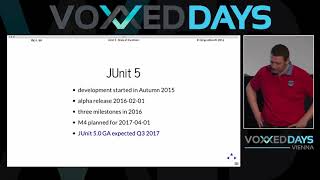
JUnit 5 - State of the Union
Explore JUnit 5's new features, including Java 8 support and Lambda expressions in assertions. Learn how this major update enhances testing practices and simplifies exception checking.