Mathematical Foundation of Various MCMC Methods
Explore advanced MCMC methods for combinatorial optimization, including multi-spin flip techniques. Compare mathematical and numerical results to evaluate efficiency in different contexts.
Probing Sign Structure Using Measurement-Induced Entanglement - Timothy Hsieh
Exploring measurement-induced entanglement to probe sign structure in quantum systems, with applications to hybrid circuits, spin systems, and critical models. Novel insights into quantum information and condensed matter physics.
Critical Phenomena Through the Lens of the Ising Model by Hugo Duminil-Copin
Explore critical phenomena in the Ising model, a powerful tool for understanding cooperative phenomena in statistical physics, with insights on recent progress in three and four dimensions.
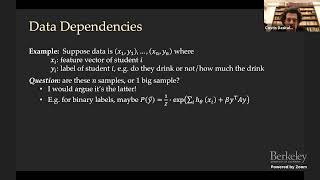
Learning Ising Models from One, Ten or a Thousand Samples
Explore statistical learning theory and Ising models, focusing on sample complexity and efficient algorithms for learning in high-dimensional settings.
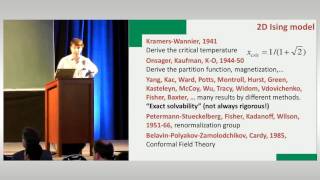
Panorama of Mathematics - Clusters, Loops and Trees in the Ising Model
Explore clusters, loops, and trees in the Ising model with Fields Medalist Stanislav Smirnov, covering topics from conformal field theory to discrete complex analysis and random cost representation.
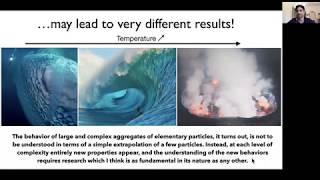
Phase Transitions - From Physics to Computer Science
Explore phase transitions across physics and computer science, from water states to combinatorial optimization and information theory, revealing their universal nature in complex systems.
Why Do Simple Models Work? Partial Answers from Information Geometry - Lecture 1
Explores information geometry to understand why simple models effectively describe complex systems, focusing on statistical mechanics, renormalization, and model reduction in physics and biology.
Topological Dualities from Matchgate Tensor Networks
Explore topological dualities connecting toric code, superconductors, and Ising model using matchgate tensor networks. Unifies approaches to non-local duality between fermionic and bosonic systems.
On Pfaffians in Spin Models
Explore Pfaffian relations in spin models, focusing on Ising models on planar graphs and their correlation functions. Discover insights into ferromagnetic spin models and graph simplifications.
Spectral Gap Estimates for the Random Field Ising Model - Lecture
Spectral gap estimates for random field Ising model: convergence rates, Glauber dynamics, Griffiths phase. Combines stochastic localization and percolation-theoretic coarse-graining techniques.
Critical Phenomena Through the Lens of the Ising Model
Explore critical phenomena in the Ising model, from its origins in ferromagnetism to recent breakthroughs in three and four dimensions using probabilistic interpretations and percolation models.
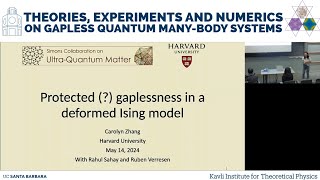
Protected Gaplessness in a Deformed Ising Model
Explore protected gaplessness in deformed Ising models with Carolyn Zhang. Discover insights on quantum many-body systems, critical points, and symmetries in condensed matter physics.
Spectrum of the Ising Model
Explore the correspondence between Ising models and algebro-geometric data, extending Kenyon and Okounkov's work on dimer models and Harnack curves in this advanced mathematical presentation.
Teaching and Learning with the MIT Atomic Scale Modeling Toolkit - Classical and Quantum Atomic Modeling
Explore classical and quantum atomic modeling using MIT's toolkit. Perform molecular dynamics, Monte Carlo simulations, and quantum chemistry computations. Learn practical applications for various physics and chemistry courses.
Probability, Conformal Invariance, and Critical Phenomena in Statistical Physics
Explore conformal invariance and critical phenomena in statistical physics, focusing on probabilistic approaches and their applications to complex systems.
Bootstrapping the Ising Model on the Lattice
Explore advanced techniques for analyzing the Ising model on lattices using bootstrap methods, uncovering critical behavior and phase transitions in statistical physics.
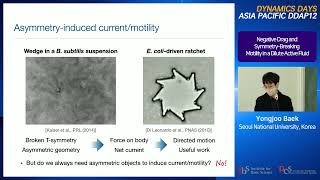
Negative Drag and Symmetry-Breaking Motility in a Dilute Active Fluid
Explore negative drag and symmetry-breaking motility in dilute active fluids, examining continuous and discontinuous transitions in object velocity and critical phenomena in the mean-field Ising universality class.
Quantum Chaos and Eigenstate Thermalization - Lecture 4
Explore quantum chaos, eigenstate thermalization, and their applications in spin systems. Delve into entropy, symmetries, and classical limits in quantum dynamics.
Quantum Chaos and Eigenstate Thermalization - Lecture 2
Explore quantum chaos, eigenstate thermalization, and their extensions to non-classical systems like Ising and Heisenberg spins. Delve into entropy, symmetries, and alternative theories.
Quantum Chaos and Eigenstate Thermalization - Lecture 3
Explore quantum chaos, eigenstate thermalization, and their applications in various systems, including spin systems and classical limits.
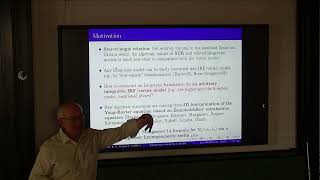
An Ising-Type Formulation of the Six-Vertex Model
Explore integrability in condensed matter physics and quantum field theory through an Ising-type formulation of the six-vertex model.