Consciousness in Biological and Artificial Brains
Exploration of consciousness in biological and artificial brains, discussing Integrated Information Theory and why digital systems may never truly experience consciousness like humans do.
Is a Turing Test for Intelligence Equivalent to a Turing Test for Consciousness?
Explore the distinction between intelligence and consciousness in AI systems, examining neural correlates, theories of consciousness, and implications for future technology.
Generalised Integrated Information Theories
Exploring generalizations of Integrated Information Theory to address technical issues and extend applicability beyond classical systems, using category theory and process theories.
An Integrated Information Decomposition Account of Emergent Mental Phenomena
Explore the intersection of Integrated Information Theory and Partial Information Decomposition to understand consciousness and causal emergence, offering new perspectives on mental phenomena and selfhood.
How Morphological Computation Shapes Integrated Information in Embodied Agents
Exploring the relationship between morphological computation and integrated information in embodied agents, highlighting their antagonistic nature and impact on brain-body-environment interactions.
A Vector Model of How Consciousness as Integrated Information Makes a Causal Difference
Explore a vector model of consciousness based on Integrated Information Theory, examining how phenomenal experiences can exert causal influence on physical substrates.

A Life of the Mind - Intellectual Journey with Daniel Dennett
Renowned philosopher Daniel Dennett reflects on his intellectual journey, exploring key ideas in cognitive science and philosophy while emphasizing the value of mistakes in the pursuit of knowledge.
David Chalmers – Consciousness and the Collapse of the Wave Function
Explore the intriguing theory of consciousness collapsing quantum wave functions, combining integrated information theory with quantum collapse dynamics and discussing potential experimental tests.
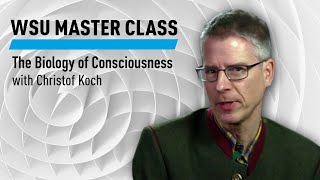
The Biology of Consciousness
Neuroscientist Christof Koch explores the biology of consciousness, discussing modern understanding, neural correlates, and integrated information theory in this insightful lecture.

The Whispering Mind - The Enduring Conundrum of Consciousness
Explore the enigma of consciousness with leading researchers, delving into its neurobiological basis, potential existence beyond humans, and fundamental biochemical processes underlying the mind's mysteries.
Integrated Information Theory of Consciousness in Conventional Computing
Exploring how computer programs influence cause-effect structures in integrated information theory, challenging assumptions about consciousness in simulated systems.
Learning to Predict Requires Integrated Information
Exploring how Integrated Information Theory quantifies consciousness in neural networks and its relationship with embodied intelligence and predictive learning in AI agents.
Informational Models of the Phenomenon of Consciousness and the Mechanistic Project
Exploring informational models of consciousness, their methodological contributions, and limitations in guiding mechanistic research. Critiques panpsychist interpretations and discusses quantitative recharacterizations.
Information Structures and Consciousness
Exploring brain dynamics through evolving informational structures, linking to consciousness theories and providing insights into disorders of consciousness with high-precision classification.
Consciousness - Coherence of Modalities
Explores a coherence-based theory of consciousness, proposing structured nets and dynamic mappings as key elements. Discusses data structures, neural codes, and links to mathematical concepts.
What Do Theories of Consciousness Predict About the Onset of Infant Consciousness?
Explores predictions of major consciousness theories on infant consciousness onset, examining higher-order, global workspace, integrated information, and recurrent processing theories.
Integrated Information Theory - A Perspective on Weak and Strong Versions
Explores 'weak' and 'strong' versions of Integrated Information Theory, discussing its potential to explain consciousness and highlighting key empirical evidence and theoretical challenges.
Computing Meaning from Conceptual Structures in Integrated Information Theory
Explores computing compositional meaning in Integrated Information Theory using category theory and distributional semantics, addressing the role of meaning in conscious experience.
Integrated Information in the Active Inference Framework
Explore how active inference agents integrate information and consciousness through unified perception and action selection, with insights into information-theoretic measures and agent-environment interactions.
Anticipation and Collective Surprise in Information Theory and Consciousness
Explore the intersection of consciousness theories, information processing, and surprise mechanisms in the brain, examining integrated approaches to understanding predictive cognition and sensory anticipation.